This is AI generated Response.
Asked by: francis
Created at: 2026-01-21 13:44:05
Final Answer:
RenderedRaw Text
Did you like this answer?
# Step-by-Step Solution and Explanation
## Part 1: Dynamic Pricing Algorithms and Real-Time Revenue Measurement
**(a) Price Formation and Revenue Capture Flow Diagram**
The flow begins with the collection of real-time data (demand patterns, customer profiles, inventory levels, competitor pricing). The AI-driven dynamic pricing engine processes this data and updates product prices accordingly. Customers view the updated prices and make purchase decisions. Transactions are recorded, and revenue is captured based on the price at the moment of sale. The system continually loops by feeding new transaction data back into the AI model to further refine pricing.
**(b) Transaction Price Determination Table**
A table would track product prices across different time periods and for different customer segments. For example:
| Time | Customer Segment | Inventory Level | Competitor Price | Final Price |
|------------|------------------|----------------|------------------|-------------|
| 10:00 AM | New | High | $100 | $98 |
| 2:00 PM | Returning | Medium | $105 | $102 |
| 5:00 PM | VIP | Low | $110 | $108 |
**(c) Revenue Recognition Timing Matrix**
This matrix assesses when revenue should be recognized under varying payment or delivery scenarios. For fluctuating consideration (variable prices), revenue is recognized when control transfers to the customer, considering constraints on variable consideration as per accounting standards (e.g., ASC 606/IFRS 15). A matrix may look like:
| Scenario | Payment Timing | Revenue Recognition Point |
|-----------------------------|---------------|-----------------------------|
| Immediate delivery/purchase | At sale | At delivery |
| Pre-order | In advance | Upon delivery |
| Subscription | Monthly | Over subscription period |
**(d) Risks Analysis**
Revenue overstatement can occur if the system overestimates probable consideration due to frequent price changes. Audit complexity rises as auditors must verify real-time data and algorithmic price determinations. Control weaknesses may stem from inadequate oversight of the pricing engine, poor data quality, or insufficient documentation of pricing logic.
---
## Part 2: Workforce Gigification and Flexible Labor Models
**(a) Workforce Classification Decision Diagram**
Start with the nature of work and relationship:
- Is work controlled by the company? If yes, employee. If no, consider further.
- Does the worker set their own hours and provide services to others? If yes, likely contractor.
- Is payment based on output rather than time? Contractor.
- Are benefits provided? If yes, likely employee.
**(b) Cost Recognition and Accrual Tables**
Prepare separate tables for each model.
For employees: Salaries, benefits, payroll taxes, recognized over employment period.
For contractors/gig workers: Payments based on output or project milestones, recognized when service is delivered.
| Worker Type | Payment Basis | Cost Recognition Timing |
|----------------|----------------|------------------------|
| Employee | Salary | Periodic (monthly) |
| Contractor | Per project | Upon completion |
| Gig Worker | Task-based | Upon task delivery |
**(c) Accounting for Incentives, Penalties, Contract Termination**
Incentives and penalties should be accrued when probable and measurable. Contract termination costs are recognized when the company is obligated to pay. Differences in timing and amount affect reported expenses.
**(d) Evaluation of Impact**
Switching to gig/flexible models can improve profitability and cost volatility due to variable labor costs, but increases ESG (Environmental, Social, Governance) disclosure complexity (worker rights, fair pay) and raises sustainability concerns over long-term workforce stability and knowledge retention.
---
**Final Answer:**
Dynamic pricing and real-time revenue measurement require robust data systems and careful revenue recognition to avoid overstatement. Workforce gigification provides cost flexibility but introduces classification, reporting, and sustainability challenges. Both areas demand strong controls, documentation, and clear accounting policies to ensure accurate financial reporting and compliance.
VIPSolutions focuses on clear, step‑by‑step explanations so you can learn quickly. Whether you need an AI‑generated walkthrough or a short hint to get unstuck, each solution is organized for fast reading and easy review later.
Search similar questions, compare approaches, and bookmark the best answers for revision. Our goal is simple: quick, reliable study help that feels natural—not noisy.
 VIPSolutions
 Hill Li I n
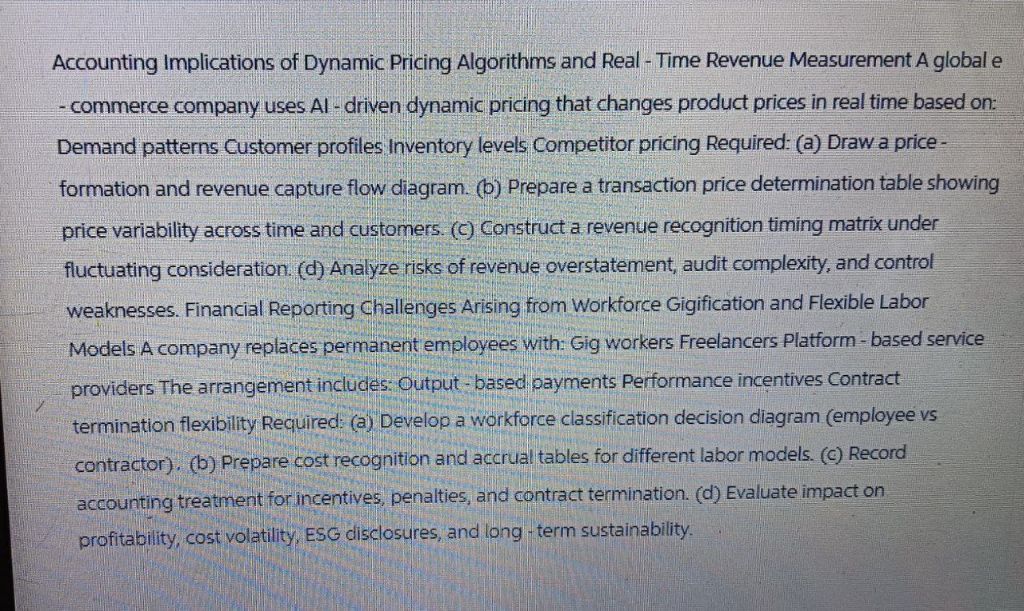
Accounting Implications of Dynamic Pricing Algorithms and Real - Time Revenue Measurement A global e :
- commerce company uses Al- driven dynamic pricing that changes product prices in real time based on:
Demand patterns Customer Pio: verter levels Competitor pricing Required: (a) Draw a price = Eve
formation and revenue capture flow diagram. ®) Prepare a Hansaction price determination table showing -
price variability across time and customers. © Constructa revenue recognition timing matrix under rE:
fluctuating consideration. (d) Analyze risks of revenue overstatement, audit complexity, and contol
weaknesses. Financial Reporting Challenges Arising from Workforce Gigification and Flexible Labor .
© Models A company replaces permanent employees With: Gig workers Freelancers Platform based sence.
| providers Th arrangement nce: Guip- based payments Performance incentives conta.
sili ti i ne Le