 VIPSolutions
Give step-by-step solution with explanation and final answer: (give me answer without using bullet points)In a simultaneous nitrification-denitrification (SND) oxidation ditch, the bulk dissolved oxygen concentration DO is maintained at a low level to promote anosic micro-zones within the activated sludge flocs. Construct a diffusion-reaction model for a spherical floc of radius R. where the oxygen diffusion coefficient Dayz and the nitrate diffusion coefficient Diyos dictate the depth of the arabic and anoxic layers. Derive the critica floc radius Re at which the denitrification rate is maximized, assuming zero-order kinetics for nitrate reduction and Monod Kinetics for oxygen consumption. The operational control of a dissolved ai flotation (DAF) unit for sludge thickening relies on the air-to-solds rato A/S. Derive the theoretical rise velocity v, of a sludge-air agglomerate complex using Stokes’ Law dynamics. The formulation must account for the composite density of the floc-bubble matrix page, whichis a function of the number of attached air bubbles 1, and the bubble diameter dy, Prove that the separation eficiency is independent of the hycrauiic loading rate HLR as ong as the risa velocity exceeds the overflow rae. The disinfection kinetics of a piug-flow chlorine contact chamber are often modeled using the Chick Watson Law, but this fails 10 account fo hydraulic inefficiencies. Derive the actual lethality factor by integrating the dispersion number & nto the survival ratio equation N/No, The derivation must transform the standard first-order decay model into a Wehner-Wihelm formulation, showing that as the dispersion number increases from zero to infinity, the reactor performance degrades from an ideal exponential decay to a damped algebraic function characteristic of a completely mixed tank.
Question:
Give step-by-step solution with explanation and final answer:
(give me answer without using bullet points)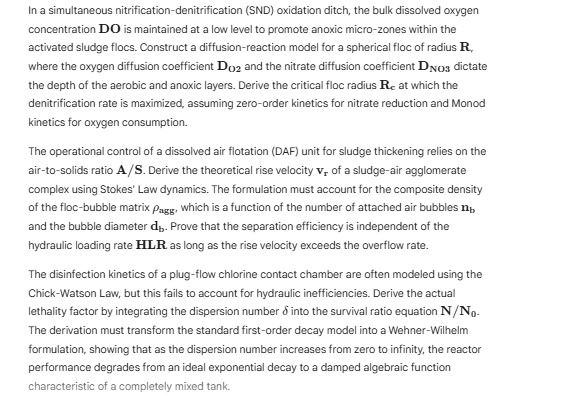 In a simultaneous nitrification-denitrification (SND) oxidation ditch, the bulk dissolved oxygen
concentration DO is maintained at a low level to promote anosic micro-zones within the
activated sludge flocs. Construct a diffusion-reaction model for a spherical floc of radius R.
where the oxygen diffusion coefficient Dayz and the nitrate diffusion coefficient Diyos dictate
the depth of the arabic and anoxic layers. Derive the critica floc radius Re at which the
denitrification rate is maximized, assuming zero-order kinetics for nitrate reduction and Monod
Kinetics for oxygen consumption.
The operational control of a dissolved ai flotation (DAF) unit for sludge thickening relies on the
air-to-solds rato A/S. Derive the theoretical rise velocity v, of a sludge-air agglomerate
complex using Stokes’ Law dynamics. The formulation must account for the composite density
of the floc-bubble matrix page, whichis a function of the number of attached air bubbles 1,
and the bubble diameter dy, Prove that the separation eficiency is independent of the
hycrauiic loading rate HLR as ong as the risa velocity exceeds the overflow rae.
The disinfection kinetics of a piug-flow chlorine contact chamber are often modeled using the
Chick Watson Law, but this fails 10 account fo hydraulic inefficiencies. Derive the actual
lethality factor by integrating the dispersion number & nto the survival ratio equation N/No,
The derivation must transform the standard first-order decay model into a Wehner-Wihelm
formulation, showing that as the dispersion number increases from zero to infinity, the reactor
performance degrades from an ideal exponential decay to a damped algebraic function
characteristic of a completely mixed tank.
Asked by: Francis
Created at: 2026-01-21 08:50:01
Final Answer:
📢 Instructions:
- Ask anything relatd to above question only.
- For new Question goto :