 VIPSolutions
Give step-by-step solution with explanation and final answer: (Give me answer without using bullet points)In the optimization of a non-isothermal PFR carrying out a reversible exothermic reaction A = B, the equifbrium conversion decreases while the forward rate constant increases with temperature. Derive the equation fo the Locus of Maximum Rates on the temperature- conversion phase plane. Explain how a sequence of adiabatic beds with interstage cooling can be designed to approximate this optimal rzjectory, and caleuiate the required heat duty for the intercoolers o restore the foed temperature to the optimal nt condition for each subsequent. stage. Aheterageneous catalytic reaction i poisoned by the presence of a foed impurity that adsorbs. reversibly onto the active sites. Considering a Langmir-Hinshelwood mechanism where the main reaction requires dul-site adsorption and the poison competes for the same sites, derive the modified ate expression. The fina equation must explicitly show the dependence of the reaction rate on the partial pressure of the poison Py and the adsorption equiibrium constant Kr, demonstrating the increase n the apparent denominator term. The thermal stability of a batch reactor conducting a highly exothermic zero-order reaction is compromised by a fale in the cooling system. Starting from the unsteady-state energy balance, derive the expression for the Time to Maximum Rate (TMI) under adiabatic conditions. The derivation must assume the Frank-Kamenetski approximation fo the Arrhenius temperature dependence to dbtain a closed-form analytical estimate of the thermal runaway induction period.
Question:
Give step-by-step solution with explanation and final answer:
(Give me answer without using bullet points)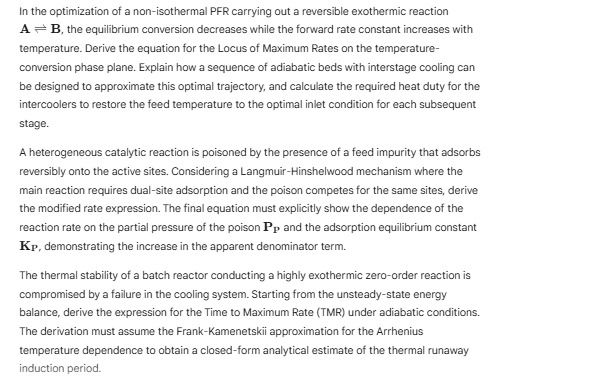 In the optimization of a non-isothermal PFR carrying out a reversible exothermic reaction
A = B, the equifbrium conversion decreases while the forward rate constant increases with
temperature. Derive the equation fo the Locus of Maximum Rates on the temperature-
conversion phase plane. Explain how a sequence of adiabatic beds with interstage cooling can
be designed to approximate this optimal rzjectory, and caleuiate the required heat duty for the
intercoolers o restore the foed temperature to the optimal nt condition for each subsequent.
stage.
Aheterageneous catalytic reaction i poisoned by the presence of a foed impurity that adsorbs.
reversibly onto the active sites. Considering a Langmir-Hinshelwood mechanism where the
main reaction requires dul-site adsorption and the poison competes for the same sites, derive
the modified ate expression. The fina equation must explicitly show the dependence of the
reaction rate on the partial pressure of the poison Py and the adsorption equiibrium constant
Kr, demonstrating the increase n the apparent denominator term.
The thermal stability of a batch reactor conducting a highly exothermic zero-order reaction is
compromised by a fale in the cooling system. Starting from the unsteady-state energy
balance, derive the expression for the Time to Maximum Rate (TMI) under adiabatic conditions.
The derivation must assume the Frank-Kamenetski approximation fo the Arrhenius
temperature dependence to dbtain a closed-form analytical estimate of the thermal runaway
induction period.
Asked by: singaluri krishna kumari
Created at: 2026-01-21 08:15:44
Final Answer:
📢 Instructions:
- Ask anything relatd to above question only.
- For new Question goto :