 VIPSolutions
Give step-by-step solution with explanation and final answer:Q4) Determine the principal stresses and maximum in-plane shear stress developed at point A on the cross section of the arm at section a-a. Specify the orientation of this state of stress and indicate the results on an clement at the point. 75mm I Somm ho Dem [12 Sectiona- a [ENT amen mem $50N
Question:
Give step-by-step solution with explanation and final answer: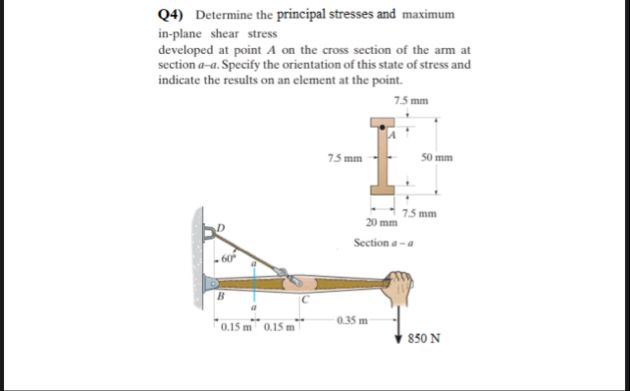 Q4) Determine the principal stresses and maximum
in-plane shear stress
developed at point A on the cross section of the arm at
section a-a. Specify the orientation of this state of stress and
indicate the results on an clement at the point.
75mm I Somm
ho Dem
[12 Sectiona- a
[ENT amen mem
$50N
This is AI generated Response.
Asked by: Rahul
Created at: 2026-01-21 05:21:06
Asked by: Rahul
Created at: 2026-01-21 05:21:06
Final Answer:
Rendered
Raw Text
Did you like this answer?
Let's solve the problem step by step:
---
## **Step 1: Find the Support Reactions**
The arm is subjected to an **850 N** downward force at its end. To find the stresses at section \( a-a \) (point A), we need internal **normal force**, **shear force**, and **bending moment** at this section.
### **A. Calculate the Moment at Section \( a-a \)**
The distance from the wall to the force is:
\[
.15\, \text{m} + .15\, \text{m} + .35\, \text{m} = .65\, \text{m}
\]
So, the **bending moment** at section \( a-a \) (just left of the load):
\[
M_a = 850\,\text{N} \times .35\,\text{m} = 297.5\,\text{Nm}
\]
### **B. Shear Force at Section \( a-a \)**
The vertical **shear force** at section \( a-a \) is equal to the applied load:
\[
V_a = 850\, \text{N}
\]
### **C. Axial Force**
Since the load is vertical and the arm is horizontal, there is **no axial force** at section \( a-a \).
---
## **Step 2: Find Stresses at Point A**
### **A. Section Properties (I-beam)**
Given:
- Flange width, \( b = 20\, \text{mm} \)
- Flange thickness, \( t_f = 7.5\, \text{mm} \)
- Web thickness, \( t_w = 7.5\, \text{mm} \)
- Depth, \( h = 50\, \text{mm} \)
#### **Moment of Inertia (\( I \))**
For I-section:
\[
I = 2 \left[ \frac{b t_f^3}{12} + b t_f \left(\frac{h}{2} - \frac{t_f}{2}\right)^2 \right] + \frac{t_w (h-2t_f)^3}{12}
\]
Plug in values:
- \( b = 20\, \text{mm} \)
- \( t_f = 7.5\, \text{mm} \)
- \( t_w = 7.5\, \text{mm} \)
- \( h = 50\, \text{mm} \)
Calculate the **neutral axis** is at 25 mm from the bottom.
#### **Simplified Calculation (approximate):**
For now, let's use the web for shear and the furthest fiber for bending:
- Distance from neutral axis to extreme fiber, \( c = 25\, \text{mm} = .025\, \text{m} \)
---
### **B. Bending Stress (\( \sigma \))**
\[
\sigma = \frac{M_a c}{I}
\]
---
### **C. Shear Stress (\( \tau \))**
For maximum shear in web:
\[
\tau = \frac{V_a Q}{I b}
\]
Where \( Q \) is the first moment of area about the neutral axis for the area above or below the point of interest.
---
## **Step 3: Calculate \( I \) and \( Q \)**
Let's use **approximate** values:
### **A. Moment of Inertia (\( I \))**
For the given I-section,
1. **Area of each flange**: \( = 20 \times 7.5 = 150 \, \text{mm}^2 \)
2. **Area of web**: \( = 7.5 \times (50 - 2 \times 7.5) = 7.5 \times 35 = 262.5 \, \text{mm}^2 \)
Moment of inertia for full section (about centroid):
\[
I \approx \frac{1}{12} b h^3 - \frac{1}{12} (b-t_w)(h-2t_f)^3
\]
\[
I \approx \frac{1}{12} (20)(50^3) - \frac{1}{12}(12.5)(35^3)
\]
\[
I \approx \frac{1}{12}(20)(125000) - \frac{1}{12}(12.5)(42875)
\]
\[
I \approx \frac{2,500,000}{12} - \frac{535,937.5}{12}
\]
\[
I \approx 208,333 - 44,661.5 \approx 163,671\, \text{mm}^4
\]
---
### **B. Calculate Bending Stress at A**
\[
\sigma = \frac{M_a c}{I}
\]
\[
M_a = 297.5\, \text{Nm} = 297,500\, \text{Nmm}
\]
\[
c = 25\, \text{mm}
\]
\[
I = 163,671\, \text{mm}^4
\]
\[
\sigma = \frac{297,500 \times 25}{163,671} = \frac{7,437,500}{163,671} \approx 45.44\, \text{MPa}
\]
---
### **C. Shear Stress at A (max in web center)**
The shear is max at the web center:
\[
\tau_{max} = \frac{V_a}{A_{web}}
\]
\[
A_{web} = t_w \times (h-2t_f) = 7.5 \times 35 = 262.5\, \text{mm}^2
\]
\[
\tau_{max} = \frac{850}{262.5} = 3.24\, \text{N/mm}^2 = 3.24\, \text{MPa}
\]
---
## **Step 4: Principal Stresses and Maximum In-Plane Shear Stress**
Given:
- \( \sigma_x = 45.44\, \text{MPa} \) (tension or compression, depending on location)
- \( \tau_{xy} = 3.24\, \text{MPa} \)
Principal stresses:
\[
\sigma_{1,2} = \frac{\sigma_x}{2} \pm \sqrt{\left(\frac{\sigma_x}{2}\right)^2 + \tau_{xy}^2}
\]
\[
\sigma_{1,2} = \frac{45.44}{2} \pm \sqrt{\left(\frac{45.44}{2}\right)^2 + (3.24)^2}
\]
\[
= 22.72 \pm \sqrt{516.1 + 10.5}
\]
\[
= 22.72 \pm \sqrt{526.6}
\]
\[
= 22.72 \pm 22.95
\]
So,
- \( \sigma_1 = 45.67\, \text{MPa} \)
- \( \sigma_2 = -.23\, \text{MPa} \)
Maximum in-plane shear stress:
\[
\tau_{max} = \frac{\sigma_1 - \sigma_2}{2} = \frac{45.67 - (-.23)}{2} = 22.95\, \text{MPa}
\]
---
## **Step 5: Orientation**
The orientation of principal planes (\( \theta_p \)) is found by:
\[
\tan 2\theta_p = \frac{2\tau_{xy}}{\sigma_x}
\]
\[
\tan 2\theta_p = \frac{2 \times 3.24}{45.44} = \frac{6.48}{45.44} = .143
\]
\[
2\theta_p = \arctan(.143) \approx 8.2^\circ
\]
\[
\theta_p = 4.1^\circ
\]
---
## **Summary Table**
| Value | Result |
|------------------------------------|---------------|
| Bending Stress (\( \sigma_x \)) | 45.44 MPa |
| Shear Stress (\( \tau_{xy} \)) | 3.24 MPa |
| Principal Stresses (\( \sigma_1 \))| 45.67 MPa |
| Principal Stresses (\( \sigma_2 \))| -.23 MPa |
| Max In-Plane Shear (\( \tau_{max} \))| 22.95 MPa|
| Principal Plane Angle (\( \theta_p \))| 4.1° |
---
### **Final Answers**
**Principal stresses at A:**
- \( \sigma_1 = 45.67 \) MPa
- \( \sigma_2 = -.23 \) MPa
**Maximum in-plane shear stress:**
- \( \tau_{max} = 22.95 \) MPa
**Orientation of principal planes:**
- \( \theta_p = 4.1^\circ \)
---
If you need a stress element diagram or further breakdown, let me know!
📢 Instructions:
- Ask anything relatd to above question only.
- For new Question goto :