 VIPSolutions
Give step-by-step solution with explanation and final answer:TE TE Te AE SEE Process 1-2: . o » Qu _ a kkg =F = m Process 2-3: » - a » 2 J/kg = %- a Process 3-4: . » Qs _ a Whe = — B m Process 4-1: » . o » kg AL = 1 ou = + | m
Question:
Give step-by-step solution with explanation and final answer: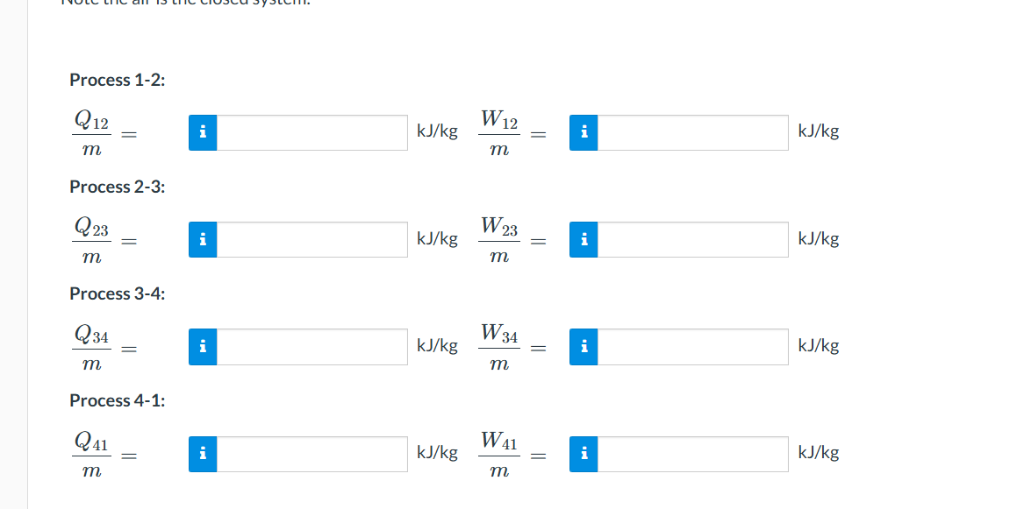 TE TE Te AE SEE
Process 1-2: . o »
Qu _ a kkg =F =
m
Process 2-3: » - a »
2 J/kg =
%- a
Process 3-4: . »
Qs _ a Whe = — B
m
Process 4-1: » . o »
kg AL =
1
ou = + | m
This is AI generated Response.
Asked by: Rahul
Created at: 2026-01-21 05:06:32
Asked by: Rahul
Created at: 2026-01-21 05:06:32
Final Answer:
Rendered
Raw Text
Did you like this answer?
### Step-by-Step Solution
To solve for \( \frac{Q}{m} \) and \( \frac{W}{m} \) (heat and work per unit mass) for each process, we need details about the cycle, such as **pressure, volume, and temperature at each state**, and the **type of processes** (isothermal, isobaric, isochoric, adiabatic).
Since the image does **not provide those values or process types**, I'll give you a **general method** for each process in a typical thermodynamic cycle (like the air-standard Otto, Diesel, or Brayton cycles).
Let’s proceed with generic equations for **ideal gas** and **closed system** (as stated).
---
## **Process 1-2**
#### **General Equations**
- **Heat transferred:** \( \frac{Q_{12}}{m} = u_2 - u_1 + W_{12}/m \)
- **Work done:** \( \frac{W_{12}}{m} = \int_{1}^{2} P\,dv \)
If process type is known (e.g., isochoric, isobaric, isothermal, or adiabatic), formulas simplify:
- **Isochoric (constant volume):**
- \( \frac{Q_{12}}{m} = u_2 - u_1 \)
- \( \frac{W_{12}}{m} = \)
- **Isobaric (constant pressure):**
- \( \frac{Q_{12}}{m} = h_2 - h_1 \)
- \( \frac{W_{12}}{m} = P (v_2 - v_1) \)
- **Isothermal (ideal gas):**
- \( \frac{Q_{12}}{m} = \frac{W_{12}}{m} = R T \ln\left(\frac{v_2}{v_1}\right) \)
- **Adiabatic (isentropic, ideal gas):**
- \( \frac{Q_{12}}{m} = \)
- \( \frac{W_{12}}{m} = u_1 - u_2 \) (if reversible, \( k = c_p/c_v \))
---
## **Process 2-3**
_Similar logic as above for appropriate process:_
- **Isochoric:** \( \frac{Q_{23}}{m} = u_3 - u_2 \), \( \frac{W_{23}}{m} = \)
- **Isobaric:** \( \frac{Q_{23}}{m} = h_3 - h_2 \), \( \frac{W_{23}}{m} = P (v_3 - v_2) \)
- **Isothermal:** \( \frac{Q_{23}}{m} = \frac{W_{23}}{m} = R T \ln\left(\frac{v_3}{v_2}\right) \)
- **Adiabatic:** \( \frac{Q_{23}}{m} = \), \( \frac{W_{23}}{m} = u_2 - u_3 \)
---
## **Process 3-4**
_Repeat as above for the process type:_
- **Isochoric:** \( \frac{Q_{34}}{m} = u_4 - u_3 \), \( \frac{W_{34}}{m} = \)
- **Isobaric:** \( \frac{Q_{34}}{m} = h_4 - h_3 \), \( \frac{W_{34}}{m} = P (v_4 - v_3) \)
- **Isothermal:** \( \frac{Q_{34}}{m} = \frac{W_{34}}{m} = R T \ln\left(\frac{v_4}{v_3}\right) \)
- **Adiabatic:** \( \frac{Q_{34}}{m} = \), \( \frac{W_{34}}{m} = u_3 - u_4 \)
---
## **Process 4-1**
- **Isochoric:** \( \frac{Q_{41}}{m} = u_1 - u_4 \), \( \frac{W_{41}}{m} = \)
- **Isobaric:** \( \frac{Q_{41}}{m} = h_1 - h_4 \), \( \frac{W_{41}}{m} = P (v_1 - v_4) \)
- **Isothermal:** \( \frac{Q_{41}}{m} = \frac{W_{41}}{m} = R T \ln\left(\frac{v_1}{v_4}\right) \)
- **Adiabatic:** \( \frac{Q_{41}}{m} = \), \( \frac{W_{41}}{m} = u_4 - u_1 \)
---
## **Summary Table**
| Process | \( \frac{Q}{m} \) (kJ/kg) | \( \frac{W}{m} \) (kJ/kg) |
|---------|---------------------------|---------------------------|
| 1-2 | [depends on process] | [depends on process] |
| 2-3 | [depends on process] | [depends on process] |
| 3-4 | [depends on process] | [depends on process] |
| 4-1 | [depends on process] | [depends on process] |
---
### **Final Answer**
You need to **identify the process type** for each stage and **plug in the values** for temperature, pressure, and specific volumes to use the correct equation from above.
If you provide **state properties or process types**, I can give you the exact numerical answers.
**Let me know the process types or properties, and I’ll solve it step-by-step with numbers!**
📢 Instructions:
- Ask anything relatd to above question only.
- For new Question goto :