 VIPSolutions
Give step-by-step solution with explanation and final answer:(3) A tunnel is excavated in an elastic rock (see a cross-section plane in the figure below). At a point (red dot shown in the figure) located immediately on the back of the tunnel, the stress acting in the horizontal direction is 100 MPa, and the stress parallel to the tunnel’s long axis (perpendicular to the cross-section plane) is 20 MPa. (a) What are the three principal stresses (magnitudes and orientations) at this point? (b) Show the state-of-stress of this point in the cross-section plane on a Mohr diagram.
Question:
Give step-by-step solution with explanation and final answer: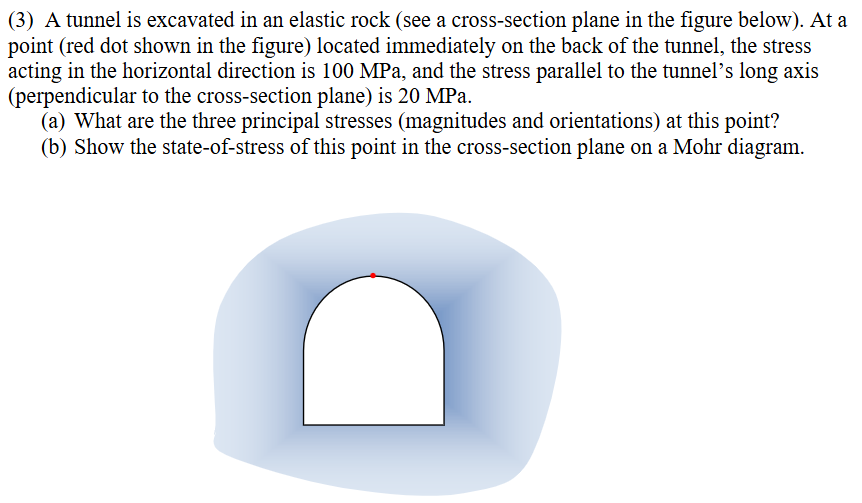 (3) A tunnel is excavated in an elastic rock (see a cross-section plane in the figure below). At a
point (red dot shown in the figure) located immediately on the back of the tunnel, the stress
acting in the horizontal direction is 100 MPa, and the stress parallel to the tunnel’s long axis
(perpendicular to the cross-section plane) is 20 MPa.
(a) What are the three principal stresses (magnitudes and orientations) at this point?
(b) Show the state-of-stress of this point in the cross-section plane on a Mohr diagram.
This is AI generated Response.
Asked by: Rahul
Created at: 2026-01-21 05:02:16
Asked by: Rahul
Created at: 2026-01-21 05:02:16
Final Answer:
Rendered
Raw Text
Did you like this answer?
Let's break down and **solve the problem step-by-step**:
---
## **Given Data**
- **Horizontal stress** (in the cross-section plane): \(\sigma_x = 100\) MPa
- **Vertical stress** (perpendicular to the cross-section plane, i.e., along tunnel axis): \(\sigma_z = 20\) MPa
- **No mention of vertical stress in the cross-section plane:** So, let's assume the vertical stress in the cross-section plane (\(\sigma_y\)) is **** (common assumption if not specified).
- **No shear stresses mentioned:** Assume all shear stresses (\(\tau_{xy}, \tau_{xz}, \tau_{yz}\)) are zero.
---
## **(a) Principal Stresses (Magnitudes and Orientations)**
### **Step 1: Write the Stress Tensor**
\[
\begin{align*}
\text{Let:} \quad &\sigma_x = 100 \text{ MPa (horizontal in section)} \\
&\sigma_y = \text{ MPa (vertical in section, not specified)} \\
&\sigma_z = 20 \text{ MPa (parallel to tunnel axis)} \\
\end{align*}
\]
\[
\mathbf{\sigma} = \begin{bmatrix}
100 & & \\
& & \\
& & 20 \\
\end{bmatrix}
\]
### **Step 2: Principal Stresses**
Since the stress tensor is diagonal and all shear stresses are zero, the **principal stresses are simply the diagonal components**:
\[
\boxed{
\begin{align*}
\sigma_1 &= 100 \ \text{MPa} \\
\sigma_2 &= 20 \ \text{MPa} \\
\sigma_3 &= \ \text{MPa} \\
\end{align*}
}
\]
- Directions:
- \(\sigma_1\) (100 MPa): Horizontal direction (in the section plane)
- \(\sigma_2\) (20 MPa): Along the tunnel axis (perpendicular to the section)
- \(\sigma_3\) ( MPa): Vertical direction (in the section plane)
---
## **(b) Mohr Circle in Cross-Section Plane**
### **Step 1: State-of-Stress in Cross-Section Plane**
In the cross-section plane (**ignore the tunnel axis direction**):
- \(\sigma_x = 100\) MPa (horizontal)
- \(\sigma_y = \) MPa (vertical)
- Shear stress \(\tau_{xy} = \)
### **Step 2: Draw Mohr’s Circle**
- The center of the circle, \(C\), is at:
\[
C = \frac{\sigma_x + \sigma_y}{2} = \frac{100 + }{2} = 50 \ \text{MPa}
\]
- The radius, \(R\), is:
\[
R = \frac{\sigma_x - \sigma_y}{2} = \frac{100 - }{2} = 50 \ \text{MPa}
\]
### **Step 3: Mohr Circle Endpoints**
- Left endpoint: \((\sigma_y, ) = (, )\)
- Right endpoint: \((\sigma_x, ) = (100, )\)
### **Step 4: Sketch**
```
σ
^
|
100 MPa | o
| /
| /
50 MPa |------o------ (center at 50 MPa)
| \
| \
MPa |-----------o
+---------------------->
```
- **Horizontal axis:** Normal stress (\(\sigma\)), in MPa
- **Vertical axis:** Shear stress (\(\tau\)), in MPa
---
## **Final Answers**
### **(a) Principal Stresses**
- **Magnitudes:**
\(\boxed{100 \text{ MPa},\ 20 \text{ MPa},\ \text{ MPa}}\)
- **Orientations:**
- 100 MPa: Horizontal (cross-section plane)
- 20 MPa: Along tunnel axis (out of plane)
- MPa: Vertical (cross-section plane)
### **(b) Mohr Diagram**
- The Mohr circle has:
- **Center:** 50 MPa on the \(\sigma\) axis
- **Radius:** 50 MPa
- **Endpoints:** MPa and 100 MPa on the \(\sigma\) axis
- **No shear stress (\(\tau = \))**
Let me know if you want a hand-drawn or software-generated Mohr Circle!
📢 Instructions:
- Ask anything relatd to above question only.
- For new Question goto :