 VIPSolutions
Give step-by-step solution with explanation and final answer:4. Propose a mechanism to account for the following addition reactions. Show the structure of the intermediate(s), and use curved arrows to follow electron flows in each step. (20P) lo > oll ~ a oi
Question:
Give step-by-step solution with explanation and final answer: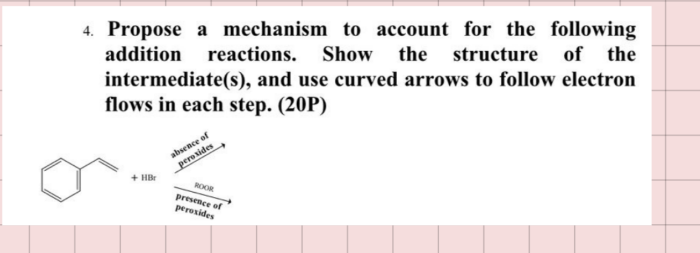 4. Propose a mechanism to account for the following
addition reactions. Show the structure of the
intermediate(s), and use curved arrows to follow electron
flows in each step. (20P)
lo
> oll
~ a
oi
This is AI generated Response.
Asked by: Rahul
Created at: 2026-01-21 03:22:47
Asked by: Rahul
Created at: 2026-01-21 03:22:47
Final Answer:
Rendered
Raw Text
Did you like this answer?
Let's break down the solution for the **addition of HBr to styrene (C₆H₅-CH=CH₂)** under **two conditions**:
---
## **1. Addition of HBr to Styrene in the Absence of Peroxides (Markovnikov Addition)**
### **Step 1: Protonation of the Double Bond**
- The π electrons of the alkene attack the proton (H⁺) from HBr.
- The benzyl position (CH₂ next to the benzene ring) stabilizes the carbocation via resonance, so the **more stable carbocation is formed at the benzylic position**.
**Curved Arrow Mechanism:**
- Double bond electrons form a bond with H⁺, generating a carbocation.
**Intermediate:**
```plaintext
H
|
C6H5-CH-CH3 (benzylic carbocation)
+
```
### **Step 2: Nucleophilic Attack by Bromide Ion**
- Br⁻ attacks the carbocation.
**Product:**
```plaintext
Br
|
C6H5-CH-CH3 (Markovnikov product)
```
### **Summary Mechanism (Markovnikov):**
1. Electrons from the double bond attack H⁺ → benzylic carbocation (stabilized by resonance).
2. Br⁻ attacks carbocation → **C6H5-CH(Br)-CH3**.
---
## **2. Addition of HBr to Styrene in the Presence of Peroxides (Anti-Markovnikov Addition, Free Radical Mechanism)**
### **Step 1: Initiation (Formation of Br Radical)**
- Peroxide decomposes to form alkoxy radicals.
- Alkoxy radical abstracts H from HBr → Br• radical is formed.
### **Step 2: Propagation (Radical Addition)**
- The Br• radical adds to the **less substituted carbon** of the double bond (terminal carbon) to produce the more stable benzylic radical.
**Intermediate:**
```plaintext
C6H5-CH•-CH2Br (benzylic radical)
```
### **Step 3: Radical Abstraction of H from HBr**
- The benzylic radical abstracts H from another molecule of HBr, regenerating Br•.
**Product:**
```plaintext
C6H5-CH2-CH2Br (Anti-Markovnikov product)
```
### **Summary Mechanism (Anti-Markovnikov):**
1. Br• adds to terminal carbon → benzylic radical.
2. Benzylic radical abstracts H from HBr → **C6H5-CH2-CH2Br**.
---
## **Final Answers (with Structures):**
### **Markovnikov Product (No Peroxides):**
```
Br
|
C6H5-CH-CH3
```
**Name:** 1-Phenyl-1-bromopropane
### **Anti-Markovnikov Product (With Peroxides):**
```
C6H5-CH2-CH2Br
```
**Name:** 1-Phenyl-2-bromopropane
---
## **Electron Flow with Curved Arrows (Summary):**
### **Markovnikov:**
1. π electrons (double bond) → H⁺ of HBr; Br⁻ leaves.
2. Carbocation stabilized by resonance.
3. Br⁻ attacks carbocation.
### **Anti-Markovnikov:**
1. ROOR → 2RO• (heat/light).
2. RO• + HBr → ROH + Br•
3. Br• + alkene → benzylic radical.
4. Benzylic radical + HBr → product + Br•
---
If you need **illustrated curved arrow mechanisms**, let me know, and I can provide them as diagrams!
📢 Instructions:
- Ask anything relatd to above question only.
- For new Question goto :