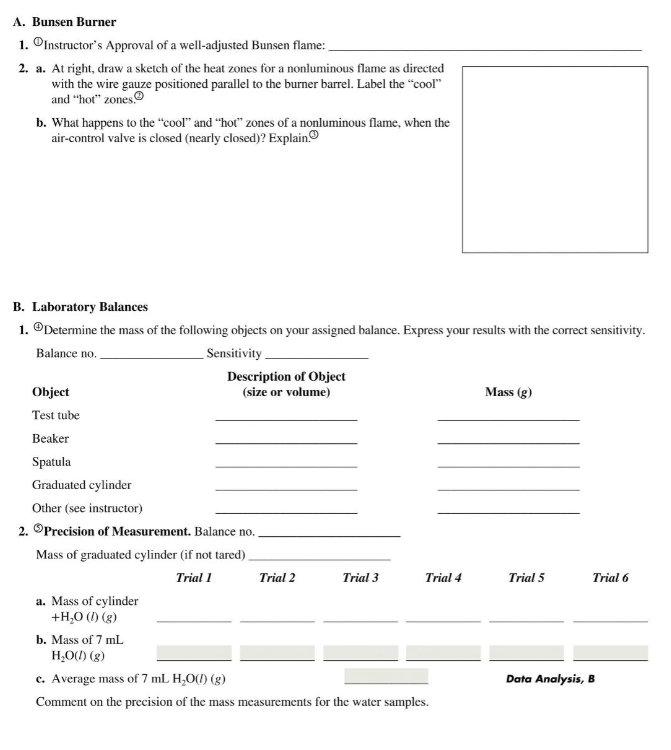
Give step-by-step solution with explanation and final answer:A. Bunsen Burner
1. Olnstructor's Approval of a well-adjusted Bunsen flame:
2. a. Atright, draw a sketch of the heat zones for a nonluminous flame as directed
with the wire gauze positioned parallel to the burner barrel. Label the “cool”
and “ho” z0nes®
ai-control valve is closed (nearly closed)? Explain®
B. Laboratory Balances
1. @Determine the mass of the following objects on your assigned balance. Express your results with the correct sensitivity.
Balanceno. __ Semsitvity
Description of Object
Object (size or volume) Mass (g)
Test wbe
Beaker
Spatula
Graduated cylinder
Other (see instructor)
2. Oprecision of Measurement. Balance no.
Mass of graduated cylinder (if not tared)
Trial 1 Trial 2 Trial 3 Trial 4 Trial 5 Trial 6
a. Mass of cylinder
HOME EE EE
b. Mass of 7 mL.
HO (2) I NE SU SU SS S—
e. Average mass of 7 mL H,00) (5) Data Analysis, B
‘Comment on the precision of the mass measurements for the water samples.
Question:
Give step-by-step solution with explanation and final answer:A. Bunsen Burner
1. Olnstructor's Approval of a well-adjusted Bunsen flame:
2. a. Atright, draw a sketch of the heat zones for a nonluminous flame as directed
with the wire gauze positioned parallel to the burner barrel. Label the “cool”
and “ho” z0nes®
ai-control valve is closed (nearly closed)? Explain®
B. Laboratory Balances
1. @Determine the mass of the following objects on your assigned balance. Express your results with the correct sensitivity.
Balanceno. __ Semsitvity
Description of Object
Object (size or volume) Mass (g)
Test wbe
Beaker
Spatula
Graduated cylinder
Other (see instructor)
2. Oprecision of Measurement. Balance no.
Mass of graduated cylinder (if not tared)
Trial 1 Trial 2 Trial 3 Trial 4 Trial 5 Trial 6
a. Mass of cylinder
HOME EE EE
b. Mass of 7 mL.
HO (2) I NE SU SU SS S—
e. Average mass of 7 mL H,00) (5) Data Analysis, B
‘Comment on the precision of the mass measurements for the water samples.
This is AI generated Response.
Asked by: Rahul
Created at: 2026-01-21 03:19:21
Final Answer:
RenderedRaw Text
Did you like this answer?
Let's break down each part step-by-step:
---
# **A. Bunsen Burner**
### 1. Instructor’s Approval
- **This is for your instructor to sign after you've shown them a well-adjusted Bunsen flame.**
---
### 2. a. **Sketch of Heat Zones**
- **Describe and Sketch:**
For a nonluminous (blue) flame:
- There are two primary zones:
1. **Inner (Cool) Zone:** Near the base, inside the flame, appears blue or almost invisible. This area is cooler because the gas is still mixing with air and hasn't fully combusted.
2. **Outer (Hot) Zone:** The tip and outside edge of the flame. This is where complete combustion occurs, and it's the hottest part of the flame.
- **Label the “cool” and “hot” zones** on your sketch as described above.
#### **[Text description for sketch if drawing is not possible]:**
```
^
| (outer, hottest part, blue)
|
[HOT ZONE]
|
---------------
[COOL ZONE]
(inner, lower part, pale blue)
---------------
|
(Burner barrel)
```
- **Wire gauze** should be placed horizontally above the barrel, parallel to it.
---
### 2. b. **Effect of Closing Air-Control Valve**
- **When the air-control valve is closed (nearly closed):**
- Less air mixes with gas.
- The flame turns yellow and becomes luminous ("luminous flame").
- The inner (cool) zone grows larger, and the outer (hot) zone shrinks and becomes less hot.
- The flame is less efficient, produces soot (carbon), and is not as hot.
---
# **B. Laboratory Balances**
### 1. **Measuring Mass**
- **Fill in the table with the mass of each object using your balance.**
- Record the **description** (size/volume) and **mass (g)** for each item:
- Test tube
- Beaker
- Spatula
- Graduated cylinder
- Other (as specified)
---
### 2. **Precision of Measurement**
**Balance no.:** (Fill in your assigned balance number)
#### a. **Mass of Cylinder + 7 mL H₂O**
- For each trial, record the mass of the graduated cylinder **plus** water.
#### b. **Mass of 7 mL H₂O (g)**
- Subtract the mass of the empty graduated cylinder from the value in part a for each trial:
\[
\text{Mass of 7 mL H}_2\text{O} = \text{(Mass of cylinder + water)} - \text{(Mass of cylinder)}
\]
#### c. **Average Mass of 7 mL H₂O**
- Calculate the average:
\[
\text{Average mass} = \frac{\text{Sum of all 7 mL H}_2\text{O masses}}{\text{Number of trials}}
\]
#### d. **Comment on Precision**
- **Precision:** If the values from all trials are close to each other, your measurements are precise.
- **Example comment:** "The mass measurements for the water samples were consistent across all trials, indicating high precision."
---
## **Summary/Final Answers**
### **A. Bunsen Burner**
- **a.** Sketch and label as described.
- **b.** When the air-control valve is closed, the cool zone increases, the hot zone decreases, and the flame becomes yellow and less hot.
### **B. Laboratory Balances**
- **1.** Fill in the table with measured masses.
- **2.** Calculate masses for each trial, the average, and comment on the precision as shown.
---
**If you provide your specific data for the balances, I can help you calculate the actual answers!**
VIPSolutions focuses on clear, step‑by‑step explanations so you can learn quickly. Whether you need an AI‑generated walkthrough or a short hint to get unstuck, each solution is organized for fast reading and easy review later.
Search similar questions, compare approaches, and bookmark the best answers for revision. Our goal is simple: quick, reliable study help that feels natural—not noisy.
 VIPSolutions
 A. Bunsen Burner
1. Olnstructor's Approval of a well-adjusted Bunsen flame:
2. a. Atright, draw a sketch of the heat zones for a nonluminous flame as directed
with the wire gauze positioned parallel to the burner barrel. Label the “cool”
and “ho” z0nes®
ai-control valve is closed (nearly closed)? Explain®
B. Laboratory Balances
1. @Determine the mass of the following objects on your assigned balance. Express your results with the correct sensitivity.
Balanceno. __ Semsitvity
Description of Object
Object (size or volume) Mass (g)
Test wbe
Beaker
Spatula
Graduated cylinder
Other (see instructor)
2. Oprecision of Measurement. Balance no.
Mass of graduated cylinder (if not tared)
Trial 1 Trial 2 Trial 3 Trial 4 Trial 5 Trial 6
a. Mass of cylinder
HOME EE EE
b. Mass of 7 mL.
HO (2) I NE SU SU SS S—
e. Average mass of 7 mL H,00) (5) Data Analysis, B
‘Comment on the precision of the mass measurements for the water samples.