 VIPSolutions
Give step-by-step solution with explanation and final answer:5. An aluminum (G = 26 GPa) shaft with a 60-mm-diameter has an allowable shear stress of To, = 80 MPa. Determine the (a) maximum allowable torque T and (b) the corresponding angle of twist of disk A relative to disk C. | 120m B 120m 2 kl T ND T C Ir
Question:
Give step-by-step solution with explanation and final answer: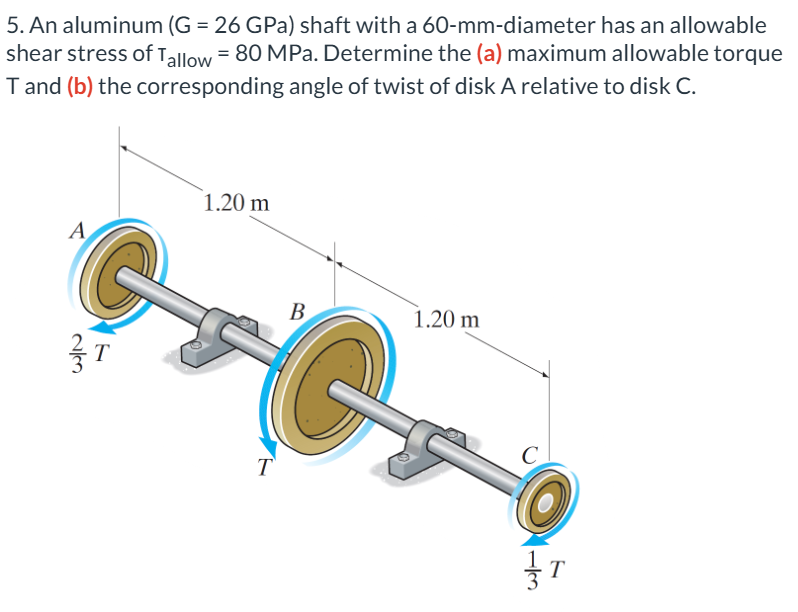 5. An aluminum (G = 26 GPa) shaft with a 60-mm-diameter has an allowable
shear stress of To, = 80 MPa. Determine the (a) maximum allowable torque
T and (b) the corresponding angle of twist of disk A relative to disk C.
| 120m
B 120m
2
kl T ND
T C
Ir
This is AI generated Response.
Asked by: Rahul
Created at: 2026-01-21 02:48:13
Asked by: Rahul
Created at: 2026-01-21 02:48:13
Final Answer:
Rendered
Raw Text
Did you like this answer?
Let's solve the problem step by step:
---
## **Given Data**
- Shear Modulus, \( G = 26 \) GPa \( = 26 \times 10^9 \) Pa
- Shaft diameter, \( d = 60 \) mm \( = .06 \) m
- Allowable shear stress, \( \tau_{allow} = 80 \) MPa \( = 80 \times 10^6 \) Pa
- Lengths: \( AB = BC = 1.20 \) m
---
## **Step 1: Maximum Allowable Torque \( T \)**
The maximum shear stress in a solid circular shaft is:
\[
\tau_{max} = \frac{Tc}{J}
\]
Where:
- \( T \) = applied torque
- \( c \) = outer radius (\( = d/2 \))
- \( J \) = polar moment of inertia for a solid shaft (\( = \frac{\pi}{32} d^4 \))
Set \( \tau_{max} = \tau_{allow} \):
\[
\tau_{allow} = \frac{T_{max} \cdot c}{J}
\]
\[
T_{max} = \frac{\tau_{allow} \cdot J}{c}
\]
Calculate \( J \) and \( c \):
\[
c = \frac{d}{2} = \frac{.06}{2} = .03 \text{ m}
\]
\[
J = \frac{\pi}{32} d^4 = \frac{\pi}{32} (.06)^4 = \frac{\pi}{32} (.00001296) \approx 1.274 \times 10^{-6} \text{ m}^4
\]
Plug in the values:
\[
T_{max} = \frac{80 \times 10^6 \times 1.274 \times 10^{-6}}{.03}
\]
\[
T_{max} = \frac{101.92}{.03} \times 10^
\]
\[
T_{max} = 3397 \text{ Nm}
\]
**Maximum allowable torque:**
\[
\boxed{T_{max} = 3.40 \text{ kN}\cdot\text{m}}
\]
---
## **Step 2: Angle of Twist from Disk A to Disk C (\( \theta_{AC} \))**
The angle of twist in a shaft is:
\[
\theta = \frac{T L}{J G}
\]
For this system, sum the twists in each segment:
### **Torque in Each Segment**
- Segment AB: torque = \( \frac{2}{3}T \)
- Segment BC: torque = \( \frac{1}{3}T \)
### **Total Angle of Twist**
\[
\theta_{AC} = \theta_{AB} + \theta_{BC}
\]
\[
\theta_{AC} = \frac{\left(\frac{2}{3}T\right) L_{AB}}{J G} + \frac{\left(\frac{1}{3}T\right) L_{BC}}{J G}
\]
\[
= \frac{T}{J G} \left( \frac{2}{3}L_{AB} + \frac{1}{3}L_{BC} \right)
\]
Plug in \( L_{AB} = L_{BC} = 1.2 \) m:
\[
\theta_{AC} = \frac{T}{J G} \left( \frac{2}{3} \times 1.2 + \frac{1}{3} \times 1.2 \right)
\]
\[
= \frac{T}{J G} \left( .8 + .4 \right)
\]
\[
= \frac{T}{J G} (1.2)
\]
Plug in \( T = 3397 \) Nm, \( J = 1.274 \times 10^{-6} \) m\(^4\), \( G = 26 \times 10^9 \) Pa:
\[
\theta_{AC} = \frac{3397 \times 1.2}{1.274 \times 10^{-6} \times 26 \times 10^9}
\]
Calculate denominator:
\[
1.274 \times 10^{-6} \times 26 \times 10^9 = 1.274 \times 26 \times 10^{3}
= 33.124 \times 10^3 = 33,124
\]
\[
\theta_{AC} = \frac{3397 \times 1.2}{33,124}
= \frac{4076.4}{33,124}
\approx .123 \text{ radians}
\]
**Convert to degrees:**
\[
.123 \times \frac{180}{\pi} \approx 7.05^\circ
\]
---
## **Final Answers**
### (a) **Maximum allowable torque:**
\[
\boxed{T_{max} = 3.40 \ \text{kN}\cdot\text{m}}
\]
### (b) **Corresponding angle of twist (A relative to C):**
\[
\boxed{\theta_{AC} = .123 \ \text{radians} \approx 7.05^\circ}
\]
📢 Instructions:
- Ask anything relatd to above question only.
- For new Question goto :