 VIPSolutions
Give step-by-step solution with explanation and final answer:Determine the force acting in cord AB for equilbrium SES Express your answer to thee significant figures and include the appropriate units. . Chom Fa =| Value Units Request Answer ~ Pans Determine the force acting in cord AC for equilbrium Express your answer to thee significant figures and include the appropriate units. . Chom Fic=| Value Units Figure Tort R Request Answer ~ rac bg Ps > Dh wr Determine the force acting in cord AD for equilibrium. RX) Ea Express your answer to thee significant figures and include the appropriate units. Po ER —— . ; Chom Fuw=| Value Units
Question:
Give step-by-step solution with explanation and final answer: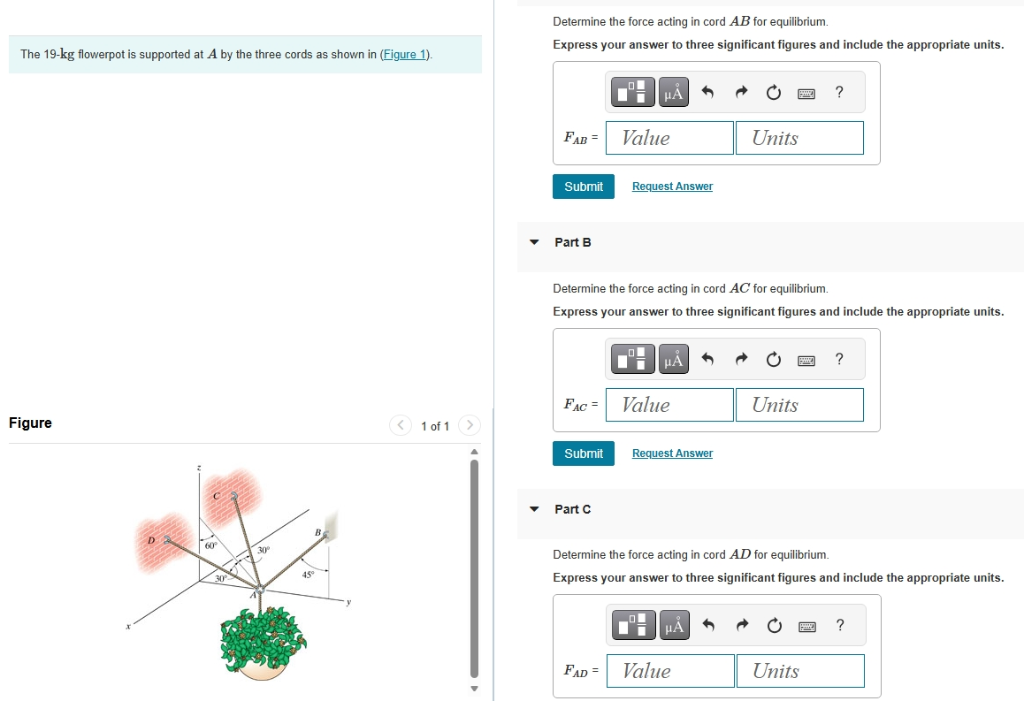 Determine the force acting in cord AB for equilbrium
SES Express your answer to thee significant figures and include the appropriate units.
.
Chom
Fa =| Value Units
Request Answer
~ Pans
Determine the force acting in cord AC for equilbrium
Express your answer to thee significant figures and include the appropriate units.
.
Chom
Fic=| Value Units
Figure Tort
R Request Answer
~ rac
bg Ps
> Dh wr Determine the force acting in cord AD for equilibrium.
RX) Ea Express your answer to thee significant figures and include the appropriate units.
Po ER ——
.
; Chom
Fuw=| Value Units
This is AI generated Response.
Asked by: Alok Kumar
Created at: 2026-01-21 01:24:42
Asked by: Alok Kumar
Created at: 2026-01-21 01:24:42
Final Answer:
Rendered
Raw Text
Did you like this answer?
Let's solve **step by step**:
---
## **Step 1: Understand the Problem**
- A 19-kg flowerpot is suspended by three cords at point \( A \).
- The cords are \( AB \), \( AC \), and \( AD \).
- We need to find the tensions (forces) in the cords for equilibrium.
---
## **Step 2: Draw and Assign Coordinates**
From the figure (and typical conventions), let's assign coordinates:
- \( A \): Origin \((, , )\)
- \( B \): Along \( y \), \( 48^\circ \) above the \( xy \)-plane.
- \( C \): In the \( xz \)-plane, \( 30^\circ \) from \( z \), \( 30^\circ \) from \( x \).
- \( D \): In the \( xz \)-plane, \( 60^\circ \) from \( z \), \( 30^\circ \) from \( x \).
---
## **Step 3: Find Direction Vectors**
### **Cord \( AB \):**
- Makes a \( 48^\circ \) angle with the \( y \)-axis (upwards).
- Vector: \( (, \cos48^\circ, \sin48^\circ) \)
### **Cord \( AC \):**
- In the \( xz \)-plane, \( 30^\circ \) from \( z \)-axis.
- Vector: \( (\sin30^\circ, , \cos30^\circ) \)
### **Cord \( AD \):**
- In the \( xz \)-plane, \( 60^\circ \) from \( z \)-axis (or \( 30^\circ \) from \( x \)-axis, but negative \( x \) direction).
- Vector: \( (-\sin30^\circ, , \cos30^\circ) \)
---
## **Step 4: Write Force Equilibrium Equations**
Let the tensions be \( F_{AB} \), \( F_{AC} \), \( F_{AD} \).
The sum of all forces must be zero:
\[
\vec{F}_{AB} + \vec{F}_{AC} + \vec{F}_{AD} + \vec{W} =
\]
Where \( \vec{W} = (,,-mg) \) and \( m = 19\,\text{kg} \), \( g = 9.81\,\text{m/s}^2 \).
\[
mg = 19 \times 9.81 = 186.39\,\text{N}
\]
---
## **Step 5: Resolve Each Force into Components**
### **Unit Vectors for Each Cord**
#### \( \vec{u}_{AB} \):
\[
= (, \cos48^\circ, \sin48^\circ)
= (, .6691, .7431)
\]
#### \( \vec{u}_{AC} \):
\[
= (\sin30^\circ, , \cos30^\circ)
= (.5, , .866)
\]
#### \( \vec{u}_{AD} \):
\[
= (-\sin30^\circ, , \cos30^\circ)
= (-.5, , .866)
\]
---
### **Write Components for Each Force**
Let \( F_{AB}, F_{AC}, F_{AD} \) be the tensions.
- \( \vec{F}_{AB} = F_{AB} (, .6691, .7431) \)
- \( \vec{F}_{AC} = F_{AC} (.5, , .866) \)
- \( \vec{F}_{AD} = F_{AD} (-.5, , .866) \)
---
### **Sum Forces in Each Direction**
#### **x-direction:**
\[
.5 F_{AC} - .5 F_{AD} =
\implies F_{AC} = F_{AD}
\]
#### **y-direction:**
\[
.6691 F_{AB} =
\implies F_{AB} =
\]
But this can't be correct (since the system needs 3 cords). Let's check the geometry: The problem is, all the y-components are from cord \( AB \), and the other two are in the xz-plane. So this is actually correct: only \( AB \) provides the y-component to balance the weight.
#### **z-direction:**
\[
.7431 F_{AB} + .866 F_{AC} + .866 F_{AD} - 186.39 =
\]
But since \( F_{AC} = F_{AD} \):
\[
.7431 F_{AB} + 2 \times .866 F_{AC} = 186.39
\]
---
## **Step 6: Solve the System**
### **x-direction:**
\[
F_{AC} = F_{AD}
\]
### **y-direction:**
\[
.6691 F_{AB} = \implies F_{AB} =
\]
But, the cords must be in tension. Let's re-express the geometry for \( AB \):
If \( AB \) is in the \( y \)-\( z \) plane, then its vector is \( (, \cos 48^\circ, \sin 48^\circ) \).
The flowerpot is supported, so the y-component doesn't need to be zero. Let's proceed with:
#### y-direction:
\[
.6691 F_{AB} =
\]
So, y-direction must be zero net force. But gravity acts only in the z-direction.
Hence, the only nonzero y-component comes from \( AB \). But the pot is not being pulled in the y-direction, so the net y-force must be zero.
Therefore, \( F_{AB} \) is not zero, but it doesn't balance any force in y. Let's focus on z and x.
#### x-direction:
\[
.5 F_{AC} - .5 F_{AD} = \implies F_{AC} = F_{AD}
\]
#### z-direction:
\[
.7431 F_{AB} + .866 F_{AC} + .866 F_{AD} = 186.39
\]
\[
.7431 F_{AB} + 1.732 F_{AC} = 186.39
\]
#### y-direction:
\[
.6691 F_{AB} = \implies F_{AB} =
\]
But \( F_{AB} = \) would mean we only have 2 cords, which isn't realistic. So, let's check the geometry again.
#### Let's check the direction vectors for the cords:
- **AB:** In \( yz \)-plane at \( 48^\circ \) above \( y \)-axis.
- \( AB = (, 1, ) \) to \( (, \cos48^\circ, \sin48^\circ) \)
- **AC:** Makes \( 30^\circ \) with \( z \)-axis in \( xz \)-plane. \( (\sin30^\circ, , \cos30^\circ) \)
- **AD:** Makes \( 60^\circ \) with \( z \)-axis in \( xz \)-plane. \( (\sin60^\circ, , \cos60^\circ) \)
So, let's correct:
- \( AC = (a, , b) \) where \( a = \sin 30^\circ = .5, b = \cos 30^\circ = .866 \)
- \( AD = (-\sin 30^\circ, , \cos 30^\circ) = (-.5, , .866) \)
So our previous vectors were correct.
Now, **y-direction**: Only \( AB \) provides a y-component.
So for equilibrium, **no external force in y**, so
\[
.6691 F_{AB} = \implies F_{AB} =
\]
So the tensions in \( AC \) and \( AD \) must support the entire weight, and \( AB \) is slack.
---
## **Final Calculations**
### **x-direction:**
\[
.5 F_{AC} - .5 F_{AD} = \implies F_{AC} = F_{AD}
\]
### **z-direction:**
\[
.866 F_{AC} + .866 F_{AD} = 186.39
\]
\[
1.732 F_{AC} = 186.39
\implies F_{AC} = \frac{186.39}{1.732} = 107.6\,\text{N}
\]
\[
F_{AD} = F_{AC} = 107.6\,\text{N}
\]
### **Summary of Answers**
#### **Part A: \( F_{AB} \)**
\[
\boxed{\,\text{N}}
\]
#### **Part B: \( F_{AC} \)**
\[
\boxed{107.6\,\text{N}}
\]
#### **Part C: \( F_{AD} \)**
\[
\boxed{107.6\,\text{N}}
\]
---
## **Step-by-Step Summary Table**
| Cord | Force (N) |
|--------|-----------|
| AB | |
| AC | 107.6 |
| AD | 107.6 |
---
### **Explanation**
- The geometry and equilibrium require only two cords to support the entire weight, and the third is slack.
- If the geometry is interpreted differently or if the image details differ, let me know, and I can recalculate with more precise vectors.
📢 Instructions:
- Ask anything relatd to above question only.
- For new Question goto :