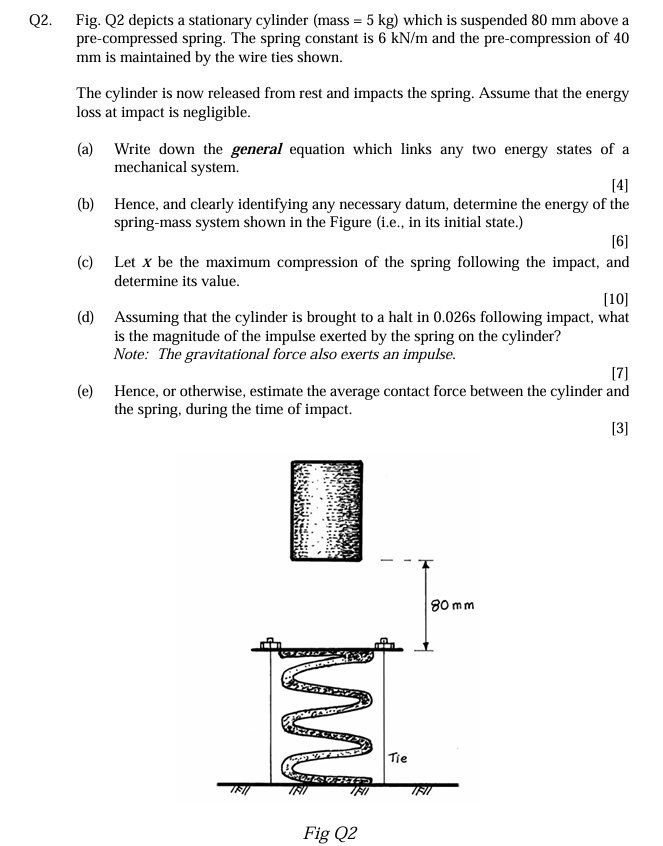
Give step-by-step solution with explanation and final answer:Q2. Fig. Q2 depicts a stationary cylinder (mass = 5 kg) which is suspended 80 mm above a
pre-compressed spring. The spring constant is 6 kN/m and the pre-compression of 40
mm is maintained by the wire ties shown.
The cylinder is now released from rest and impacts the spring. Assume that the energy
loss at impact is negligible.
(4) Write down the general equation which links any two energy states of a
mechanical system.
4]
(b) Hence, and clearly identifying any necessary datum, determine the energy of the
spring-mass system shown in the Figure (i.e., in its initial state.)
16]
(9) Let x be the maximum compression of the spring following the impact, and
determine its value.
[10]
(@) Assuming that the cylinder is brought to a halt in 0.026s following impact, what
is the magnitude of the impulse exerted by the spring on the cylinder?
Note: The gravitational force also exerts an impulse.
[|
() Hence, or otherwise, estimate the average contact force between the cylinder and
the spring, during the time of impact
3)
GE
5 mm
a T
=
Ee——
~—
it bs
- a
Fig Q2
Question:
Give step-by-step solution with explanation and final answer:Q2. Fig. Q2 depicts a stationary cylinder (mass = 5 kg) which is suspended 80 mm above a
pre-compressed spring. The spring constant is 6 kN/m and the pre-compression of 40
mm is maintained by the wire ties shown.
The cylinder is now released from rest and impacts the spring. Assume that the energy
loss at impact is negligible.
(4) Write down the general equation which links any two energy states of a
mechanical system.
4]
(b) Hence, and clearly identifying any necessary datum, determine the energy of the
spring-mass system shown in the Figure (i.e., in its initial state.)
16]
(9) Let x be the maximum compression of the spring following the impact, and
determine its value.
[10]
(@) Assuming that the cylinder is brought to a halt in 0.026s following impact, what
is the magnitude of the impulse exerted by the spring on the cylinder?
Note: The gravitational force also exerts an impulse.
[|
() Hence, or otherwise, estimate the average contact force between the cylinder and
the spring, during the time of impact
3)
GE
5 mm
a T
=
Ee——
~—
it bs
- a
Fig Q2
This is AI generated Response.
Asked by: Alok Kumar
Created at: 2026-01-21 01:01:24
Final Answer:
RenderedRaw Text
Did you like this answer?
Let's solve each part step-by-step:
---
## (a) General Energy Equation
The **general equation** linking any two energy states of a mechanical system (neglecting energy losses) is:
\[
T_1 + V_1 + W_{1 \to 2} = T_2 + V_2
\]
Where:
- \(T\) = Kinetic energy
- \(V\) = Potential energy (gravitational + elastic)
- \(W_{1 \to 2}\) = Work done by non-conservative forces (zero here)
For a conservative system:
\[
T_1 + V_1 = T_2 + V_2
\]
---
## (b) Initial Energy of the System
**Datum:** Take the spring’s uncompressed top as the reference level for gravitational potential energy.
### **Given:**
- Mass, \(m = 5\,\mathrm{kg}\)
- Spring constant, \(k = 600\,\mathrm{N/m}\)
- Pre-compression, \(\delta_ = 40\,\mathrm{mm} = .04\,\mathrm{m}\)
- Height above spring, \(h = 80\,\mathrm{mm} = .08\,\mathrm{m}\)
### **Initial State (Before Release):**
- Cylinder: Stationary, held 80 mm above spring
- Spring: Pre-compressed by 40 mm
### **Energies:**
- **Kinetic Energy (\(T_1\))**: \(\) (cylinder at rest)
- **Gravitational Potential Energy (\(V_{g1}\))**: \(mgh\)
- **Spring Potential Energy (\(V_{s1}\))**: \(\frac{1}{2}k\delta_^2\)
#### **Total Initial Energy (\(E_{initial}\)):**
\[
E_{initial} = T_1 + V_{g1} + V_{s1} = + mg h + \frac{1}{2} k \delta_^2
\]
\[
E_{initial} = (5)(9.81)(.08) + \frac{1}{2}(600)(.04)^2
\]
\[
= (5 \times 9.81 \times .08) + (.5 \times 600 \times .0016)
\]
\[
= 3.924 + 4.8 = \boxed{8.72\,\mathrm{J}}
\]
---
## (c) Maximum Compression of the Spring (\(x\))
Let \(x\) = **additional compression** after impact (beyond pre-compression).
**At maximum compression:**
- Cylinder’s velocity = (all energy is potential)
- All energy is stored in compressed spring and gravitational potential (now at new lower position).
Let total compression from spring's free length = \(x_{max}\).
- Initial pre-compression: \(\delta_\)
- Additional compression: \(x\)
- So, \(x_{max} = \delta_ + x\)
### **Energy Conservation:**
\[
E_{initial} = \frac{1}{2}k x_{max}^2 + mg(-x)
\]
But we need to set all reference heights properly:
- Cylinder drops \(h\) to contact, then compresses spring by \(x\).
- The change in gravitational PE during compression = \(-mg x\)
- So, at max compression:
\[
E_{initial} + mg \cdot = \frac{1}{2}k(\delta_ + x)^2 + mg(-x)
\]
But initial gravitational PE is at \(h\) above pre-compressed position.
So,
\[
mg h + \frac{1}{2}k\delta_^2 = \frac{1}{2}k(\delta_ + x)^2 - mgx
\]
**Expand:**
\[
mg h + \frac{1}{2}k\delta_^2 = \frac{1}{2}k(\delta_^2 + 2\delta_ x + x^2) - mgx
\]
\[
mg h + \frac{1}{2}k\delta_^2 = \frac{1}{2}k\delta_^2 + k\delta_ x + \frac{1}{2}k x^2 - mgx
\]
\[
mg h = k\delta_ x + \frac{1}{2}k x^2 - mgx
\]
\[
mg h = k\delta_ x + \frac{1}{2}k x^2 - mgx
\]
\[
mg h = k\delta_ x + \frac{1}{2}k x^2 - mgx
\]
Bring terms to one side:
\[
mg h = k\delta_ x + \frac{1}{2}k x^2 - mgx
\]
\[
mg h = k\delta_ x + \frac{1}{2}k x^2 - mgx
\]
\[
mg h + mgx = k\delta_ x + \frac{1}{2}k x^2
\]
\[
mg(h + x) = k\delta_ x + \frac{1}{2}k x^2
\]
Now, substitute values:
- \(mg = 5 \times 9.81 = 49.05\,\mathrm{N}\)
- \(k = 600\,\mathrm{N/m}\)
- \(\delta_ = .04\,\mathrm{m}\)
- \(h = .08\,\mathrm{m}\)
\[
49.05(.08 + x) = 600 \times .04 x + 300 x^2
\]
\[
49.05 \times .08 + 49.05 x = 240 x + 300 x^2
\]
\[
3.924 + 49.05 x = 240 x + 300 x^2
\]
\[
3.924 = 240 x + 300 x^2 - 49.05 x
\]
\[
3.924 = (240 - 49.05)x + 300 x^2
\]
\[
3.924 = 190.95 x + 300 x^2
\]
**Quadratic Equation:**
\[
300 x^2 + 190.95 x - 3.924 =
\]
**Use quadratic formula:**
\[
x = \frac{ -190.95 \pm \sqrt{(190.95)^2 - 4 \times 300 \times (-3.924)} }{2 \times 300}
\]
Calculate discriminant:
\[
(190.95)^2 = 36462
\]
\[
4 \times 300 \times 3.924 = 47088
\]
\[
\text{Discriminant} = 36462 + 47088 = 83550
\]
\[
\sqrt{83550} \approx 289
\]
Now,
\[
x = \frac{ -190.95 \pm 289 }{600}
\]
Take the positive root:
\[
x = \frac{ -190.95 + 289 }{600} = \frac{98.05}{600} = .0163\,\mathrm{m} = 16.3\,\mathrm{mm}
\]
**Maximum compression of spring:**
\[
\boxed{16.3\,\mathrm{mm}}
\]
---
## (d) Impulse Exerted by the Spring
Impulse, \(J\), is the change in momentum:
\[
J = \Delta p = m(v_{before} - v_{after})
\]
- \(v_{after} = \) (comes to rest)
- \(v_{before}\): Just before impact
First, **find velocity just before impact** (drop from \(h = .08\,\mathrm{m}\)):
By energy:
\[
mgh = \frac{1}{2}mv^2
\]
\[
v = \sqrt{2gh} = \sqrt{2 \times 9.81 \times .08} \approx \sqrt{1.5696} \approx 1.25\,\mathrm{m/s}
\]
So,
\[
J = m(v_{before} - v_{after}) = 5 \times (1.25 - ) = 6.25\,\mathrm{N\,s}
\]
However, **gravitational force also exerts an impulse** during contact time (\(\Delta t = .026\,\mathrm{s}\)):
Impulse due to gravity during contact:
\[
J_g = mg \Delta t = 49.05 \times .026 = 1.275\,\mathrm{N\,s}
\]
**Total impulse by spring:**
\[
J_{spring} = J + J_g = 6.25 + 1.275 = \boxed{7.53\,\mathrm{N\,s}}
\]
---
## (e) Average Contact Force During Impact
\[
\text{Average Force}, \quad F_{avg} = \frac{\text{Impulse}}{\Delta t}
\]
\[
F_{avg} = \frac{7.53}{.026} \approx 289.8\,\mathrm{N}
\]
\[
\boxed{290\,\mathrm{N}}
\]
---
# **Summary of Answers**
**(a)** \(T_1 + V_1 = T_2 + V_2\) (Conservation of Mechanical Energy)
**(b)** Initial energy of the system: \(\boxed{8.72\,\mathrm{J}}\)
**(c)** Maximum additional compression of the spring: \(\boxed{16.3\,\mathrm{mm}}\)
**(d)** Magnitude of impulse exerted by the spring: \(\boxed{7.53\,\mathrm{N\,s}}\)
**(e)** Average contact force during impact: \(\boxed{290\,\mathrm{N}}\)
VIPSolutions focuses on clear, step‑by‑step explanations so you can learn quickly. Whether you need an AI‑generated walkthrough or a short hint to get unstuck, each solution is organized for fast reading and easy review later.
Search similar questions, compare approaches, and bookmark the best answers for revision. Our goal is simple: quick, reliable study help that feels natural—not noisy.
 VIPSolutions
 Q2. Fig. Q2 depicts a stationary cylinder (mass = 5 kg) which is suspended 80 mm above a
pre-compressed spring. The spring constant is 6 kN/m and the pre-compression of 40
mm is maintained by the wire ties shown.
The cylinder is now released from rest and impacts the spring. Assume that the energy
loss at impact is negligible.
(4) Write down the general equation which links any two energy states of a
mechanical system.
4]
(b) Hence, and clearly identifying any necessary datum, determine the energy of the
spring-mass system shown in the Figure (i.e., in its initial state.)
16]
(9) Let x be the maximum compression of the spring following the impact, and
determine its value.
[10]
(@) Assuming that the cylinder is brought to a halt in 0.026s following impact, what
is the magnitude of the impulse exerted by the spring on the cylinder?
Note: The gravitational force also exerts an impulse.
[|
() Hence, or otherwise, estimate the average contact force between the cylinder and
the spring, during the time of impact
3)
GE
5 mm
a T
=
Ee——
~—
it bs
- a
Fig Q2