 VIPSolutions
Give step-by-step solution with explanation and final answer:Question 1 2) Explain THREE (3) the differences between open and closed oop systems. You need to draw diagrams to ilstrate your answers. 5 Marks] b) With the help of a block diagram, explain various elements in the typical process. control system loop. (5 Marks) ©) Explain briefly what the following terms mean in the context of process control, ‘You may cite examples orland draw diagrams to llusirate your answers. i Transducer [3 Marks) ii. Noise [3 Marks] iil. Seltregulation process. [8 Marks) Ww. Hysteresis [3 Marks] Vv. Mounting Position [3 Marks] 1
Question:
Give step-by-step solution with explanation and final answer: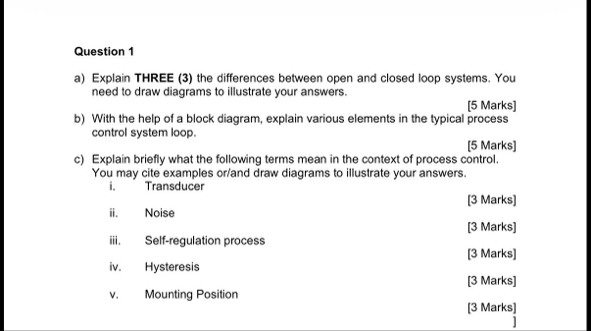 Question 1
2) Explain THREE (3) the differences between open and closed oop systems. You
need to draw diagrams to ilstrate your answers.
5 Marks]
b) With the help of a block diagram, explain various elements in the typical process.
control system loop.
(5 Marks)
©) Explain briefly what the following terms mean in the context of process control,
‘You may cite examples orland draw diagrams to llusirate your answers.
i Transducer
[3 Marks)
ii. Noise
[3 Marks]
iil. Seltregulation process.
[8 Marks)
Ww. Hysteresis
[3 Marks]
Vv. Mounting Position
[3 Marks]
1
This is AI generated Response.
Asked by: Alok Kumar
Created at: 2026-01-21 00:26:19
Asked by: Alok Kumar
Created at: 2026-01-21 00:26:19
Final Answer:
Rendered
Raw Text
Did you like this answer?
# Question 1 - Step-by-Step Solution
---
## a) Three Differences Between Open and Closed Loop Systems
### **1. Feedback Mechanism**
- **Open Loop:** No feedback from output to input. System acts on input only.
- **Closed Loop:** Feedback exists; system adjusts based on output.
**Diagrams:**
- **Open Loop:**
```
[Input] → [Process] → [Output]
```
- **Closed Loop:**
```
[Input] → [Process] → [Output]
↑ |
|_____________|
Feedback
```
### **2. Accuracy**
- **Open Loop:** Less accurate, as errors aren't corrected automatically.
- **Closed Loop:** More accurate, as feedback allows error correction.
### **3. Complexity and Cost**
- **Open Loop:** Simple design, cheaper to build and maintain.
- **Closed Loop:** More complex and expensive due to additional components for feedback.
---
## b) Block Diagram & Elements in a Typical Process Control System Loop
### **Block Diagram:**
```
[Set Point] → [Controller] → [Actuator/Final Control Element] → [Process] → [Sensor/Transducer] → [Feedback] → [Controller]
```
### **Explanation of Elements:**
- **Set Point:** Desired value of the process variable.
- **Controller:** Compares set point with feedback and generates control signal.
- **Actuator/Final Control Element:** Converts control signal into physical action.
- **Process:** The plant or system being controlled (e.g., temperature, pressure).
- **Sensor/Transducer:** Measures process variable and sends signal back.
- **Feedback:** Path for returning measured value to controller.
---
## c) Explanation of Terms in Process Control
### i. **Transducer**
- A device that converts one form of energy into another (e.g., temperature sensor converts heat to electrical signal).
- **Diagram Example:**
```
[Physical Quantity] → [Transducer] → [Electrical Signal]
```
### ii. **Noise**
- Unwanted disturbances superimposed on a useful signal, causing errors in process control.
- **Example:** Electrical interference affecting sensor readings.
### iii. **Self-Regulation Process**
- A process that naturally settles at a stable value after a disturbance, without external intervention.
- **Example:** Water tank level stabilizing due to overflow outlet.
### iv. **Hysteresis**
- Difference in output when input is increasing versus decreasing, even if input values are the same.
- **Example:** Thermostat turns heater on at 18°C and off at 22°C; doesn’t switch instantly.
### v. **Mounting Position**
- The location and orientation of a sensor or device, affecting its performance and accuracy.
- **Example:** Pressure sensor must be mounted vertically for correct readings.
---
## **Final Structured Answers**
**a) Differences:**
1. Feedback (open: none, closed: present)
2. Accuracy (open: less, closed: more)
3. Complexity/cost (open: simple/cheap, closed: complex/expensive)
**b) Block diagram elements:**
- Set Point
- Controller
- Actuator/Final Control Element
- Process
- Sensor/Transducer
- Feedback
**c) Terms:**
- **Transducer:** Converts physical signal to electrical.
- **Noise:** Unwanted signal disturbance.
- **Self-regulation:** Process naturally stabilizes.
- **Hysteresis:** Output difference for same input depending on direction.
- **Mounting Position:** Sensor/device placement affecting accuracy.
📢 Instructions:
- Ask anything relatd to above question only.
- For new Question goto :