 VIPSolutions
Give step-by-step solution with explanation and final answer:2) (30 pts) When the Reynolds number |s high enough, the power ges on air density o, wind speed V, rotor radius R and rotor angul i speed parameters non-dimensionalize this relation, Suppose that wi wo generated by a wrbine with a rotor radius of 50 m at a wind speed of conditions. This tutbine would operate at 0.4 rad/s, We plan to ge experimental measurements and we do not want to perform the pe m/s. What is the minimum rotor radius of the model If the angular exceed 50 rad/s. For that model is the power measured P wi full-scale turbine be. Note: Experiment is also done at sta
Question:
Give step-by-step solution with explanation and final answer: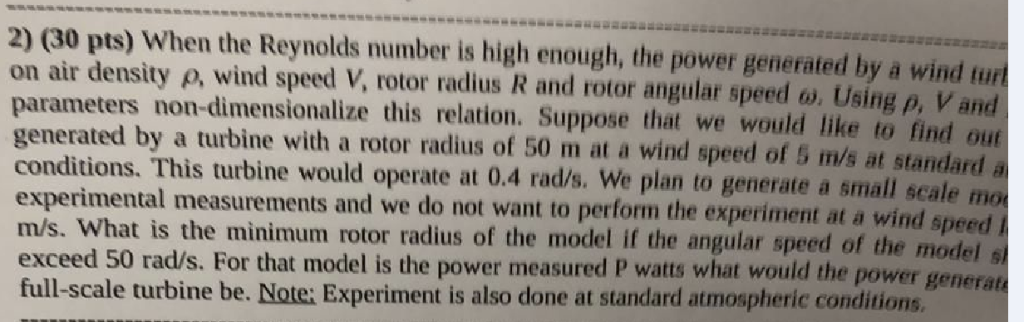 2) (30 pts) When the Reynolds number |s high enough, the power ges
on air density o, wind speed V, rotor radius R and rotor angul i speed
parameters non-dimensionalize this relation, Suppose that wi wo
generated by a wrbine with a rotor radius of 50 m at a wind speed of
conditions. This tutbine would operate at 0.4 rad/s, We plan to ge
experimental measurements and we do not want to perform the pe
m/s. What is the minimum rotor radius of the model If the angular
exceed 50 rad/s. For that model is the power measured P wi
full-scale turbine be. Note: Experiment is also done at sta
This is AI generated Response.
Asked by: Alok Kumar
Created at: 2026-01-21 00:22:55
Asked by: Alok Kumar
Created at: 2026-01-21 00:22:55
Final Answer:
Rendered
Raw Text
Did you like this answer?
Let's break down and solve the problem step by step:
---
## **Problem Restatement**
We have:
- **Parameters:** air density (\(\rho\)), wind speed (\(V\)), rotor radius (\(R\)), rotor angular speed (\(\omega\)).
- **Prototype (Full Scale):** \(R_p = 50~\text{m}\), \(V_p = 5~\text{m/s}\), \(\omega_p = .4~\text{rad/s}\).
- **Model:** We want to use a smaller rotor, but the model's angular speed \(\omega_m\) **must not exceed 50 rad/s**. What is the **minimum rotor radius \(R_m\) for the model**?
- **Non-dimensionalize the power relation.**
- **If the model generates \(P\) watts, what is the power of the prototype?**
---
## **Step 1: Non-dimensionalize the Power Relation**
The **power generated** by a wind turbine is generally
\[
P = f(\rho, V, R, \omega)
\]
We use **Buckingham π theorem**:
**Dimensions:**
- \([\rho] = M L^{-3}\)
- \([V] = L T^{-1}\)
- \([R] = L\)
- \([\omega] = T^{-1}\)
- \([P] = M L^2 T^{-3}\)
We want to express \(P\) in non-dimensional form.
Let’s construct dimensionless groups:
Let’s guess a group: \(\frac{P}{\rho R^2 V^3}\)
Check:
- \([\rho R^2 V^3] = (M L^{-3})(L^2)(L^3 T^{-3}) = M L^2 T^{-3}\)
- Same as [P].
So,
\[
\pi_1 = \frac{P}{\rho R^2 V^3}
\]
The other relevant dimensionless group is the **tip speed ratio**:
\[
\lambda = \frac{\omega R}{V}
\]
So, the non-dimensionalized relation is:
\[
\frac{P}{\rho R^2 V^3} = F\left(\frac{\omega R}{V}\right)
\]
---
## **Step 2: Model-Prototype Similarity (Matching \(\lambda\))**
For **dynamic similarity**, the **tip speed ratio** must be the same for both model and prototype:
\[
\lambda_p = \lambda_m \implies \frac{\omega_p R_p}{V_p} = \frac{\omega_m R_m}{V_m}
\]
**Given:**
- \(R_p = 50~\text{m}\)
- \(V_p = 5~\text{m/s}\)
- \(\omega_p = .4~\text{rad/s}\)
- \(V_m = 5~\text{m/s}\) (since “we do not want to perform the experiment at a wind speed other than 5 m/s”)
**Unknown:** \(R_m\) (minimum, \(\omega_m \leq 50~\text{rad/s}\))
---
## **Step 3: Find Minimum Model Rotor Radius**
From similarity,
\[
\frac{\omega_m R_m}{V_m} = \frac{\omega_p R_p}{V_p}
\]
Plug in known values:
\[
\frac{\omega_m R_m}{5} = \frac{.4 \times 50}{5} = 4
\]
\[
\omega_m R_m = 20
\]
But \(\omega_m \leq 50\):
\[
R_m = \frac{20}{\omega_m}
\]
to **minimize \(R_m\)**, use **maximum allowable \(\omega_m = 50\) rad/s**:
\[
R_m = \frac{20}{50} = .4~\text{m}
\]
---
## **Step 4: Scaling the Power**
From the non-dimensional relation:
\[
\frac{P_p}{\rho R_p^2 V_p^3} = \frac{P_m}{\rho R_m^2 V_m^3}
\]
\[
P_p = P_m \cdot \frac{R_p^2 V_p^3}{R_m^2 V_m^3}
\]
---
## **Step 5: Final Answers**
### **A. Minimum Rotor Radius for the Model**
\[
\boxed{R_m = .4~\text{m}}
\]
---
### **B. Power Scaling**
If model produces \(P_m = P\) watts, then the full-scale turbine would produce:
\[
P_p = P \cdot \frac{R_p^2 V_p^3}{R_m^2 V_m^3}
\]
Plug in values:
- \(R_p = 50~\text{m}\)
- \(V_p = 5~\text{m/s}\)
- \(R_m = .4~\text{m}\)
- \(V_m = 5~\text{m/s}\)
\[
P_p = P \cdot \frac{(50)^2 \cdot (5)^3}{(.4)^2 \cdot (5)^3}
\]
\[
P_p = P \cdot \frac{250}{.16}
\]
\[
P_p = P \cdot 15625
\]
---
## **Summary Table**
| Quantity | Value/Expression |
|----------|------------------|
| Minimum \(R_m\) | \(.4~\text{m}\) |
| Power scaling | \(P_p = 15625 \times P\) |
---
## **Final Answers**
### **1. Minimum rotor radius of the model:**
\[
\boxed{.4~\text{m}}
\]
### **2. Power scaling:**
If the model generates \(P\) watts, the full-scale turbine generates:
\[
\boxed{P_p = 15{,}625~P}
\]
Let me know if you need further explanation on any step!
📢 Instructions:
- Ask anything relatd to above question only.
- For new Question goto :