 VIPSolutions
Give step-by-step solution with explanation and final answer:Part (a) (i) Identify the potential functional groups of Morphine (Structure |, below). (ii) Propose and draw the analogues you would synthesise to complete a structure-activity relationship study with Morphine. (iii) State which binding interactions each analogue would be used to investigate, and how the analogue you have proposed would change the activity of the drug. Use schematics to support your answer. HO ) [o) “, i W& “I ~ \~CH \ 3 HOY Structure |
Question:
Give step-by-step solution with explanation and final answer: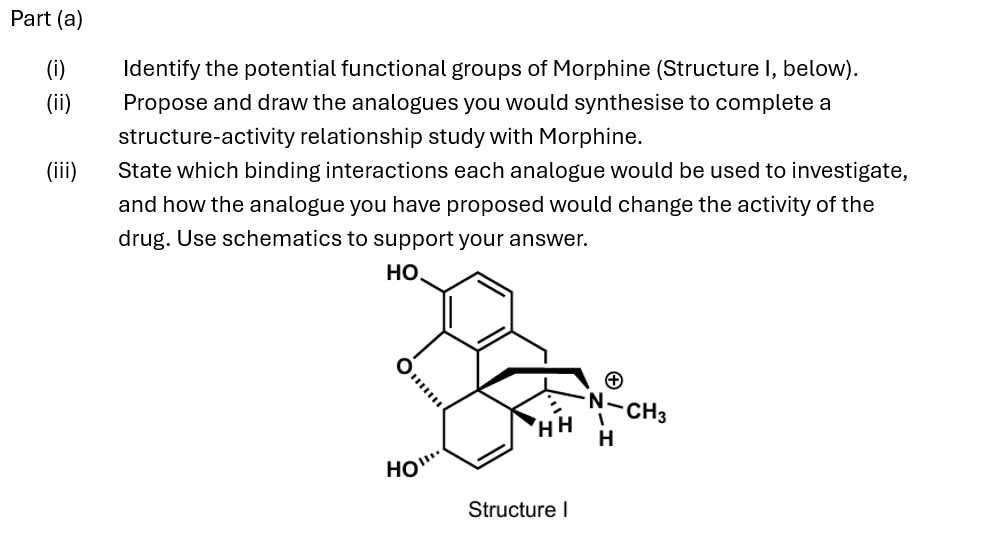 Part (a)
(i) Identify the potential functional groups of Morphine (Structure |, below).
(ii) Propose and draw the analogues you would synthesise to complete a
structure-activity relationship study with Morphine.
(iii) State which binding interactions each analogue would be used to investigate,
and how the analogue you have proposed would change the activity of the
drug. Use schematics to support your answer.
HO )
[o)
“, i W&
“I ~ \~CH
\ 3
HOY
Structure |
This is AI generated Response.
Asked by: naveen kumae
Created at: 2026-01-20 21:25:39
Asked by: naveen kumae
Created at: 2026-01-20 21:25:39
Final Answer:
Rendered
Raw Text
Did you like this answer?
# Step-by-Step Solution
## (i) Identify the potential functional groups of Morphine (Structure I)
Examine the structure and list the functional groups present:
1. **Phenol** – The benzene ring with an -OH group at the top left (aromatic alcohol).
2. **Alcohol** – The secondary alcohol at the bottom left (-OH attached to a saturated carbon).
3. **Ether** – The oxygen atom forming a bridge between two carbons (bottom right of the ring system).
4. **Tertiary Amine** – The nitrogen atom (N) bonded to three carbons (one being a methyl group).
5. **Alkene** – The double bond in the lower right ring.
6. **Aromatic ring** – The benzene ring system.
**Summary Table:**
| Functional Group | Location in Structure |
|------------------|----------------------|
| Phenol | Top left (-OH on aromatic ring) |
| Alcohol | Bottom left (-OH on saturated carbon) |
| Ether | Bridging oxygen in ring system |
| Tertiary Amine | Nitrogen with methyl group |
| Alkene | Double bond in lower right |
| Aromatic ring | Benzene ring system |
---
## (ii) Propose and draw analogues for structure-activity relationship (SAR) study
**Analogue 1: O-Methylmorphine (Codeine)**
- Methylate the phenol group (replace top-left -OH with -OCH₃).
- **Purpose:** Investigate the importance of the phenolic hydroxyl group for activity.
**Analogue 2: N-Dealkylmorphine (Normorphine)**
- Remove the N-methyl group (replace -N-CH₃ with -NH).
- **Purpose:** Test the effect of the N-methyl group on receptor binding.
**Analogue 3: 6-Deoxymorphine**
- Remove the secondary alcohol at position 6 (bottom left).
- **Purpose:** Determine the role of the 6-hydroxy group.
**Analogue 4: Ether Cleavage**
- Replace the bridging oxygen with a methylene group (-CH₂-).
- **Purpose:** Examine the importance of the ether bridge.
**Schematics:**
### Analogue 1: O-Methylmorphine (Codeine)
```
HO
|
≡OCH₃ (instead of HO, at top left)
```
### Analogue 2: N-Dealkylmorphine
```
N-H (instead of N-CH₃)
```
### Analogue 3: 6-Deoxymorphine
```
(No OH at position 6, bottom left)
```
### Analogue 4: Bridge Oxygen Removed
```
-CH₂- (instead of O in ether bridge)
```
---
## (iii) Binding interactions and effects
For each analogue, we investigate specific binding interactions:
### **Analogue 1 (O-Methylmorphine / Codeine)**
- **Binding Interaction:** Hydrogen bonding at the phenolic -OH.
- **Effect:** Methylation blocks hydrogen bonding; decreased activity (less receptor interaction).
- **Schematic:**

*Phenolic OH (red) forms H-bond with receptor; methylation blocks this.*
### **Analogue 2 (N-Dealkylmorphine)**
- **Binding Interaction:** Ionic or hydrogen bonding at the amine nitrogen.
- **Effect:** Removing the methyl group may reduce lipophilicity and alter binding affinity.
- **Schematic:**

*N-methyl group (blue) interacts with receptor site; absence may weaken interaction.*
### **Analogue 3 (6-Deoxymorphine)**
- **Binding Interaction:** Hydrogen bonding at the 6-hydroxyl group.
- **Effect:** Removing the 6-OH disrupts possible H-bonding, potentially reducing activity.
### **Analogue 4 (Ether Bridge Cleaved)**
- **Binding Interaction:** Ether oxygen may participate in polar interactions or maintain the rigid structure.
- **Effect:** Replacing with -CH₂- may disrupt correct positioning for receptor binding, reducing activity.
---
## **Summary Table**
| Analogue | Group Modified | Interaction Probed | Expected Effect on Activity |
|-------------------------|-------------------|-------------------|---------------------------------------|
| O-Methylmorphine | Phenolic OH | H-bond donor | Decreased (blocks H-bond) |
| N-Dealkylmorphine | N-Methyl | Ionic/H-bond | Variable (can reduce or alter) |
| 6-Deoxymorphine | 6-OH | H-bond donor | Decreased (loss of H-bond) |
| Ether Cleaved | Ether bridge | Structural/polar | Decreased (alignment disrupted) |
---
## Final Answer
### (i) **Functional groups:** Phenol, secondary alcohol, ether, tertiary amine, alkene, aromatic ring.
### (ii) **Analogues proposed:**
- O-methylmorphine (Codeine), N-dealkylmorphine, 6-deoxymorphine, ether-cleaved derivative.
### (iii) **Binding interactions:**
- Each analogue allows investigation of the role of specific groups in receptor binding and activity.
- Modifications reduce or alter activity, highlighting the importance of each functional group.
**Schematics and concise tables were provided above to support the answer.**
📢 Instructions:
- Ask anything relatd to above question only.
- For new Question goto :