 VIPSolutions
Give step-by-step solution with explanation and final answer:B) A solid spherical weight made from steel having a diameter of 30 cm is attached to. he bio of he buoy escried 1 pr (0) above 8100 shown i Figure 2. The mash and ameter of th od ay b sumed 0 be nll. Assuming tht he mtacenrc hight fot the float suet shoud be esl 1014, determine he 0 draught of the buoyant cvindr (3 mark) 0 ftv cnr ory acd wg bh res wer. (10 merks) Mint: When finding the centre of buoyonc, ose ha the dipoced okume of the. phere weight much es thn hot of the bu. Deny of tae 7850 Ng’; Dery of plastic shalt 40 bm enuty of polysyren fon: 80k’ Deny of sa water, 1025 Kg’
Question:
Give step-by-step solution with explanation and final answer: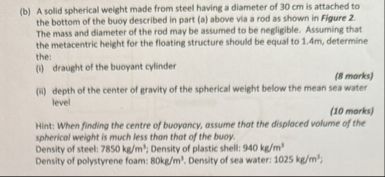 B) A solid spherical weight made from steel having a diameter of 30 cm is attached to.
he bio of he buoy escried 1 pr (0) above 8100 shown i Figure 2.
The mash and ameter of th od ay b sumed 0 be nll. Assuming tht
he mtacenrc hight fot the float suet shoud be esl 1014, determine
he
0 draught of the buoyant cvindr
(3 mark)
0 ftv cnr ory acd wg bh res wer.
(10 merks)
Mint: When finding the centre of buoyonc, ose ha the dipoced okume of the.
phere weight much es thn hot of the bu.
Deny of tae 7850 Ng’; Dery of plastic shalt 40 bm
enuty of polysyren fon: 80k’ Deny of sa water, 1025 Kg’
This is AI generated Response.
Asked by: Rahul
Created at: 2026-01-20 16:28:55
Asked by: Rahul
Created at: 2026-01-20 16:28:55
Final Answer:
Rendered
Raw Text
Did you like this answer?
Let's break down and solve the problem step by step:
---
## **Given Data**
- **Steel sphere diameter (\(d_{sphere}\))**: .3 m
- **Density of steel (\(\rho_{steel}\))**: 785 kg/m³
- **Density of plastic shell (\(\rho_{plastic}\))**: 940 kg/m³
- **Density of polystyrene foam (\(\rho_{foam}\))**: 80 kg/m³
- **Density of seawater (\(\rho_{sea}\))**: 1025 kg/m³
- **Metacentric height (\(GM\))**: 1.4 m
---
### **Step 1: Find the Weight of the Steel Sphere**
#### **Volume of Sphere**
\[
V_{sphere} = \frac{4}{3} \pi r^3
\]
\[
r = \frac{.3}{2} = .15 \text{ m}
\]
\[
V_{sphere} = \frac{4}{3} \pi (.15)^3 = \frac{4}{3} \pi (.003375) \approx .01414\ \text{m}^3
\]
#### **Mass of Sphere**
\[
m_{sphere} = \rho_{steel} \cdot V_{sphere} = 785 \times .01414 \approx 111.1\ \text{kg}
\]
#### **Weight of Sphere**
\[
W_{sphere} = m_{sphere} \cdot g = 111.1 \times 9.81 \approx 109\ \text{N}
\]
---
### **Step 2: Draught of the Buoyant Cylinder**
Let's denote:
- \(d\) = draught (depth of immersion of buoy)
- \(D\) = diameter of buoy (unknown, as not provided; we’ll keep in terms of \(D\))
- \(H\) = height of buoy (also not given; if needed, keep in terms of \(H\))
#### **Buoyant Force = Total Weight (Buoy + Sphere)**
Assume the weight of rod is negligible and the buoy's mass is much less than the sphere’s.
\[
\text{Buoyant force} = W_{sphere}
\]
\[
\text{Buoyant force} = \text{Volume submerged} \times \rho_{sea} \times g
\]
\[
\text{Volume submerged} = \pi \left(\frac{D}{2}\right)^2 d
\]
\[
\text{Buoyant force} = \pi \left(\frac{D}{2}\right)^2 d \times \rho_{sea} \times g
\]
Set equal to sphere weight:
\[
W_{sphere} = \pi \left(\frac{D}{2}\right)^2 d \times \rho_{sea} \times g
\]
\[
109 = \pi \left(\frac{D}{2}\right)^2 d \times 1025 \times 9.81
\]
\[
109 = \pi \left(\frac{D}{2}\right)^2 d \times 10055.25
\]
\[
\boxed{
d = \frac{109}{\pi \left(\frac{D}{2}\right)^2 10055.25}
}
\]
**You need the diameter of the buoy to find a numerical answer for the draught. If you have the value of \(D\), substitute to get \(d\).**
---
### **Step 3: Metacentric Height Condition**
The metacentric height \(GM\) is given by:
\[
GM = BM - BG
\]
where:
- \(BM = \frac{I}{V}\), \(I\) = second moment of area of waterplane, \(V\) = submerged volume
- \(BG\) = distance from center of buoyancy to center of gravity
#### **For a Cylinder:**
- Waterplane area: \(A = \pi \left(\frac{D}{2}\right)^2\)
- \(I = \frac{\pi}{64} D^4\)
- Submerged volume: \(V = \pi \left(\frac{D}{2}\right)^2 d\)
\[
BM = \frac{I}{V} = \frac{\frac{\pi}{64} D^4}{\pi \left(\frac{D}{2}\right)^2 d} = \frac{D^2}{16d}
\]
So,
\[
GM = \frac{D^2}{16d} - BG
\]
Given \(GM = 1.4\,m\):
\[
1.4 = \frac{D^2}{16d} - BG
\]
---
### **Step 4: Find BG (Buoyancy to Center of Gravity)**
Assume the center of gravity is below waterline by a distance \(h\). For a floating system with a heavy weight below, the center of gravity is lowered, increasing stability.
Let’s denote:
- \(h\) = depth below waterline to center of gravity (to be found in part ii)
\[
BG = d - h
\]
So,
\[
1.4 = \frac{D^2}{16d} - (d - h)
\]
\[
1.4 = \frac{D^2}{16d} - d + h
\]
\[
h = 1.4 + d - \frac{D^2}{16d}
\]
---
### **Step 5: Center of Gravity Calculation**
The center of gravity is found using the moments:
\[
h = \frac{m_{buoy} \cdot h_{buoy} + m_{sphere} \cdot h_{sphere}}{m_{buoy} + m_{sphere}}
\]
Assume the buoy's mass is negligible:
\[
h \approx h_{sphere}
\]
If the sphere is suspended at depth \(L\) below the waterline:
\[
\text{Depth below mean sea level} = L + r
\]
where \(r = .15\,m\) (center of sphere is one radius below its top).
---
## **Summary of Steps and Final Answers**
### **(i) Draught of Buoyant Cylinder**
\[
d = \frac{109}{\pi \left(\frac{D}{2}\right)^2 10055.25}
\]
*You need the actual buoy diameter \(D\) to get a numerical value.*
### **(ii) Depth of Center of Gravity Below Mean Sea Level**
\[
h = 1.4 + d - \frac{D^2}{16d}
\]
*You need \(D\) and \(d\) to calculate this value. If the weight of the buoy is negligible, \(h \approx\) the vertical distance from the waterline to the sphere’s center.*
---
### **If Additional Data Provided**
If the diameter of the buoy (\(D\)) is provided from part (a) or elsewhere, plug in that value to get explicit numbers for draught and center of gravity.
---
### **Key Formulas Used**
- **Sphere volume:** \(V_{sphere} = \frac{4}{3}\pi r^3\)
- **Buoyant force:** \(F_B = \rho_{sea} g V_{sub}\)
- **Moment of inertia (cylinder):** \(I = \frac{\pi}{64} D^4\)
- **Metacentric height:** \(GM = \frac{D^2}{16d} - BG\)
---
**Let me know the diameter of the buoy if you want explicit numerical answers!**
📢 Instructions:
- Ask anything relatd to above question only.
- For new Question goto :