Give step-by-step solution with explanation and final answer:
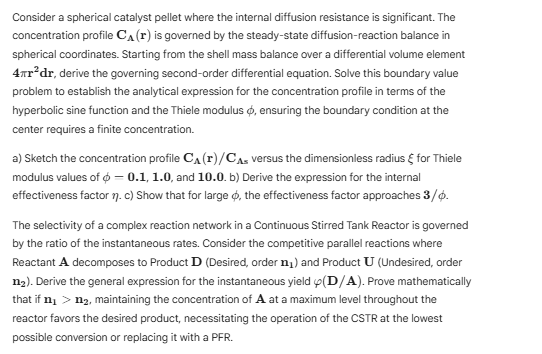
{give me the answer using without bullet-points}Consider a spherical catalyst pellet where the internal diffusion resistance is significant. The
concentration profile Ci (r) is governed by the steady-state diffusion-reaction balance in
spherical coordinates. Starting from the shell mass balance over a differential volume element
4rd, derive the governing second-order differential equation. Save this boundary value:
problem to estabish the analytical expression for the concentration profile in terms of the
hyperbolic sine function and the Thiele modulus ¢, ensuring the boundary condition a the
center requires a finite concentration.
2) Sketch the concentration profile Ci (r) / Cx versus the dimensionless radius € for Thiele
modus values of ¢ — 0.1, 1.0, and 10.0. b) Derive the expression fo the internal
effectiveness factor 7.) Show that for large , the effectiveness factor approaches 3/6.
The selectiity of a complex reaction network in a Continuous Stired Tank Reactor is governed
by the ratio of the instantaneous rates. Consider the competitive parale reactions where
Reactant A decomposes to Product D (Desired, order my) and Product U (Undesred, order
12). Derive the general expression for the instantaneous yield (D/A). Prove mathematically
that fm, > ma, maintaining the concentration of A at a maximum evel throughout the
reactor favors the desired product, necessitating the operation of the CSTR a the lowest
possible conversion or replacing t with a PFR.
Question:
Give step-by-step solution with explanation and final answer:
{give me the answer using without bullet-points}Consider a spherical catalyst pellet where the internal diffusion resistance is significant. The
concentration profile Ci (r) is governed by the steady-state diffusion-reaction balance in
spherical coordinates. Starting from the shell mass balance over a differential volume element
4rd, derive the governing second-order differential equation. Save this boundary value:
problem to estabish the analytical expression for the concentration profile in terms of the
hyperbolic sine function and the Thiele modulus ¢, ensuring the boundary condition a the
center requires a finite concentration.
2) Sketch the concentration profile Ci (r) / Cx versus the dimensionless radius € for Thiele
modus values of ¢ — 0.1, 1.0, and 10.0. b) Derive the expression fo the internal
effectiveness factor 7.) Show that for large , the effectiveness factor approaches 3/6.
The selectiity of a complex reaction network in a Continuous Stired Tank Reactor is governed
by the ratio of the instantaneous rates. Consider the competitive parale reactions where
Reactant A decomposes to Product D (Desired, order my) and Product U (Undesred, order
12). Derive the general expression for the instantaneous yield (D/A). Prove mathematically
that fm, > ma, maintaining the concentration of A at a maximum evel throughout the
reactor favors the desired product, necessitating the operation of the CSTR a the lowest
possible conversion or replacing t with a PFR.
This is AI generated Response.
Asked by: Francis
Created at: 2026-01-20 15:04:06
Final Answer:
RenderedRaw Text
Did you like this answer?
Let's solve each part step by step as requested.
---
## 1. **Governing Differential Equation (Spherical Geometry)**
The steady-state mol balance over a spherical shell of thickness \( dr \) gives:
\[
\text{Net rate of diffusion in} + \textRate of generation by reaction} =
\]
For species A:
- Diffusion flux (Fick's law): \( -D_e \frac{dC_A}{dr} \)
- Surface area at radius \( r \): \( 4\pi r^2 \)
- Rate of reaction per unit volume: \( -k C_A \)
So, net diffusive flux at \( r \) and \( r+dr \):
\[
4\pi r^2 \left(-D_e \frac{dC_A}{dr} \right)_{r} - 4\pi (r+dr)^2 \left(-D_e \frac{dC_A}{dr} \right)_{r+dr} + (4\pi r^2 dr) (-k C_A) =
\]
Divide by \( 4\pi dr \) and take the limit \( dr \to \):
\[
\frac{1}{r^2} \frac{d}{dr}\left( r^2 \frac{dC_A}{dr} \right) - \frac{k}{D_e} C_A =
\]
---
## 2. **Non-dimensionalizing & Thiele Modulus**
Let \( R \) = pellet radius, \( C_{As} \) = surface concentration, \( \xi = \frac{r}{R} \), \( \phi^2 = \frac{kR^2}{D_e} \).
Set \( C_A^* = \frac{C_A}{C_{As}} \):
\[
\frac{1}{\xi^2} \frac{d}{d\xi} \left( \xi^2 \frac{dC_A^*}{d\xi} \right) - \phi^2 C_A^* =
\]
---
## 3. **General Solution**
This is a standard second-order ODE for spherical geometry with constant reaction:
\[
\frac{1}{\xi^2} \frac{d}{d\xi} \left( \xi^2 \frac{dC_A^*}{d\xi} \right) - \phi^2 C_A^* =
\]
The solution (finite at \( \xi = \)) is:
\[
C_A^*(\xi) = \frac{\sinh(\phi \xi)}{\xi \sinh\phi}
\]
Boundary conditions:
- At \( \xi = 1 \): \( C_A^* = 1 \)
- At \( \xi = \): finite concentration (as \( \frac{\sinh(\phi \xi)}{\xi} \to \phi \) as \( \xi \to \))
---
## 4. **a) Sketch the Concentration Profile**
For \( \phi = .1, 1., 10. \):
- **Small \( \phi \):** Profile is nearly flat (diffusion fast vs. reaction).
- **Large \( \phi \):** Steep drop near the surface (diffusion limited).
You would sketch \( C_A^* \) vs. \( \xi \), showing the above behavior.
---
## 5. **b) Internal Effectiveness Factor \( \eta \)**
Defined as the ratio of actual reaction rate to rate if entire pellet were at surface concentration:
\[
\eta = \frac{\text{Actual rate}}{\text{Rate at } C_{As}}
\]
The actual rate (integrated over the volume):
\[
\text{Actual rate} = \int_^R 4\pi r^2 k C_A(r) dr
\]
Rate at surface concentration:
\[
\text{Rate at } C_{As} = \int_^R 4\pi r^2 k C_{As} dr = k C_{As} \frac{4}{3}\pi R^3
\]
So,
\[
\eta = \frac{3}{R^3} \int_^R r^2 \frac{C_A(r)}{C_{As}} dr
\]
Substitute \( \xi = \frac{r}{R} \):
\[
\eta = 3 \int_^1 \xi^2 C_A^*(\xi) d\xi
\]
Plugging in the solution:
\[
\eta = 3 \int_^1 \xi^2 \frac{\sinh(\phi \xi)}{\xi \sinh\phi} d\xi
= \frac{3}{\phi^2} \left[ \phi \coth\phi - 1 \right]
\]
---
## 6. **c) Large \( \phi \) Limit**
For large \( \phi \), \( \coth\phi \to 1 \), so:
\[
\eta \approx \frac{3}{\phi^2} [\phi - 1] \approx \frac{3}{\phi}
\]
Thus, for large \( \phi \), \( \eta \to \frac{3}{\phi} \).
---
## 7. **CSTR Competitive Reactions Yield**
Consider \( A \rightarrow D \) (desired, order \( n_1 \)), \( A \rightarrow U \) (undesired, order \( n_2 \)).
The yield is:
\[
Y = \frac{\text{rate of D formation}}{\text{rate of A consumption}} = \frac{k_1 C_A^{n_1}}{k_1 C_A^{n_1} + k_2 C_A^{n_2}}
\]
To maximize \( Y \), if \( n_1 > n_2 \), you want to maximize \( C_A \), i.e., operate at low conversion (CSTR) or use a PFR.
If \( n_1 > n_2 \), mathematically:
\[
\frac{\partial Y}{\partial C_A} >
\]
So higher \( C_A \) gives higher yield of D.
---
## **Summary of Final Answers**
1. **Differential equation:**
\[
\frac{1}{r^2} \frac{d}{dr}\left(r^2 \frac{dC_A}{dr}\right) - \frac{k}{D_e} C_A =
\]
2. **Dimensionless solution:**
\[
C_A^*(\xi) = \frac{\sinh(\phi \xi)}{\xi \sinh\phi}
\]
3. **Effectiveness factor:**
\[
\eta = \frac{3}{\phi^2} (\phi \coth\phi - 1)
\]
4. **Large \( \phi \) limit:**
\[
\eta \approx \frac{3}{\phi}
\]
5. **Instantaneous yield for competitive reactions:**
\[
Y = \frac{k_1 C_A^{n_1}}{k_1 C_A^{n_1} + k_2 C_A^{n_2}}
\]
6. **For \( n_1 > n_2 \)**, a CSTR at low conversion or a PFR is favored to maximize the desired product yield.
Let me know if you need any specific plot or further explanation for any step.
VIPSolutions focuses on clear, step‑by‑step explanations so you can learn quickly. Whether you need an AI‑generated walkthrough or a short hint to get unstuck, each solution is organized for fast reading and easy review later.
Search similar questions, compare approaches, and bookmark the best answers for revision. Our goal is simple: quick, reliable study help that feels natural—not noisy.
 VIPSolutions
 Consider a spherical catalyst pellet where the internal diffusion resistance is significant. The
concentration profile Ci (r) is governed by the steady-state diffusion-reaction balance in
spherical coordinates. Starting from the shell mass balance over a differential volume element
4rd, derive the governing second-order differential equation. Save this boundary value:
problem to estabish the analytical expression for the concentration profile in terms of the
hyperbolic sine function and the Thiele modulus ¢, ensuring the boundary condition a the
center requires a finite concentration.
2) Sketch the concentration profile Ci (r) / Cx versus the dimensionless radius € for Thiele
modus values of ¢ — 0.1, 1.0, and 10.0. b) Derive the expression fo the internal
effectiveness factor 7.) Show that for large , the effectiveness factor approaches 3/6.
The selectiity of a complex reaction network in a Continuous Stired Tank Reactor is governed
by the ratio of the instantaneous rates. Consider the competitive parale reactions where
Reactant A decomposes to Product D (Desired, order my) and Product U (Undesred, order
12). Derive the general expression for the instantaneous yield (D/A). Prove mathematically
that fm, > ma, maintaining the concentration of A at a maximum evel throughout the
reactor favors the desired product, necessitating the operation of the CSTR a the lowest
possible conversion or replacing t with a PFR.