Give step-by-step solution with explanation and final answer:
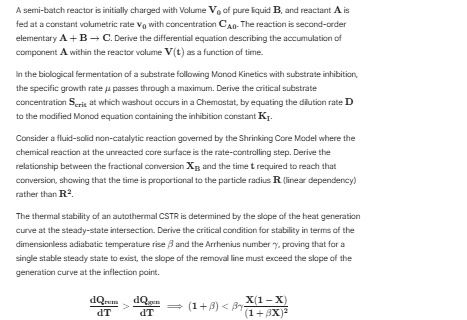
{ give me answer without using bullet-points}A semi-botch reactor nally charged with Volume Vi of pure quid B, and reactant As
[ES STUN HES —
mrtry A+B — C. Dre the frets action dsc he scumibion of
compen A iti the reais kar (8) 5 ction re.
helo rms of sts elon orc Kes wilh ste hn
speci gro rt posses sh msi Dore he crcl tte
ConcainionS. whichwmbout ccc is Chimes, by ein hs dito te D
1th maid Mond sqm coisin th tion cron Ky
(Cont kscl on-tyric escion gover by the Sinking Cox Moe wher the
ett ota th ociorl crn Xo nd their cps 0 rch hat
[ES YA —
ater han BE,
he thers of an sth CSTR deere by th dpe of th est geri
imersies dobar arperse se) ad the har as 5, prov to
stale sty te 0 ct ope rn mit xcs the pe of he
imettion eve ithe foci pot.
Qn dQ oo XOX)
at Car. — HA
Question:
Give step-by-step solution with explanation and final answer:
{ give me answer without using bullet-points}A semi-botch reactor nally charged with Volume Vi of pure quid B, and reactant As
[ES STUN HES —
mrtry A+B — C. Dre the frets action dsc he scumibion of
compen A iti the reais kar (8) 5 ction re.
helo rms of sts elon orc Kes wilh ste hn
speci gro rt posses sh msi Dore he crcl tte
ConcainionS. whichwmbout ccc is Chimes, by ein hs dito te D
1th maid Mond sqm coisin th tion cron Ky
(Cont kscl on-tyric escion gover by the Sinking Cox Moe wher the
ett ota th ociorl crn Xo nd their cps 0 rch hat
[ES YA —
ater han BE,
he thers of an sth CSTR deere by th dpe of th est geri
imersies dobar arperse se) ad the har as 5, prov to
stale sty te 0 ct ope rn mit xcs the pe of he
imettion eve ithe foci pot.
Qn dQ oo XOX)
at Car. — HA
This is AI generated Response.
Asked by: singaluri krishna kumari
Created at: 2026-01-20 10:33:32
Final Answer:
RenderedRaw Text
Did you like this answer?
Let's go through each part step-by-step, explaining the concepts and deriving the equations as required.
---
### 1. Semi-batch Reactor: Second-order Reaction
**Given:**
- Initial Volume: \( V_ \) (pure liquid B)
- Reactant A is fed at rate \( v_ \), concentration \( C_{A} \)
- Second-order reaction: \( A + B \rightarrow C \)
- Volume at time \( t \): \( V(t) \)
**To Find:**
*The differential equation for the accumulation of A in the reactor.*
**Solution:**
Let \( N_A \) be the moles of A in the reactor at time \( t \):
\( N_A = C_A V \)
Material balance for A:
Rate in - Rate out ± Rate of generation = Accumulation
For a semi-batch reactor (no outflow):
\[
\frac{dN_A}{dt} = \text{in} - \text{consumed}
\]
Inflow of A:
\[
\text{in} = v_ C_{A}
\]
Consumption by reaction (second-order):
\[
\text{consumed} = k C_A C_B V
\]
But, as only A is being fed, the volume increases:
\[
V(t) = V_ + v_ t
\]
The concentration \( C_B \) can be written in terms of \( N_B \) and \( V \). Initially, only B is present, and it is consumed as A is consumed.
So,
\[
\frac{d(C_A V)}{dt} = v_ C_{A} - k C_A C_B V
\]
Expanding the derivative on the left:
\[
V \frac{dC_A}{dt} + C_A \frac{dV}{dt} = v_ C_{A} - k C_A C_B V
\]
Since \( \frac{dV}{dt} = v_ \):
\[
V \frac{dC_A}{dt} + C_A v_ = v_ C_{A} - k C_A C_B V
\]
\[
V \frac{dC_A}{dt} = v_ (C_{A} - C_A) - k C_A C_B V
\]
So, the final differential equation is:
\[
\boxed{V \frac{dC_A}{dt} = v_ (C_{A} - C_A) - k C_A C_B V}
\]
---
### 2. Monod Kinetics with Inhibition: Critical Substrate Concentration
**Given:**
- Monod Kinetics with inhibition
- Washout in a chemostat
- Dilution rate: \( D \)
- Inhibition constant: \( K_I \)
**To Find:**
*Critical substrate concentration at washout.*
**Solution:**
Monod with inhibition:
\[
\mu = \frac{\mu_{\max} S}{K_S + S + \frac{S^2}{K_I}}
\]
At washout, microbial growth rate = dilution rate:
\[
\mu = D
\]
So,
\[
D = \frac{\mu_{\max} S_{crit}}{K_S + S_{crit} + \frac{S_{crit}^2}{K_I}}
\]
This is the equation for the critical substrate concentration at washout in terms of \( D, \mu_{\max}, K_S, K_I \):
\[
\boxed{D = \frac{\mu_{\max} S_{crit}}{K_S + S_{crit} + \frac{S_{crit}^2}{K_I}}}
\]
---
### 3. Shrinking Core Model: Fractional Conversion
**Given:**
- Non-catalytic reaction, Shrinking Core Model
- Fractional conversion: \( X_B \)
- Proportional to particle radius \( R \)
**To Find:**
*Relationship between \( X_B \), time, and \( R \) (for reaction-controlled case).*
**Solution:**
For reaction-controlled case:
\[
1 - (1 - X_B)^{1/3} = k t
\]
Where \( k \) is a rate constant dependent on \( R \):
\[
k = \frac{k_s C_{A,\infty}}{\rho_B R}
\]
So, time required to reach conversion \( X_B \):
\[
t = \frac{1}{k} [1 - (1 - X_B)^{1/3}]
\]
Since \( k \propto \frac{1}{R} \):
\[
t \propto R [1 - (1 - X_B)^{1/3}]
\]
---
### 4. Autothermal CSTR Stability
**Given:**
- Slope of heat generation and removal curves
- Stability determined at steady-state intersection
**To Find:**
*Critical condition for stability.*
**Solution:**
Stability requires the slope of the removal line to be greater than the slope of the generation curve at the intersection.
Mathematically,
\[
\frac{dQ_{rem}}{dT} > \frac{dQ_{gen}}{dT}
\]
At the critical point (onset of instability):
\[
\frac{dQ_{rem}}{dT} = \frac{dQ_{gen}}{dT}
\]
Given the provided expression:
\[
\frac{dQ_{rem}}{dT} = (1 + \beta) > \beta \frac{X(1-X)}{(1+\beta X)^2}
\]
So, the critical condition is when:
\[
\frac{dQ_{rem}}{dT} = \frac{dQ_{gen}}{dT}
\]
---
### Summary
1. The differential equation for accumulation of A is:
\( V \frac{dC_A}{dt} = v_ (C_{A} - C_A) - k C_A C_B V \)
2. The critical substrate concentration at washout is given by:
\( D = \frac{\mu_{\max} S_{crit}}{K_S + S_{crit} + \frac{S_{crit}^2}{K_I}} \)
3. The time for a given conversion in the shrinking core model (reaction-controlled) is:
\( t = \frac{1}{k} [1 - (1 - X_B)^{1/3}] \) and \( t \propto R \)
4. The CSTR is stable if:
\( \frac{dQ_{rem}}{dT} > \frac{dQ_{gen}}{dT} \) at steady-state.
The critical point is when these slopes are equal.
VIPSolutions focuses on clear, step‑by‑step explanations so you can learn quickly. Whether you need an AI‑generated walkthrough or a short hint to get unstuck, each solution is organized for fast reading and easy review later.
Search similar questions, compare approaches, and bookmark the best answers for revision. Our goal is simple: quick, reliable study help that feels natural—not noisy.
 VIPSolutions
 A semi-botch reactor nally charged with Volume Vi of pure quid B, and reactant As
[ES STUN HES —
mrtry A+B — C. Dre the frets action dsc he scumibion of
compen A iti the reais kar (8) 5 ction re.
helo rms of sts elon orc Kes wilh ste hn
speci gro rt posses sh msi Dore he crcl tte
ConcainionS. whichwmbout ccc is Chimes, by ein hs dito te D
1th maid Mond sqm coisin th tion cron Ky
(Cont kscl on-tyric escion gover by the Sinking Cox Moe wher the
ett ota th ociorl crn Xo nd their cps 0 rch hat
[ES YA —
ater han BE,
he thers of an sth CSTR deere by th dpe of th est geri
imersies dobar arperse se) ad the har as 5, prov to
stale sty te 0 ct ope rn mit xcs the pe of he
imettion eve ithe foci pot.
Qn dQ oo XOX)
at Car. — HA