Give step-by-step solution with explanation and final answer:
give me the answer without bullet-points40B W25 Problem Set: Week 2
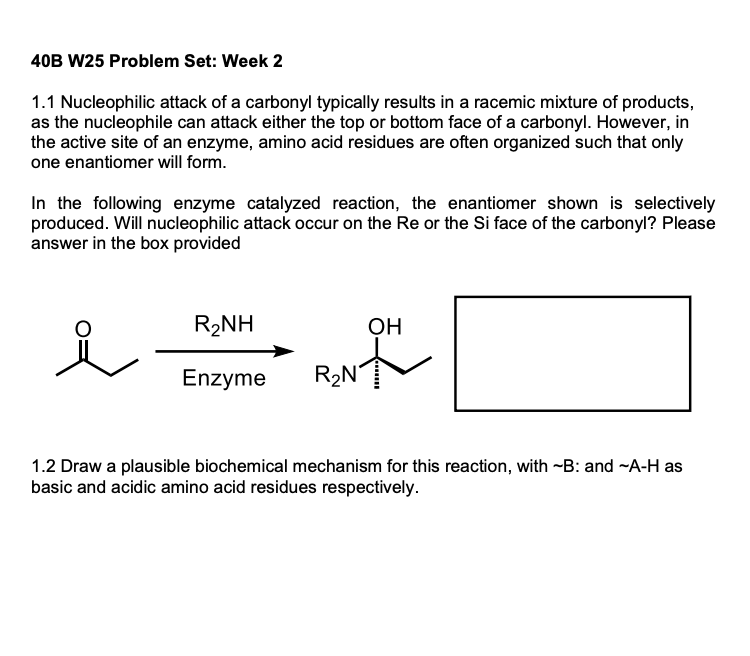
1.1 Nucleophilic attack of a carbonyl typically results in a racemic mixture of products,
as the nucleophile can attack either the top or bottom face of a carbonyl. However, in
the active site of an enzyme, amino acid residues are often organized such that only
one enantiomer will form.
In the following enzyme catalyzed reaction, the enantiomer shown is selectively
produced. Will nucleophilic attack occur on the Re or the Si face of the carbonyl? Please
answer in the box provided
Q RoNH OH
Mo A
Enzyme ~~ RoN"}
1.2 Draw a plausible biochemical mechanism for this reaction, with ~B: and ~A-H as
basic and acidic amino acid residues respectively.
Question:
Give step-by-step solution with explanation and final answer:
give me the answer without bullet-points40B W25 Problem Set: Week 2
1.1 Nucleophilic attack of a carbonyl typically results in a racemic mixture of products,
as the nucleophile can attack either the top or bottom face of a carbonyl. However, in
the active site of an enzyme, amino acid residues are often organized such that only
one enantiomer will form.
In the following enzyme catalyzed reaction, the enantiomer shown is selectively
produced. Will nucleophilic attack occur on the Re or the Si face of the carbonyl? Please
answer in the box provided
Q RoNH OH
Mo A
Enzyme ~~ RoN"}
1.2 Draw a plausible biochemical mechanism for this reaction, with ~B: and ~A-H as
basic and acidic amino acid residues respectively.
This is AI generated Response.
Asked by: Francis
Created at: 2026-01-20 09:48:37
Final Answer:
RenderedRaw Text
Did you like this answer?
### 1.1 Re/Si Face Selection
To determine if the nucleophile attacks the Re or Si face, first assign priorities to the groups attached to the carbonyl carbon following Cahn-Ingold-Prelog rules. The three groups are: the ethyl group, the methyl group, and the carbonyl oxygen. The highest priority is the carbonyl oxygen, then ethyl, then methyl. When you view the carbonyl carbon so that the priorities decrease clockwise, the face toward you is the Re face; counterclockwise is the Si face.
The product shows the new group (NR₂) attached as a wedge (coming out of the plane) and the hydroxyl group as a dash (going into the plane), which means the nucleophile attacked from the bottom face (Si face) of the carbonyl. Thus, **nucleophilic attack occurs on the Si face** of the carbonyl.
**Final answer for 1.1:**
Si face
---
### 1.2 Biochemical Mechanism
Step 1: The basic amino acid residue (~B:) deprotonates the amine (R₂NH), making it a better nucleophile.
Step 2: The deprotonated amine attacks the carbonyl carbon from the Si face, forming a tetrahedral intermediate.
Step 3: The acidic amino acid residue (~A-H) donates a proton to the carbonyl oxygen, leading to the formation of the alcohol group (OH).
The enzyme's active site arranges the residues to direct the nucleophile to attack specifically from the Si face, leading to the observed stereochemistry in the product.
**Final answer for 1.2 (mechanism):**
1. Basic residue (~B:) deprotonates R₂NH
2. R₂N: attacks carbonyl carbon from the Si face
3. Acidic residue (~A-H) protonates the oxygen, yielding the observed stereochemistry
If you need a drawing for the mechanism, let me know!
VIPSolutions focuses on clear, step‑by‑step explanations so you can learn quickly. Whether you need an AI‑generated walkthrough or a short hint to get unstuck, each solution is organized for fast reading and easy review later.
Search similar questions, compare approaches, and bookmark the best answers for revision. Our goal is simple: quick, reliable study help that feels natural—not noisy.
 VIPSolutions
 40B W25 Problem Set: Week 2
1.1 Nucleophilic attack of a carbonyl typically results in a racemic mixture of products,
as the nucleophile can attack either the top or bottom face of a carbonyl. However, in
the active site of an enzyme, amino acid residues are often organized such that only
one enantiomer will form.
In the following enzyme catalyzed reaction, the enantiomer shown is selectively
produced. Will nucleophilic attack occur on the Re or the Si face of the carbonyl? Please
answer in the box provided
Q RoNH OH
Mo A
Enzyme ~~ RoN"}
1.2 Draw a plausible biochemical mechanism for this reaction, with ~B: and ~A-H as
basic and acidic amino acid residues respectively.