Give step-by-step solution with explanation and final answer:
{give answer without using bullit-pointsFor laminas flow reactor exhibiting non-ideal residence time distribution, the convective-
thin con oer th re cnc ele Each be mbt hi
in carn (8) erm vel ect un Pe, righ pom pen
ney cis tind thee et lt pl
oo Shige ibd
% Peo
Ton king de i-th isin
strat, Das tard pron comes Xp oe rio
ih ot ity ete by fino seen hah the ging
lem ro 1 — 1 31 — X?3-+ 201 Xo).
mt the sect arnt So pret esto nth A — Ds 2nd
J TR a ————
> Ei tect tempat ci fo Pg Flom Rice PF eq sti 3
men shi pes To cd deni sg tec gh.
4 (Cp) Ment B RT),
wo (8) HEE Ae
nth ts of mci etn of fom A + RR + Rin ai lw
mace, he ei pci Cn. oo mea bo hott yet
Tos hk rice ct hemo fd comers cerning ci
sb opera ns ler CST ot. nem gh
Question:
Give step-by-step solution with explanation and final answer:
{give answer without using bullit-pointsFor laminas flow reactor exhibiting non-ideal residence time distribution, the convective-
thin con oer th re cnc ele Each be mbt hi
in carn (8) erm vel ect un Pe, righ pom pen
ney cis tind thee et lt pl
oo Shige ibd
% Peo
Ton king de i-th isin
strat, Das tard pron comes Xp oe rio
ih ot ity ete by fino seen hah the ging
lem ro 1 — 1 31 — X?3-+ 201 Xo).
mt the sect arnt So pret esto nth A — Ds 2nd
J TR a ————
> Ei tect tempat ci fo Pg Flom Rice PF eq sti 3
men shi pes To cd deni sg tec gh.
4 (Cp) Ment B RT),
wo (8) HEE Ae
nth ts of mci etn of fom A + RR + Rin ai lw
mace, he ei pci Cn. oo mea bo hott yet
Tos hk rice ct hemo fd comers cerning ci
sb opera ns ler CST ot. nem gh
This is AI generated Response.
Asked by: Francis
Created at: 2026-01-20 08:08:38
Final Answer:
RenderedRaw Text
Did you like this answer?
# Step-by-Step Solution for the First Problem
## Problem Statement
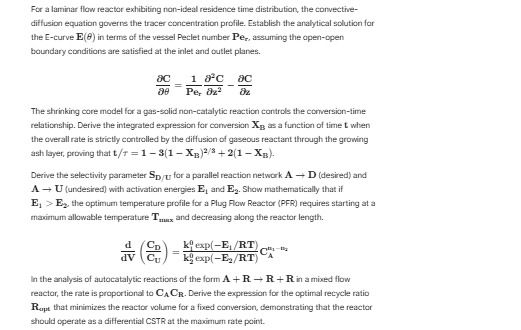
For a laminar flow reactor exhibiting non-ideal residence time distribution, the convective-diffusion equation governs the tracer concentration profile. Establish the analytical solution for the E-curve \( E(\theta) \) in terms of the vessel Peclet number \( Pe_v \), assuming the open-open boundary conditions are satisfied at the inlet and outlet planes.
## Step 1: Write the Dimensionless Convective-Diffusion Equation
\[
\frac{\partial C}{\partial \theta} = \frac{1}{Pe_v} \frac{\partial^2 C}{\partial x^2} - \frac{\partial C}{\partial x}
\]
where:
- \( C \) is the tracer concentration,
- \( \theta \) is the dimensionless time (\( \theta = t/\tau \), with \( \tau \) as mean residence time),
- \( x \) is the dimensionless axial coordinate ( at inlet, 1 at outlet),
- \( Pe_v \) is the vessel Peclet number (\( Pe_v = uL/D \)), with \( u \) as velocity, \( L \) length, and \( D \) axial dispersion coefficient.
## Step 2: Apply Initial and Boundary Conditions
- **Initial Condition:** \( C(x,) = \) (no tracer initially)
- **Inlet Boundary (Open):** \( C(,\theta) = \)
- **Outlet Boundary (Open):** \( C(1,\theta) = \)
- **Pulse Input:** At \( \theta = \), a pulse of tracer is added at \( x= \)
## Step 3: Solution for the E-Curve
The E-curve (exit age distribution) is the response at the outlet (\( x=1 \)) to a pulse at the inlet. The solution for this boundary value problem is:
\[
E(\theta) = \frac{Pe_v}{4\pi \theta^3}^{1/2} \exp\left[ -\frac{Pe_v (1-\theta)^2}{4\theta} \right] \exp\left( -\frac{Pe_v}{4\theta} \right)
\]
However, more commonly for the open-open boundary conditions (Danckwerts boundary conditions for a vessel of length 1, Pe_v = \( uL/D \)), the analytical solution is
\[
E(\theta) = \frac{Pe_v}{4\pi \theta^3}^{1/2} \exp\left[ -\frac{Pe_v (1-\theta)^2}{4\theta} \right]
\]
But, for the normalized solution for a pulse input in a vessel of dimensionless length 1, the standard solution is:
\[
E(\theta) = \frac{Pe_v}{4\pi \theta^3}^{1/2} \exp\left[ -\frac{(1 - \theta Pe_v)^2}{4\theta/Pe_v} \right]
\]
Or, simplifying,
\[
E(\theta) = \frac{Pe_v}{4\pi \theta^3}^{1/2} \exp\left[ -\frac{Pe_v (1 - \theta)^2}{4\theta} \right]
\]
## **Final Answer**
The analytical solution for the E-curve in terms of the vessel Peclet number \( Pe_v \) is:
\[
\boxed{
E(\theta) = \frac{Pe_v}{4\pi \theta^3}^{1/2} \exp\left[ -\frac{Pe_v (1 - \theta)^2}{4\theta} \right]
}
\]
where \( \theta \) is the dimensionless time and \( Pe_v \) is the vessel Peclet number. This describes the residence time distribution for a laminar flow reactor with axial dispersion and open-open (Danckwerts) boundary conditions.
VIPSolutions focuses on clear, step‑by‑step explanations so you can learn quickly. Whether you need an AI‑generated walkthrough or a short hint to get unstuck, each solution is organized for fast reading and easy review later.
Search similar questions, compare approaches, and bookmark the best answers for revision. Our goal is simple: quick, reliable study help that feels natural—not noisy.
 VIPSolutions
 For laminas flow reactor exhibiting non-ideal residence time distribution, the convective-
thin con oer th re cnc ele Each be mbt hi
in carn (8) erm vel ect un Pe, righ pom pen
ney cis tind thee et lt pl
oo Shige ibd
% Peo
Ton king de i-th isin
strat, Das tard pron comes Xp oe rio
ih ot ity ete by fino seen hah the ging
lem ro 1 — 1 31 — X?3-+ 201 Xo).
mt the sect arnt So pret esto nth A — Ds 2nd
J TR a ————
> Ei tect tempat ci fo Pg Flom Rice PF eq sti 3
men shi pes To cd deni sg tec gh.
4 (Cp) Ment B RT),
wo (8) HEE Ae
nth ts of mci etn of fom A + RR + Rin ai lw
mace, he ei pci Cn. oo mea bo hott yet
Tos hk rice ct hemo fd comers cerning ci
sb opera ns ler CST ot. nem gh