VIPSolutions logo ✨ VIPSolutions

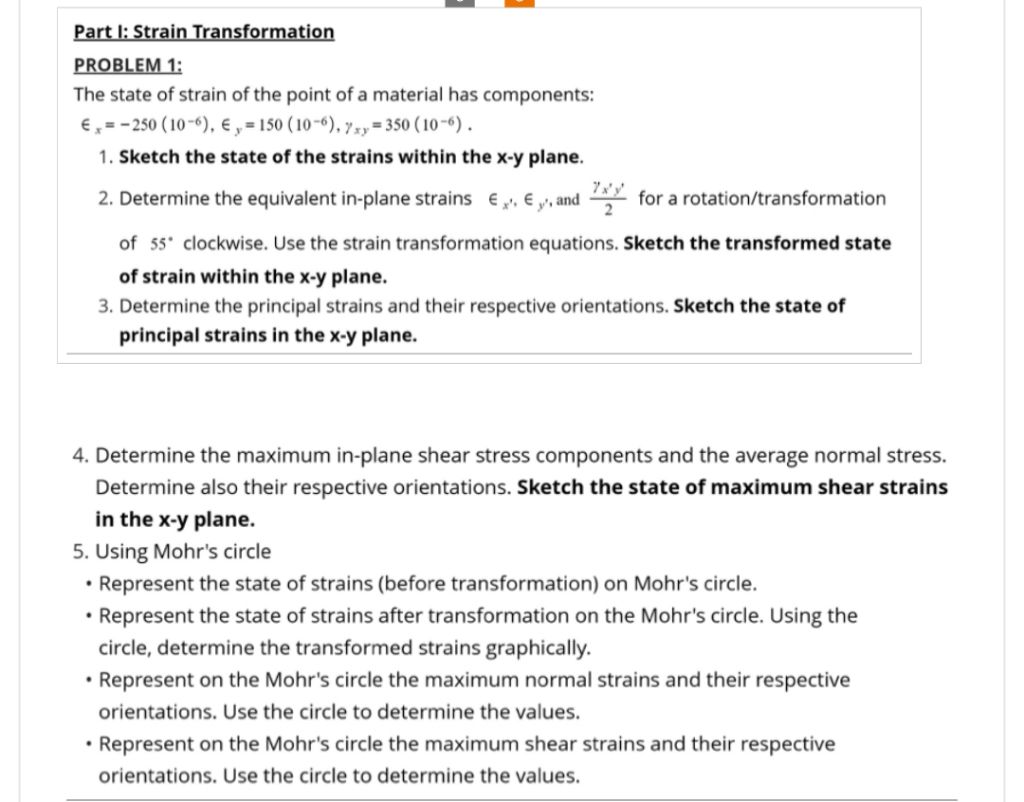
Give step-by-step solution with explanation and final answer:EE Part I: Strain Transformation PROBLEM 1: The state of strain of the point of a material has components: €,==-250(107%), € ,=150 (1079), y,,=350 (10°) . 1. Sketch the state of the strains within the x-y plane. 2. Determine the equivalent in-plane strains € ,., € and Sl for a rotation/transformation of 55° clockwise. Use the strain transformation equations. Sketch the transformed state of strain within the x-y plane. 3. Determine the principal strains and their respective orientations. Sketch the state of principal strains in the x-y plane. 4. Determine the maximum in-plane shear stress components and the average normal stress. Determine also their respective orientations. Sketch the state of maximum shear strains in the x-y plane. 5. Using Mohr's circle + Represent the state of strains (before transformation) on Mohr's circle. + Represent the state of strains after transformation on the Mohr's circle. Using the circle, determine the transformed strains graphically. * Represent on the Mohr's circle the maximum normal strains and their respective orientations. Use the circle to determine the values. + Represent on the Mohr's circle the maximum shear strains and their respective orientations. Use the circle to determine the values.

Question:

Give step-by-step solution with explanation and final answer:Uploaded ImageEE Part I: Strain Transformation PROBLEM 1: The state of strain of the point of a material has components: €,==-250(107%), € ,=150 (1079), y,,=350 (10°) . 1. Sketch the state of the strains within the x-y plane. 2. Determine the equivalent in-plane strains € ,., € and Sl for a rotation/transformation of 55° clockwise. Use the strain transformation equations. Sketch the transformed state of strain within the x-y plane. 3. Determine the principal strains and their respective orientations. Sketch the state of principal strains in the x-y plane. 4. Determine the maximum in-plane shear stress components and the average normal stress. Determine also their respective orientations. Sketch the state of maximum shear strains in the x-y plane. 5. Using Mohr's circle + Represent the state of strains (before transformation) on Mohr's circle. + Represent the state of strains after transformation on the Mohr's circle. Using the circle, determine the transformed strains graphically. * Represent on the Mohr's circle the maximum normal strains and their respective orientations. Use the circle to determine the values. + Represent on the Mohr's circle the maximum shear strains and their respective orientations. Use the circle to determine the values.

This is AI generated Response.
Asked by: Rahul
Created at: 2026-01-20 07:50:54

Final Answer:

Rendered Raw Text
Did you like this answer?
Let's solve **Problem 1** step-by-step. Given strains: - \(\epsilon_x = -250 \times 10^{-6}\) - \(\epsilon_y = 150 \times 10^{-6}\) - \(\gamma_{xy} = 350 \times 10^{-6}\) --- ## **1. Sketch the State of Strains within the x-y Plane** ### **Given:** - \(\epsilon_x = -250 \times 10^{-6}\) (compression) - \(\epsilon_y = 150 \times 10^{-6}\) (tension) - \(\gamma_{xy} = 350 \times 10^{-6}\) (shear) **Strain Diagram:** - Draw an element. On the left/right faces, show compressive strain \(\epsilon_x\) (arrows inward). - On the top/bottom faces, show tensile strain \(\epsilon_y\) (arrows outward). - Shear: Draw arrows in the +xy sense (top face right, right face up). --- ## **2. Strain Transformation for 55° Clockwise (Negative Angle)** ### **Strain Transformation Equations:** \[ \begin{align*} \epsilon_{x'} &= \frac{\epsilon_x + \epsilon_y}{2} + \frac{\epsilon_x - \epsilon_y}{2} \cos 2\theta + \frac{\gamma_{xy}}{2} \sin 2\theta \\ \epsilon_{y'} &= \frac{\epsilon_x + \epsilon_y}{2} - \frac{\epsilon_x - \epsilon_y}{2} \cos 2\theta - \frac{\gamma_{xy}}{2} \sin 2\theta \\ \gamma_{x'y'} &= -(\epsilon_x - \epsilon_y) \sin 2\theta + \gamma_{xy} \cos 2\theta \end{align*} \] Where \(\theta = -55^\circ\) (clockwise). #### **Calculate:** - \(\epsilon_x + \epsilon_y = -250 \times 10^{-6} + 150 \times 10^{-6} = -100 \times 10^{-6}\) - \(\epsilon_x - \epsilon_y = -250 \times 10^{-6} - 150 \times 10^{-6} = -400 \times 10^{-6}\) - \(\frac{\gamma_{xy}}{2} = \frac{350 \times 10^{-6}}{2} = 175 \times 10^{-6}\) - \(2\theta = -110^\circ\) \[ \cos(-110^\circ) = -.342, \quad \sin(-110^\circ) = -.9397 \] \[ \begin{align*} \epsilon_{x'} &= \frac{-100 \times 10^{-6}}{2} + \frac{-400 \times 10^{-6}}{2} \times (-.342) + 175 \times 10^{-6} \times (-.9397) \\ &= -50 \times 10^{-6} + 200 \times 10^{-6} \times .342 - 164.45 \times 10^{-6} \\ &= -50 \times 10^{-6} + 68.4 \times 10^{-6} - 164.45 \times 10^{-6} \\ &= (-50 + 68.4 - 164.45) \times 10^{-6} \\ &= -146.05 \times 10^{-6} \end{align*} \] \[ \begin{align*} \epsilon_{y'} &= -50 \times 10^{-6} - 68.4 \times 10^{-6} + 164.45 \times 10^{-6} \\ &= (-50 - 68.4 + 164.45) \times 10^{-6} \\ &= 46.05 \times 10^{-6} \end{align*} \] \[ \begin{align*} \gamma_{x'y'} &= -(-400 \times 10^{-6}) \times (-.9397) + 350 \times 10^{-6} \times (-.342) \\ &= 400 \times 10^{-6} \times .9397 - 119.7 \times 10^{-6} \\ &= 375.88 \times 10^{-6} - 119.7 \times 10^{-6} \\ &= 256.18 \times 10^{-6} \end{align*} \] **Transformed strains:** - \(\epsilon_{x'} = -146 \times 10^{-6}\) - \(\epsilon_{y'} = 46 \times 10^{-6}\) - \(\gamma_{x'y'} = 256 \times 10^{-6}\) **Sketch:** Same as before, but with new values and axes rotated 55° clockwise. --- ## **3. Principal Strains and Orientations** ### **Principal strains:** \[ \epsilon_{1,2} = \frac{\epsilon_x + \epsilon_y}{2} \pm \sqrt{\left( \frac{\epsilon_x - \epsilon_y}{2} \right)^2 + \left( \frac{\gamma_{xy}}{2} \right)^2 } \] \[ \frac{\epsilon_x + \epsilon_y}{2} = -50 \times 10^{-6} \] \[ \frac{\epsilon_x - \epsilon_y}{2} = -200 \times 10^{-6} \] \[ \frac{\gamma_{xy}}{2} = 175 \times 10^{-6} \] \[ \sqrt{(-200 \times 10^{-6})^2 + (175 \times 10^{-6})^2} = \sqrt{(4 \times 10^{-8}) + (3.0625 \times 10^{-8})} = \sqrt{7.0625 \times 10^{-8}} = 266 \times 10^{-6} \] So, \[ \epsilon_1 = -50 \times 10^{-6} + 266 \times 10^{-6} = 216 \times 10^{-6} \] \[ \epsilon_2 = -50 \times 10^{-6} - 266 \times 10^{-6} = -316 \times 10^{-6} \] ### **Orientation (\(\theta_p\)):** \[ \tan 2\theta_p = \frac{\gamma_{xy}}{\epsilon_x - \epsilon_y} = \frac{350 \times 10^{-6}}{-400 \times 10^{-6}} = -.875 \] \[ 2\theta_p = \arctan(-.875) = -41.2^\circ \implies \theta_p = -20.6^\circ \] **Sketch:** Element with principal axes rotated \(-20.6^\circ\) from x. --- ## **4. Maximum In-Plane Shear Strain and Average Normal Strain** \[ \gamma_{\text{max}} = \sqrt{(\epsilon_x - \epsilon_y)^2 + \gamma_{xy}^2} \] \[ = \sqrt{(-400 \times 10^{-6})^2 + (350 \times 10^{-6})^2} = \sqrt{1.6 \times 10^{-7} + 1.225 \times 10^{-7}} = \sqrt{2.825 \times 10^{-7}} = 532 \times 10^{-6} \] \[ \text{Average Normal Strain} = \frac{\epsilon_x + \epsilon_y}{2} = -50 \times 10^{-6} \] ### **Orientation:** \[ \theta_s = \theta_p + 45^\circ = -20.6^\circ + 45^\circ = 24.4^\circ \] --- ## **5. Mohr's Circle Construction** 1. **Plot** - Center at \((\epsilon_{\text{avg}}, )\) - Points at \((\epsilon_x, \gamma_{xy}/2)\) and \((\epsilon_y, -\gamma_{xy}/2)\) 2. **Radius:** Already found as \(266 \times 10^{-6}\) 3. **Principal strains:** On circle at \((\epsilon_{\text{avg}} \pm R, )\) 4. **Max shear:** At top/bottom of circle (\(\pm R\) above/below center) --- ## **Summary Table** | Quantity | Value (\(10^{-6}\)) | Orientation (from x) | |----------------------|--------------------------|----------------------| | \(\epsilon_x\) | -250 | ° | | \(\epsilon_y\) | 150 | ° | | \(\gamma_{xy}\) | 350 | ° | | \(\epsilon_{x'}\) | -146 | 55° clockwise | | \(\epsilon_{y'}\) | 46 | 55° clockwise | | \(\gamma_{x'y'}\) | 256 | 55° clockwise | | \(\epsilon_1\) | 216 | -20.6° | | \(\epsilon_2\) | -316 | -20.6° | | \(\gamma_{\text{max}}\) | 532 | 24.4° | | Avg. norm. strain | -50 | | --- ### **Final Answers (Boxed):** - **Principal strains:** \(\boxed{216 \times 10^{-6}}, \boxed{-316 \times 10^{-6}}\) - **Principal orientation:** \(\boxed{-20.6^\circ}\) from x - **Transformed strains at 55°:** \(\boxed{-146}, \boxed{46}, \boxed{256} \times 10^{-6}\) - **Max in-plane shear strain:** \(\boxed{532 \times 10^{-6}}\) at \(\boxed{24.4^\circ}\) from x - **Average normal strain:** \(\boxed{-50 \times 10^{-6}}\) --- **If you need sketches or Mohr's Circle plotted, let me know!**

📢 Instructions:

  • Ask anything relatd to above question only.
  • For new Question goto :

Study Help, Fast Answers

VIPSolutions focuses on clear, step‑by‑step explanations so you can learn quickly. Whether you need an AI‑generated walkthrough or a short hint to get unstuck, each solution is organized for fast reading and easy review later.

Search similar questions, compare approaches, and bookmark the best answers for revision. Our goal is simple: quick, reliable study help that feels natural—not noisy.