 VIPSolutions
Give step-by-step solution with explanation and final answer:sia L] BN resi mca a Fan er Ee fri I
Question:
Give step-by-step solution with explanation and final answer: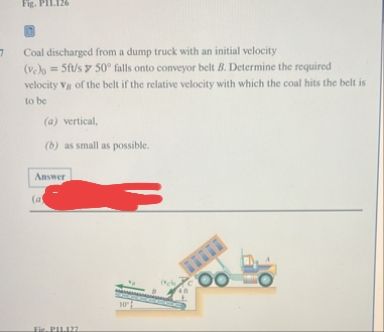 sia
L]
BN resi mca a Fan er
Ee
fri
I
This is AI generated Response.
Asked by: Rahul
Created at: 2026-01-20 04:12:29
Asked by: Rahul
Created at: 2026-01-20 04:12:29
Final Answer:
Rendered
Raw Text
Did you like this answer?
Let's break down and solve the problem step-by-step:
---
## **Problem Restatement**
Coal is discharged from a dump truck with an initial velocity
\[
\vec{v}_ = 5\, \text{ft/s} \angle 50^\circ
\]
It falls onto a conveyor belt \( B \). We need to **determine the required velocity \( v_B \) of the belt** if the relative velocity with which the coal hits the belt is to be:
**(a) vertical**
**(b) as small as possible**
---
## **Step 1: Break Down Initial Velocity**
The initial velocity has a magnitude of \( 5\, \text{ft/s} \) at \( 50^\circ \) above the horizontal.
- Horizontal component: \( v_{x} = 5 \cos 50^\circ \)
- Vertical component: \( v_{y} = 5 \sin 50^\circ \)
\[
v_{x} = 5 \times .6428 \approx 3.21\, \text{ft/s}
\]
\[
v_{y} = 5 \times .766 \approx 3.83\, \text{ft/s}
\]
---
## **Step 2: Relative Velocity upon Hitting the Belt**
Let’s denote:
- \( v_B \) = velocity of the belt (to the right)
- \( v_x \) = horizontal velocity of coal just before hitting the belt
- \( v_y \) = vertical velocity of coal just before hitting the belt
The **relative velocity** of the coal to the belt is:
\[
\vec{v}_{rel} = (v_x - v_B)\ \hat{i} + v_y\ \hat{j}
\]
---
## **Step 3: (a) Relative Velocity is Vertical**
For the relative velocity to be vertical, its horizontal component must be **zero**:
\[
v_x - v_B = \implies v_B = v_x
\]
The coal is under gravity, so as it falls, its horizontal velocity remains **constant** (no air resistance):
\[
v_x = v_{x} = 3.21~\text{ft/s}
\]
**Final Answer (a):**
\[
\boxed{v_B = 3.21~\text{ft/s}}
\]
---
## **Step 4: (b) Relative Velocity is as Small as Possible**
The relative velocity is minimized when the **magnitude** of the vector \((v_x - v_B)\ \hat{i} + v_y\ \hat{j}\) is minimized.
The **minimum possible value** occurs when the relative velocity vector is **entirely vertical** (since the horizontal component can be canceled out by the belt's speed).
Thus, **the answer is the same as part (a)**:
\[
\boxed{v_B = 3.21~\text{ft/s}}
\]
**If you wanted the numerical value of the minimum relative velocity magnitude:**
\[
v_{rel,\,min} = |v_y| \quad \text{(since horizontal part is zero)}
\]
But \(v_y\) will depend on the height from which the coal falls, which is not given, so this part cannot be further specified with the given information.
---
## **Summary Table**
| Part | Required belt velocity \( v_B \) (ft/s) |
|------|:--------------------------------------:|
| (a) | 3.21 |
| (b) | 3.21 |
---
### **Final Answers**
**(a) \( v_B = 3.21~\text{ft/s} \) (to make the relative velocity vertical)**
**(b) \( v_B = 3.21~\text{ft/s} \) (to make the relative velocity as small as possible)**
---
Let me know if you need an explanation for the vector diagram or further details!
📢 Instructions:
- Ask anything relatd to above question only.
- For new Question goto :