 VIPSolutions
Give step-by-step solution with explanation and final answer:Problem 1.3 — For the geared system shown below, assume that shaft inertias and the gear inertias I,1,,I; are negligible. The motor and load inertias in kg-m?are I, = 0.03 and Is = 0.15. The speed ratios are 2 = 2 = 1.6. Derive the system model in terms 2 ws of the speed wj3, with the applied torque T as the input. ~4n 3 7 N| Noy r ig a Cl
Question:
Give step-by-step solution with explanation and final answer: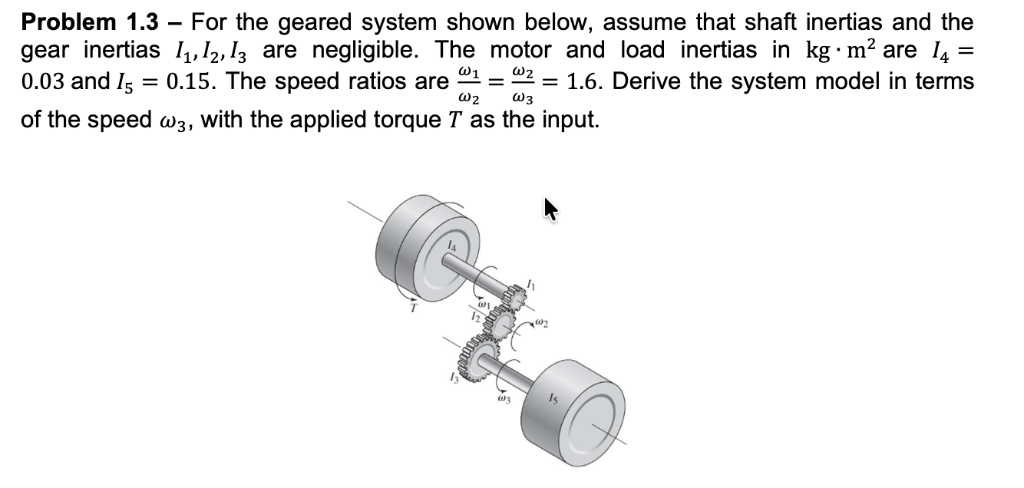 Problem 1.3 — For the geared system shown below, assume that shaft inertias and the
gear inertias I,1,,I; are negligible. The motor and load inertias in kg-m?are I, =
0.03 and Is = 0.15. The speed ratios are 2 = 2 = 1.6. Derive the system model in terms
2 ws
of the speed wj3, with the applied torque T as the input.
~4n 3
7
N| Noy
r ig a
Cl
This is AI generated Response.
Asked by: Rahul
Created at: 2026-01-20 04:08:31
Asked by: Rahul
Created at: 2026-01-20 04:08:31
Final Answer:
Rendered
Raw Text
Did you like this answer?
Let's solve the problem step by step:
---
## **Step 1: System Description**
- **Given:**
- Shaft and gear inertias (\(I_1, I_2, I_3\)) are negligible.
- Motor inertia (\(I_4\)) = .03 kg·m²
- Load inertia (\(I_5\)) = .15 kg·m²
- Speed ratios: \(\frac{\omega_1}{\omega_2} = \frac{\omega_2}{\omega_3} = 1.6\)
- Input: Applied torque \(T\)
- Output: Speed \(\omega_3\)
---
## **Step 2: Equivalent Inertia Referenced to Shaft 3 (\(\omega_3\))**
### **A. Gear Ratios**
Let:
- \(N_1 = \frac{\omega_1}{\omega_2} = 1.6\)
- \(N_2 = \frac{\omega_2}{\omega_3} = 1.6\)
So,
\[
\frac{\omega_1}{\omega_3} = N_1 \times N_2 = 1.6 \times 1.6 = 2.56
\]
---
### **B. Reflecting Inertia to Shaft 3**
- **Motor Inertia (\(I_4\)), reflected to shaft 3:**
\[
I_{4,\,eq} = I_4 \left( \frac{\omega_4}{\omega_3} \right)^2
\]
But \(\omega_4 = \omega_1\), so:
\[
I_{4,\,eq} = I_4 \left( \frac{\omega_1}{\omega_3} \right)^2 = .03 \times (2.56)^2 = .03 \times 6.5536 = .1966
\]
- **Load Inertia (\(I_5\)), already at shaft 3:**
\(I_5 = .15\)
- **Total Equivalent Inertia at shaft 3:**
\[
J_{eq} = I_{4,\,eq} + I_5 = .1966 + .15 = .3466~\text{kg}\cdot\text{m}^2
\]
---
## **Step 3: Equation of Motion**
The equation of motion about shaft 3 (ignoring friction, as not specified):
\[
J_{eq} \frac{d\omega_3}{dt} = T_{eq}
\]
where \(T_{eq}\) is the equivalent torque at shaft 3. The applied torque \(T\) is applied at shaft 1.
### **Torque Transformation**
Torque transforms **inversely** to speed ratio:
\[
T_3 = T \left( \frac{\omega_3}{\omega_1} \right)
\]
But \(\frac{\omega_3}{\omega_1} = \frac{1}{2.56}\):
\[
T_3 = \frac{T}{2.56}
\]
---
## **Step 4: Final System Model**
\[
J_{eq} \frac{d\omega_3}{dt} = \frac{T}{2.56}
\]
\[
.3466 \frac{d\omega_3}{dt} = \frac{T}{2.56}
\]
\[
\boxed{
\frac{d\omega_3}{dt} = \frac{T}{.3466 \times 2.56} = \frac{T}{.8873}
}
\]
---
### **Final Answer (Boxed):**
\[
\boxed{
\frac{d\omega_3}{dt} = \frac{T}{.8873}
}
\]
where:
- \(\omega_3\) = speed of the output shaft (shaft 3)
- \(T\) = applied torque at the motor (shaft 1)
---
**Summary of Steps:**
1. Calculated speed ratios across the gears.
2. Reflected all inertias to shaft 3.
3. Transformed input torque to shaft 3.
4. Wrote the equation of motion in terms of \(\omega_3\) and \(T\).
📢 Instructions:
- Ask anything relatd to above question only.
- For new Question goto :