 VIPSolutions
Give step-by-step solution with explanation and final answer:Hi ii 5: ti Ed i
Question:
Give step-by-step solution with explanation and final answer: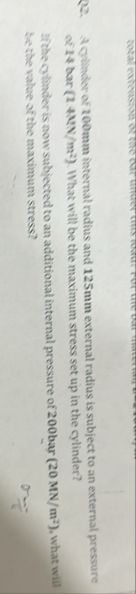 Hi
ii
5:
ti
Ed
i
This is AI generated Response.
Asked by: Rahul
Created at: 2026-01-20 03:35:46
Asked by: Rahul
Created at: 2026-01-20 03:35:46
Final Answer:
Rendered
Raw Text
Did you like this answer?
Let's solve the problem step by step.
---
## **Given:**
- **Internal radius, \( r_i \) = 100 mm**
- **External radius, \( r_o \) = 125 mm**
- **External pressure, \( p_o \) = 40 bar = 4,000 kN/m² (since 1 bar = 100 kN/m²)**
- **Initial internal pressure, \( p_i = \) (since not mentioned initially)**
- **Additional internal pressure applied, \( p_i = 200 bar = 20,000 kN/m² \)**
- **Asked:** What will be the maximum stress set up in the cylinder in both cases?
---
# **Step 1: Stresses in Thick Cylinder (Lame's Equations)**
The radial and hoop (circumferential) stresses at radius \( r \) in a thick-walled cylinder:
\[
\sigma_r = A - \frac{B}{r^2}
\]
\[
\sigma_\theta = A + \frac{B}{r^2}
\]
Where \( A \) and \( B \) are constants to be found using boundary conditions.
---
## **Case 1: Only External Pressure**
### **Boundary Conditions**
- At \( r = r_i \), \( \sigma_r = p_i = \)
- At \( r = r_o \), \( \sigma_r = -p_o \) (negative because it's compressive)
### **Apply boundary conditions:**
\[
\begin{align*}
\text{At } r_i = 100 \text{ mm}: & \quad = A - \frac{B}{(100)^2} \\
\text{At } r_o = 125 \text{ mm}: & \quad -400 = A - \frac{B}{(125)^2} \\
\end{align*}
\]
Let’s solve these equations:
1. \( = A - \frac{B}{100^2} \implies A = \frac{B}{100^2} \)
2. Substitute \( A \) into the second equation:
\[
-400 = \frac{B}{100^2} - \frac{B}{125^2}
\]
\[
-400 = B \left( \frac{1}{100^2} - \frac{1}{125^2} \right )
\]
Calculate values:
- \( 100^2 = 10,000 \)
- \( 125^2 = 15,625 \)
\[
\frac{1}{10,000} - \frac{1}{15,625} = \frac{15,625 - 10,000}{10,000 \times 15,625}
= \frac{5,625}{156,250,000}
= .000036
\]
\[
-400 = B \times .000036
\implies B = \frac{-400}{.000036} = -111,111,111
\]
Now, \( A = \frac{B}{10,000} = \frac{-111,111,111}{10,000} = -11,111.11 \)
---
### **Maximum Stress Location**
Maximum hoop (circumferential) stress occurs at the inner wall (\( r = r_i \)).
\[
\sigma_\theta (r_i) = A + \frac{B}{r_i^2}
\]
\[
= -11,111.11 + \frac{-111,111,111}{10,000}
= -11,111.11 - 11,111.11 = -22,222.22 \text{ kN/m}^2
\]
**But this is negative, which means it's compressive.**
---
### **Summary for Case 1**
- **Maximum (hoop) stress at inner wall:**
\[
\boxed{-22,222.22 \text{ kN/m}^2 \text{ (compressive)}}
\]
---
## **Case 2: Add Internal Pressure (200 bar)**
Now, \( p_i = 20,000 \) kN/m² (tensile), \( p_o = 4,000 \) kN/m² (compressive).
### **Boundary Conditions**
- At \( r = r_i \), \( \sigma_r = -p_i = -20,000 \) kN/m² (internal pressure acts outward, so negative sign for compressive radial stress)
- At \( r = r_o \), \( \sigma_r = -p_o = -4,000 \) kN/m²
### **Apply boundary conditions:**
1. \( -20,000 = A - \frac{B}{(100)^2} \)
2. \( -400 = A - \frac{B}{(125)^2} \)
Subtract equations:
\[
(-20,000) - (-400) = \left( A - \frac{B}{10,000} \right ) - \left( A - \frac{B}{15,625} \right )
\]
\[
-16,000 = -\frac{B}{10,000} + \frac{B}{15,625}
\]
\[
-16,000 = B \left( -\frac{1}{10,000} + \frac{1}{15,625} \right )
\]
\[
-16,000 = B \left( \frac{15,625 - 10,000}{10,000 \times 15,625} \right )
= B \left( \frac{5,625}{156,250,000} \right )
= B \times .000036
\]
\[
B = \frac{-16,000}{.000036} = -444,444,444
\]
Now, substitute \( B \) in 1st equation:
\[
-20,000 = A - \frac{-444,444,444}{10,000}
\]
\[
-20,000 = A + 44,444.44
\]
\[
A = -20,000 - 44,444.44 = -64,444.44
\]
---
### **Maximum Hoop Stress**
\[
\sigma_\theta (r_i) = A + \frac{B}{r_i^2}
= -64,444.44 + \frac{-444,444,444}{10,000}
= -64,444.44 - 44,444.44
= -108,888.88 \text{ kN/m}^2
\]
**Again, it's compressive.**
---
## **Final Answers**
### **Case 1 (Only External Pressure):**
\[
\boxed{-22,222 \text{ kN/m}^2 \text{ (compressive, hoop stress at inner wall)}}
\]
### **Case 2 (Internal + External Pressure):**
\[
\boxed{-108,889 \text{ kN/m}^2 \text{ (compressive, hoop stress at inner wall)}}
\]
---
### **Note:**
- All stresses are compressive due to the high external and internal pressures.
- If you want the hoop stress at the outer wall or at another radius, substitute the respective \( r \) value in the Lame’s equation.
---
Let me know if you need the stresses at other locations or a diagram!
📢 Instructions:
- Ask anything relatd to above question only.
- For new Question goto :