 VIPSolutions
Give step-by-step solution with explanation and final answer:
Question:
Give step-by-step solution with explanation and final answer: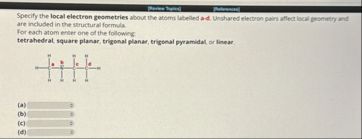
This is AI generated Response.
Asked by: Rahul
Created at: 2026-01-20 03:30:00
Asked by: Rahul
Created at: 2026-01-20 03:30:00
Final Answer:
Rendered
Raw Text
Did you like this answer?
Let's solve the problem step by step:
## Step 1: Identify Each Atom's Surroundings
Let's look at the atoms labeled **a, b, c, d** in the structure:
```
H H H H
| | | |
H—C—C—C—C—H
| | | |
H H H H
a b c d
```
- Each letter (a, b, c, d) is on a carbon atom.
## Step 2: Count Number of Groups Around Each Atom
Let's count the electron groups (bonds + lone pairs) for each carbon:
### (a) Carbon
- Surrounded by 4 atoms (3 H, 1 C)
- **4 electron groups**
### (b) Carbon
- Surrounded by 4 atoms (2 H, 2 C)
- **4 electron groups**
### (c) Carbon
- Surrounded by 4 atoms (2 H, 2 C)
- **4 electron groups**
### (d) Carbon
- Surrounded by 4 atoms (3 H, 1 C)
- **4 electron groups**
## Step 3: Assign Electron Geometry
The possible geometries are:
- **Tetrahedral**: 4 electron groups
- **Trigonal Planar**: 3 electron groups
- **Linear**: 2 electron groups
- **Trigonal Pyramidal**: 4 electron groups, but with one lone pair (like NH₃)
- **Square Planar**: 4 bonds, 2 lone pairs (like XeF₄), not relevant for C
All carbons here have **4 bonds** (no lone pairs):
**4 groups** → **Tetrahedral**
## Step 4: Write Final Answers
**(a) Tetrahedral**
**(b) Tetrahedral**
**(c) Tetrahedral**
**(d) Tetrahedral**
---
### **Final Answers**
(a) **Tetrahedral**
(b) **Tetrahedral**
(c) **Tetrahedral**
(d) **Tetrahedral**
Question:
Then solved please correct answer
This is AI generated Response.
Asked by: Rahul
Created at: 2026-01-20 03:31:07
Asked by: Rahul
Created at: 2026-01-20 03:31:07
Final Answer:
Rendered
Raw Text
Did you like this answer?
# Step-by-Step Solution
Let's analyze the provided molecular structure and determine the geometry of the specified carbon atoms labeled as **a, b, c,** and **d**.
## Step 1: Visualize the Molecular Structure
The molecular structure can be interpreted as follows:
```
H H H H
| | | |
H—C—C—C—C—H
| | | |
H H H H
a b c d
```
Each letter corresponds to a carbon atom in the chain.
## Step 2: Count Electron Groups Around Each Carbon Atom
We will determine the number of electron groups (which include bonds and lone pairs) surrounding each carbon atom:
### Atom (a)
- **Bonds**: 1 bond to carbon (C) + 3 bonds to hydrogen (H)
- **Total Groups**: 4
### Atom (b)
- **Bonds**: 2 bonds to hydrogens (H) + 2 bonds to adjacent carbons (C)
- **Total Groups**: 4
### Atom (c)
- **Bonds**: 2 bonds to hydrogens (H) + 2 bonds to adjacent carbons (C)
- **Total Groups**: 4
### Atom (d)
- **Bonds**: 1 bond to carbon (C) + 3 bonds to hydrogens (H)
- **Total Groups**: 4
## Step 3: Determine Electron Geometry
Based on the number of electron groups, we can assign the appropriate geometry:
- **4 Electron Groups**: This corresponds to a **Tetrahedral** geometry.
### Summary of Geometry Assignments
- **(a)**: Tetrahedral
- **(b)**: Tetrahedral
- **(c)**: Tetrahedral
- **(d)**: Tetrahedral
## Final Answers
- **(a)**: Tetrahedral
- **(b)**: Tetrahedral
- **(c)**: Tetrahedral
- **(d)**: Tetrahedral
This analysis confirms that all specified carbon atoms in the structure exhibit a tetrahedral geometry due to the presence of four electron groups around each carbon atom.
📢 Instructions:
- Ask anything relatd to above question only.
- For new Question goto :