 VIPSolutions
Give step-by-step solution with explanation and final answer:“ Sot thereon condor at cod comet 2 mt 2 buen io Zee ten 50 rote 2 KOCK 2 tr i © (0188S ol BONER het (1) NBS, light (2) EtON/EtOH, heat 00 (1) Bra (high temp) (2) KOC(CHa)a (2 molar equiv) 8) (2KOCKC 4 mr i CTetbook and Media wo Complete honing rosy cher for erst han N on a ory oy =r — [(— r= = J wf Ne Ne oo Re N @ © Wile stricture fos nf vious Dit Ader affcts bot csi rscond 2 et dere a with, [he ange alkene rom a &
Question:
Give step-by-step solution with explanation and final answer: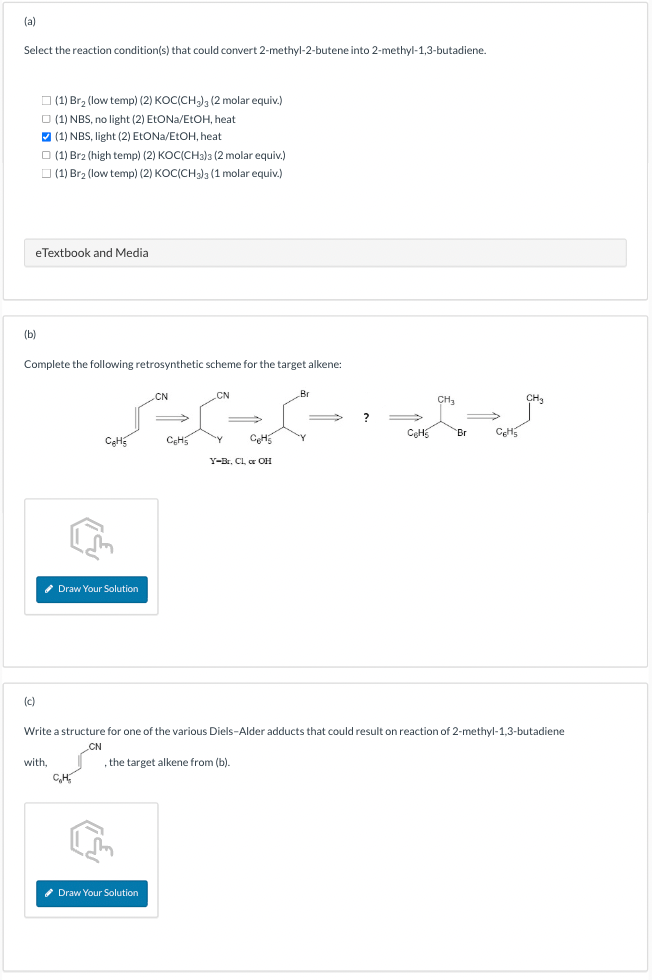 “
Sot thereon condor at cod comet 2 mt 2 buen io Zee ten
50 rote 2 KOCK 2 tr i
© (0188S ol BONER het
(1) NBS, light (2) EtON/EtOH, heat
00 (1) Bra (high temp) (2) KOC(CHa)a (2 molar equiv)
8) (2KOCKC 4 mr i
CTetbook and Media
wo
Complete honing rosy cher for erst han
N on a ory oy
=r — [(— r= = J
wf Ne Ne oo
Re
N
@
©
Wile stricture fos nf vious Dit Ader affcts bot csi rscond 2 et dere
a
with, [he ange alkene rom
a
&
This is AI generated Response.
Asked by: Rahul
Created at: 2026-01-20 03:26:06
Asked by: Rahul
Created at: 2026-01-20 03:26:06
Final Answer:
Rendered
Raw Text
Did you like this answer?
Let's solve each part step by step:
---
## (a) Reaction Conditions for Conversion
**Question:**
Select the reaction condition(s) that could convert **2-methyl-2-butene** into **2-methyl-1,3-butadiene**.
### **Step-by-step Explanation:**
- To convert an alkene (2-methyl-2-butene) into a conjugated diene (2-methyl-1,3-butadiene), you need to:
1. **Allylic bromination**: Introduce a bromine atom at the allylic position using NBS (N-bromosuccinimide) with light.
2. **Elimination**: Treat the allylic bromide with a strong base (EtONa/EtOH) and heat to generate the conjugated diene.
**Correct answer is:**
- (3) **NBS, light then EtONa/EtOH, heat**
**Final Answer for (a):**
- The correct reaction condition is:
**(3) NBS, light (2) EtONa/EtOH, heat**
---
## (b) Retrosynthetic Scheme
**Step-by-step Explanation:**
- The target alkene has two cyano groups and two phenyl groups attached to a central double bond.
- The precursor is a bromide attached to a methyl group (see scheme).
- The retrosynthetic step involves an **E2 elimination** of the bromide (using a strong base) to form the alkene.
**Retrosynthetic arrow should indicate:**
- The bromide precursor can be converted to the target alkene using a base (such as NaOEt, NaOH, etc.).
### **Retrosynthetic Scheme:**
```
Target alkene: (C₆H₅)CH=C(CN)-C(CN)=C(C₆H₅)₂
↑ (Base-induced elimination, Y = Br, Cl, or OH)
Bromide precursor: (C₆H₅)CHBr-C(CN)-C(CN)=C(C₆H₅)₂
```
---
## (c) Diels–Alder Adduct Structure
**Step-by-step Explanation:**
- Diene: **2-methyl-1,3-butadiene** (isoprene)
- Dienophile: The target alkene from (b), which is an electron-deficient alkene due to the cyano groups.
### **Diels–Alder Adduct:**
- The Diels–Alder reaction forms a **six-membered ring**.
- The new adduct will have the phenyl and cyano substituents at the positions introduced by the dienophile.
**Structure:**
Draw a six-membered cyclohexene ring with substituents:
- Two cyano groups and two phenyl groups at the positions corresponding to the original dienophile.
- The isoprene (2-methyl-1,3-butadiene) will add such that the methyl group is at the 4-position of the ring.
---
## **Summary Table**
| Part | Answer/Explanation |
|------|----------------------------------------------------------------------------------------------------|
| (a) | (3) NBS, light (2) EtONa/EtOH, heat |
| (b) | Retrosynthetic step: Elimination (base) from bromide precursor to form target alkene |
| (c) | Diels–Alder adduct: six-membered ring with two cyano and two phenyl groups, plus a methyl at C-4 |
---
### **(a) Final Answer**
> **(3) NBS, light (2) EtONa/EtOH, heat**
### **(b) Final Answer**
> The retrosynthetic step is an **elimination** (using base) from the bromide precursor:
> `(C₆H₅)CHBr-C(CN)-C(CN)=C(C₆H₅)₂ --(base)--> (C₆H₅)CH=C(CN)-C(CN)=C(C₆H₅)₂`
### **(c) Final Answer**
> The Diels–Alder adduct is a cyclohexene derivative where the ring has:
> - Two phenyl and two cyano substituents (from the dienophile)
> - A methyl group (from the 2-methyl-1,3-butadiene)
> 
> *(This is a representative structure; you can draw it in standard cyclohexene form with substituents at appropriate positions.)*
---
Let me know if you need the drawn structures or more details for part (c)!
📢 Instructions:
- Ask anything relatd to above question only.
- For new Question goto :