VIPSolutions logo ✨ VIPSolutions

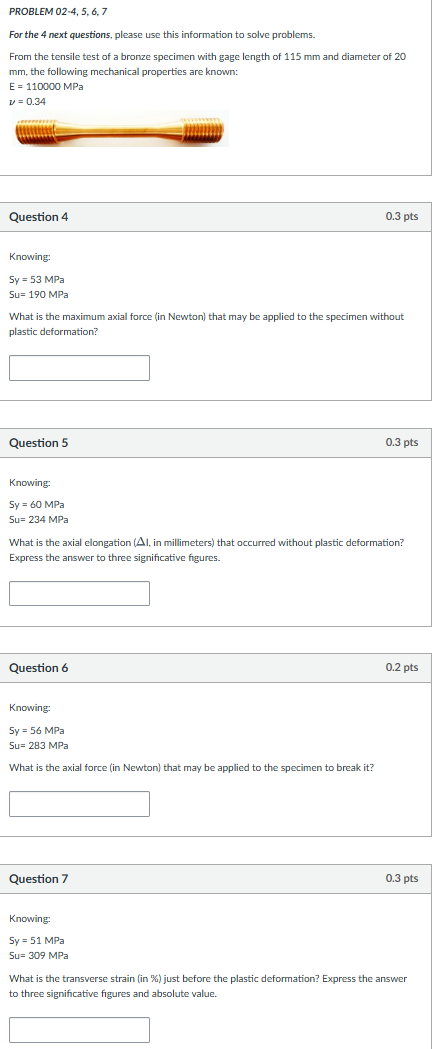
Give step-by-step solution with explanation and final answer:PROBLEM 024,5.6,7 Forthe next questions, please use this information to solve problems. From the tensile test of bronze specimen with gage length of 115 mm and diameter of 20 im the following mechanics properties ae know: £=110000 MP v=034 Question. 03pts Knowing: Sy=samps Su= 190 MP Wht isthe maximum ail fore in Newton that may be applied to the specimen without plastic deformation? Question 5 03pts Knowing: Sy=s0mps Sue 234 MP Wht is the axial elongation (AL in milimeters) that occurred without plastic deformation? Express the answer to three significative figures. Question 6 o02pts Knowing: Sy=semps Su=283P Wht is the axa force (i Newton) that may be applied othe specimen to break Question? 03pts Knowing: Sy=simps Su= 309 MPa Wht is the transverse strin m5) just befor the pli deformstion? Express the answer to three significative figures and absolute value.

Question:

Give step-by-step solution with explanation and final answer:Uploaded ImagePROBLEM 024,5.6,7 Forthe next questions, please use this information to solve problems. From the tensile test of bronze specimen with gage length of 115 mm and diameter of 20 im the following mechanics properties ae know: £=110000 MP v=034 Question. 03pts Knowing: Sy=samps Su= 190 MP Wht isthe maximum ail fore in Newton that may be applied to the specimen without plastic deformation? Question 5 03pts Knowing: Sy=s0mps Sue 234 MP Wht is the axial elongation (AL in milimeters) that occurred without plastic deformation? Express the answer to three significative figures. Question 6 o02pts Knowing: Sy=semps Su=283P Wht is the axa force (i Newton) that may be applied othe specimen to break Question? 03pts Knowing: Sy=simps Su= 309 MPa Wht is the transverse strin m5) just befor the pli deformstion? Express the answer to three significative figures and absolute value.

This is AI generated Response.
Asked by: Rahul
Created at: 2026-01-19 20:11:41

Final Answer:

Rendered Raw Text
Did you like this answer?
Let's solve each question step by step using the provided data: - **Gage length, \( L_ = 115\, \text{mm} \)** - **Diameter, \( d = 20\, \text{mm} \)** - **Young’s modulus, \( E = 110{,}000\, \text{MPa} \)** - **Poisson's ratio, \( \nu = .34 \)** ### **Step 1: Calculate Cross-Sectional Area** \[ A = \frac{\pi d^2}{4} = \frac{\pi (20)^2}{4} = \frac{\pi \times 400}{4} = 100\pi \approx 314.16\, \text{mm}^2 \] --- ## **Question 4** **Given:** \( S_y = 53\, \text{MPa} \) **Asked:** Maximum axial force (N) without plastic deformation. ### **Solution:** \[ F_{\text{max}} = S_y \times A = 53\, \text{MPa} \times 314.16\, \text{mm}^2 \] \[ = 53 \times 314.16 = 16,650.48\, \text{N} \] **Final Answer:** \[ \boxed{16,700\, \text{N}} \] (Rounded to three significant figures) --- ## **Question 5** **Given:** \( S_y = 60\, \text{MPa} \), \( L_ = 115\, \text{mm} \), \( E = 110{,}000\, \text{MPa} \) **Asked:** Axial elongation (\( \Delta l \)) in mm, without plastic deformation. ### **Solution:** Elastic strain at yield: \[ \epsilon_y = \frac{S_y}{E} = \frac{60}{110,000} = .0005455 \] Elongation: \[ \Delta l = \epsilon_y \times L_ = .0005455 \times 115 = .0627\, \text{mm} \] **Final Answer:** \[ \boxed{.0627\, \text{mm}} \] --- ## **Question 6** **Given:** \( S_u = 283\, \text{MPa} \) **Asked:** Axial force (N) to break the specimen. ### **Solution:** \[ F_{\text{break}} = S_u \times A = 283 \times 314.16 = 88,904.28\, \text{N} \] **Final Answer:** \[ \boxed{88,900\, \text{N}} \] (Rounded to three significant figures) --- ## **Question 7** **Given:** \( S_y = 51\, \text{MPa} \), \( E = 110,000\, \text{MPa} \), \( \nu = .34 \) **Asked:** Transverse strain (%) just before plastic deformation. ### **Solution:** Axial strain at yield: \[ \epsilon_{\text{axial}} = \frac{S_y}{E} = \frac{51}{110,000} = .0004636 \] Transverse strain (absolute, using Poisson's ratio): \[ \epsilon_{\text{trans}} = |\nu \cdot \epsilon_{\text{axial}}| = .34 \times .0004636 = .0001576 \] Convert to percentage: \[ \epsilon_{\text{trans}}\, (\%) = .0001576 \times 100 = .0158\% \] **Final Answer:** \[ \boxed{.0158\%} \] --- # **Summary Table** | Question | Final Answer | |----------|------------------------------| | 4 | \( 16,700\, \text{N} \) | | 5 | \( .0627\, \text{mm} \) | | 6 | \( 88,900\, \text{N} \) | | 7 | \( .0158\% \) (absolute) |

Question:

Please solved all parts

This is AI generated Response.
Asked by: Rahul
Created at: 2026-01-19 20:12:38

Final Answer:

Rendered Raw Text
Did you like this answer?
# **Solution to Problems Based on Tensile Test Data** ## **Given Data** - **Gage length, \( L = 115\, \text{mm} \)** - **Diameter, \( d = 20\, \text{mm} \)** - **Young’s modulus, \( E = 110{,}000\, \text{MPa} \)** - **Poisson's ratio, \( \nu = 0.34 \)** ### **Step 1: Calculate Cross-Sectional Area** \[ A = \frac{\pi d^2}{4} = \frac{\pi (20\, \text{mm})^2}{4} = \frac{\pi \times 400}{4} \approx 314.16\, \text{mm}^2 \] --- ## **Question 4** **Given:** \( S_y = 53\, \text{MPa} \) **Asked:** Maximum axial force (N) without plastic deformation. ### **Solution:** \[ F_{\text{max}} = S_y \times A = 53\, \text{MPa} \times 314.16\, \text{mm}^2 \] \[ F_{\text{max}} = 53 \times 314.16 \approx 16,650.48\, \text{N} \] **Final Answer:** \[ \boxed{16,700\, \text{N}} \] (Rounded to three significant figures) --- ## **Question 5** **Given:** \( S_y = 60\, \text{MPa} \) **Asked:** Axial elongation (\( \Delta l \)) in mm, without plastic deformation. ### **Solution:** Elastic strain at yield: \[ \epsilon_y = \frac{S_y}{E} = \frac{60\, \text{MPa}}{110,000\, \text{MPa}} \approx 0.0005455 \] Elongation: \[ \Delta l = \epsilon_y \times L = 0.0005455 \times 115\, \text{mm} \approx 0.0627\, \text{mm} \] **Final Answer:** \[ \boxed{0.0627\, \text{mm}} \] --- ## **Question 6** **Given:** \( S_u = 283\, \text{MPa} \) **Asked:** Axial force (N) to break the specimen. ### **Solution:** \[ F_{\text{break}} = S_u \times A = 283\, \text{MPa} \times 314.16\, \text{mm}^2 \] \[ F_{\text{break}} = 283 \times 314.16 \approx 88,904.28\, \text{N} \] **Final Answer:** \[ \boxed{88,900\, \text{N}} \] (Rounded to three significant figures) --- ## **Question 7** **Given:** \( S_y = 51\, \text{MPa} \) **Asked:** Transverse strain (%) just before plastic deformation. ### **Solution:** Axial strain at yield: \[ \epsilon_{\text{axial}} = \frac{S_y}{E} = \frac{51\, \text{MPa}}{110,000\, \text{MPa}} \approx 0.0004636 \] Transverse strain (absolute, using Poisson's ratio): \[ \epsilon_{\text{trans}} = |\nu \cdot \epsilon_{\text{axial}}| = 0.34 \times 0.0004636 \approx 0.0001576 \] Convert to percentage: \[ \epsilon_{\text{trans}}\, (\%) = 0.0001576 \times 100 \approx 0.0158\% \] **Final Answer:** \[ \boxed{0.0158\%} \] --- # **Summary Table** | Question | Final Answer | |----------|------------------------------| | 4 | \( 16,700\, \text{N} \) | | 5 | \( 0.0627\, \text{mm} \) | | 6 | \( 88,900\, \text{N} \) | | 7 | \( 0.0158\% \) |

📢 Instructions:

  • Ask anything relatd to above question only.
  • For new Question goto :

Study Help, Fast Answers

VIPSolutions focuses on clear, step‑by‑step explanations so you can learn quickly. Whether you need an AI‑generated walkthrough or a short hint to get unstuck, each solution is organized for fast reading and easy review later.

Search similar questions, compare approaches, and bookmark the best answers for revision. Our goal is simple: quick, reliable study help that feels natural—not noisy.