 VIPSolutions
Give step-by-step solution with explanation and final answer: (give me answer without using the bullet-points)A gas absorption experiment is carried out in a chemical engineering laboratory to study the absorption of SO: from a gas stream into a liquid solvent. The concentration of SO: in the gas phase (a, g/L) and the corresponding concentration absorbed in the liquid phase (g, g/L) are measured as follows: Assuming that g depends on a according to a quadratic relationship g=x,a%+x,a+x; Determine the coefficients using the naive Gauss Jordan method.
Question:
Give step-by-step solution with explanation and final answer:
(give me answer without using the bullet-points)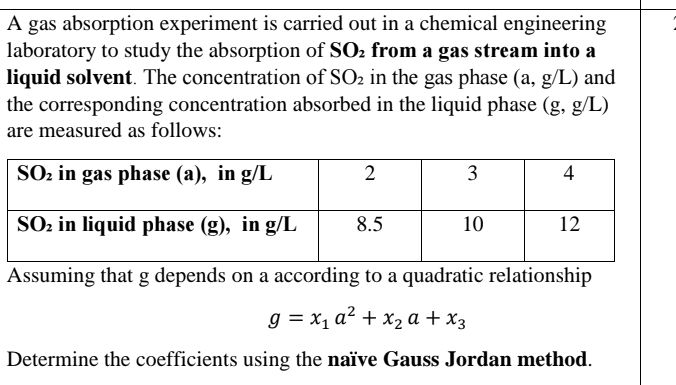 A gas absorption experiment is carried out in a chemical engineering
laboratory to study the absorption of SO: from a gas stream into a
liquid solvent. The concentration of SO: in the gas phase (a, g/L) and
the corresponding concentration absorbed in the liquid phase (g, g/L)
are measured as follows:
Assuming that g depends on a according to a quadratic relationship
g=x,a%+x,a+x;
Determine the coefficients using the naive Gauss Jordan method.
This is AI generated Response.
Asked by: Francis
Created at: 2026-01-19 09:32:16
Asked by: Francis
Created at: 2026-01-19 09:32:16
Final Answer:
Rendered
Raw Text
Did you like this answer?
Let's solve the problem step by step using the **naïve Gauss-Jordan elimination method**.
### 1. **Write the equations**
Given the quadratic relationship:
\[
g = x_1 a^2 + x_2 a + x_3
\]
From the table:
- When \( a = 2 \), \( g = 8.5 \)
- When \( a = 3 \), \( g = 10 \)
- When \( a = 4 \), \( g = 12 \)
So, set up the system:
\[
\begin{cases}
8.5 = x_1 (2^2) + x_2 (2) + x_3 \\
10 = x_1 (3^2) + x_2 (3) + x_3 \\
12 = x_1 (4^2) + x_2 (4) + x_3 \\
\end{cases}
\]
This simplifies to:
\[
\begin{cases}
8.5 = 4x_1 + 2x_2 + x_3 \\
10 = 9x_1 + 3x_2 + x_3 \\
12 = 16x_1 + 4x_2 + x_3 \\
\end{cases}
\]
### 2. **Set up the augmented matrix**
\[
\begin{bmatrix}
4 & 2 & 1 & | & 8.5 \\
9 & 3 & 1 & | & 10 \\
16 & 4 & 1 & | & 12 \\
\end{bmatrix}
\]
### 3. **Naïve Gauss-Jordan Elimination**
First, make the leading coefficient of the first row 1:
Row 1: Divide by 4:
\[
[1 \quad .5 \quad .25 \mid 2.125]
\]
Row 2: Subtract 9 × Row 1 from Row 2:
\[
[ \quad -1.5 \quad -1.25 \mid -9.125]
\]
Row 3: Subtract 16 × Row 1 from Row 3:
\[
[ \quad -4 \quad -3 \mid -21]
\]
Now, divide Row 2 by -1.5:
\[
[ \quad 1 \quad (5/6) \mid (9.125/1.5)]
\]
\( 9.125/1.5 = 6.0833 \), \( -1.25/-1.5 = .8333 \) so:
\[
[ \quad 1 \quad .8333 \mid 6.0833]
\]
Now, Row 3 minus (-4) × Row 2:
Row3: \( [ \quad -4 \quad -3 \mid -21] \)
Add \(4 \times\) (Row2): \( [ \quad 4 \quad 3.3332 \mid 24.3332] \)
So, add:
\[
[ \quad \quad .3332 \mid 3.3332]
\]
Divide Row 3 by .3332:
\[
[ \quad \quad 1 \mid 10]
\]
Now back substitute:
Row 2: \( x_2 + .8333 x_3 = 6.0833 \)
But \( x_3 = 10 \), so
\( x_2 + .8333 \times 10 = 6.0833 \)
\( x_2 + 8.333 = 6.0833 \)
\( x_2 = 6.0833 - 8.333 = -2.25 \)
Row 1: \( x_1 + .5x_2 + .25x_3 = 2.125 \)
So \( x_1 + .5(-2.25) + .25(10) = 2.125 \)
\( x_1 - 1.125 + 2.5 = 2.125 \)
\( x_1 + 1.375 = 2.125 \)
\( x_1 = 2.125 - 1.375 = .75 \)
### 4. **Final answer**
The coefficients are:
\[
\boxed{x_1 = .75, \quad x_2 = -2.25, \quad x_3 = 10}
\]
So, the quadratic relationship is:
\[
\boxed{g = .75 a^2 - 2.25 a + 10}
\]
📢 Instructions:
- Ask anything relatd to above question only.
- For new Question goto :