 VIPSolutions
Give step-by-step solution with explanation and final answer:Ee)
Question:
Give step-by-step solution with explanation and final answer: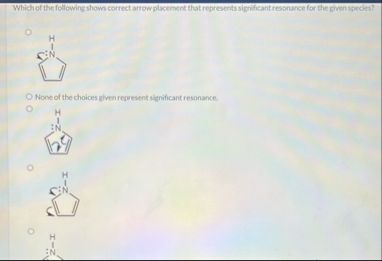 Ee)
This is AI generated Response.
Asked by: Rahul
Created at: 2026-01-19 06:19:13
Asked by: Rahul
Created at: 2026-01-19 06:19:13
Final Answer:
Rendered
Raw Text
Did you like this answer?
Let's break down the question and analyze each option step by step:
---
## Step 1: Understanding the Molecule
The molecule shown in all answer choices is **pyrrole**, a 5-membered aromatic heterocycle with the formula C₄H₅N. Pyrrole is aromatic because it has a **lone pair on nitrogen** that participates in the aromatic π-system, making it a 6 π-electron system (4 from the double bonds + 2 from the N lone pair).
## Step 2: Resonance in Pyrrole
The significant resonance structure of pyrrole involves movement of electrons that **delocalizes the lone pair on nitrogen** into the ring, forming double bonds between the carbon atoms and the nitrogen, and generating a negative charge on one of the carbons.
The correct resonance arrow movement should:
1. Move the nitrogen lone pair to form a double bond between N and adjacent C.
2. Move a double bond to the next position to maintain the aromaticity.
---
## Step 3: Evaluating the Choices
Let's analyze the curved arrow placement in each choice:
### **Option 1** (Top)
- Arrow from N lone pair to bond between N and C (correct)
- Arrow from C=C bond to next C (correct)
- This is the standard resonance movement for pyrrole.
### **Option 2**
- Arrow from C=C bond to N (incorrect: this would make N have too many bonds/electrons and disrupt aromaticity)
### **Option 3**
- Arrow from C-H bond to N (incorrect: this is not a typical resonance movement and would create an unstable carbanion)
### **Option 4**
- Arrow from C-N bond to N (incorrect: breaks aromaticity and overfills N's octet)
### **Option 5**
- "None of the choices..." (used if none are correct, but as shown above, Option 1 is correct)
---
## Step 4: **Final Answer**
### **The correct answer is the first option** (topmost structure).
**Explanation:**
The first option correctly shows the movement of the nitrogen lone pair forming a double bond between N and C, and the movement of a π bond to the adjacent carbon, preserving aromaticity and charge balance.
---
## **Summary Table**
| Option | Arrow Placement | Resonance? | Correct? |
|--------|----------------|------------|----------|
| 1 | N lone pair → N−C, C=C → next C | YES | **YES** |
| 2 | C=C → N | NO | NO |
| 3 | C−H → N | NO | NO |
| 4 | C−N → N | NO | NO |
| 5 | None | N/A | NO |
---
## **Final Answer**
> **The first option (topmost structure) shows the correct arrow placement for significant resonance in pyrrole.**
📢 Instructions:
- Ask anything relatd to above question only.
- For new Question goto :