 VIPSolutions
Give step-by-step solution with explanation and final answer:A
Question:
Give step-by-step solution with explanation and final answer: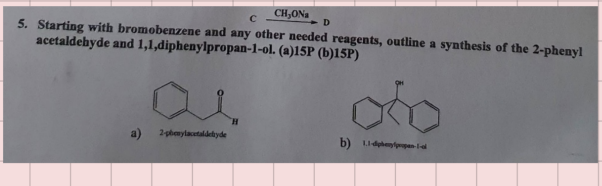 A
This is AI generated Response.
Asked by: Rahul
Created at: 2026-01-18 19:49:22
Asked by: Rahul
Created at: 2026-01-18 19:49:22
Final Answer:
Rendered
Raw Text
Did you like this answer?
Let's break down the synthesis of both compounds starting from **bromobenzene**.
---
## **(a) Synthesis of 2-Phenylacetaldehyde**
### **Target Structure**
2-Phenylacetaldehyde:
**C₆H₅–CH₂–CHO**
### **Stepwise Solution**
#### **Step 1: Formation of Benzyl Cyanide (Nitrile)**
Convert bromobenzene to benzyl cyanide via a two-step process:
1. **Friedel–Crafts Alkylation**
- **Reactants:** Bromobenzene, CH₂Cl₂, AlCl₃
- **Product:** Benzyl chloride (C₆H₅CH₂Cl)
2. **Nucleophilic Substitution**
- **Reactants:** Benzyl chloride, NaCN
- **Product:** Benzyl cyanide (C₆H₅CH₂CN)
#### **Step 2: Reduction of Nitrile to Aldehyde**
- **Reactant:** Benzyl cyanide (C₆H₅CH₂CN)
- **Partial Reduction:** DIBAL-H (Diisobutylaluminum hydride) at low temperature
- **Product:** 2-Phenylacetaldehyde (C₆H₅CH₂CHO)
---
### **Summary (a):**
1. **C₆H₅Br** → (**Friedel–Crafts + Alkyl halide formation**) → **C₆H₅CH₂Cl**
2. **C₆H₅CH₂Cl** + **NaCN** → **C₆H₅CH₂CN**
3. **C₆H₅CH₂CN** + **DIBAL-H** → **C₆H₅CH₂CHO** (2-Phenylacetaldehyde)
---
## **(b) Synthesis of 1,1-Diphenylpropan-1-ol**
### **Target Structure**
1,1-Diphenylpropan-1-ol:
**C₆H₅–C(OH)(C₆H₅)–CH₂CH₃**
### **Stepwise Solution**
#### **Step 1: Formation of Benzophenone**
- **Friedel–Crafts Acylation**
- **Reactants:** Bromobenzene, benzoyl chloride (C₆H₅COCl), AlCl₃
- **Product:** Benzophenone (C₆H₅COC₆H₅)
#### **Step 2: Grignard Reaction**
- **Preparation of Phenylmagnesium Bromide (Grignard Reagent):**
- **Reactants:** Bromobenzene + Mg in dry ether → C₆H₅MgBr
- **Alkylation:**
- **Reactants:** Benzophenone + ethyl bromide (C₂H₅Br) in presence of C₆H₅MgBr
- **Mechanism:**
1. Ethylmagnesium bromide (C₂H₅MgBr) attacks the carbonyl carbon of benzophenone.
2. Upon acidic workup, forms 1,1-diphenylpropan-1-ol.
---
### **Summary (b):**
1. **C₆H₅Br** → (**Mg, dry ether**) → **C₆H₅MgBr**
2. **C₆H₅MgBr** + **C₆H₅COCl** → **C₆H₅COC₆H₅** (Benzophenone)
3. **C₆H₅COC₆H₅** + **C₂H₅MgBr** → **1,1-diphenylpropan-1-ol (after acidic workup)**
---
## **Final Answers**
### **(a) Synthesis of 2-Phenylacetaldehyde**
1. **Bromobenzene** → **Benzyl chloride** (via Friedel–Crafts alkylation)
2. **Benzyl chloride** → **Benzyl cyanide** (via NaCN)
3. **Benzyl cyanide** → **2-Phenylacetaldehyde** (via DIBAL-H reduction)
### **(b) Synthesis of 1,1-Diphenylpropan-1-ol**
1. **Bromobenzene** → **Phenylmagnesium bromide** (Grignard reagent)
2. **Phenylmagnesium bromide** + **Benzoyl chloride** → **Benzophenone**
3. **Benzophenone** + **Ethylmagnesium bromide** → **1,1-diphenylpropan-1-ol** (after hydrolysis)
---
### **Reaction Schemes**
#### **a)**
```
C6H5Br → [Friedel–Crafts] → C6H5CH2Cl → [NaCN] → C6H5CH2CN → [DIBAL-H] → C6H5CH2CHO
```
#### **b)**
```
C6H5Br → [Mg/ether] → C6H5MgBr
2C6H5MgBr + C2H5COCl → (C6H5)2CO (Benzophenone)
(C6H5)2CO + C2H5MgBr → (C6H5)2C(OH)CH2CH3
```
If you need detailed mechanisms or reagent conditions, let me know!
📢 Instructions:
- Ask anything relatd to above question only.
- For new Question goto :