 VIPSolutions
Give step-by-step solution with explanation and final answer:4-pyranone will readily undergo an acid-base reaction. Identify the reaction conditions that wil result in the formation of an aromatic product. Then, draw the aromatic resonance product structure. Include all lone pairs in your structure. Ignore inorganic byproducts. = 2 CY JE ™) brag To! H HO" i i : Atoms, Bonds Charges and H i and Rings Lone Pairs TTT Draw or tap a new bond to see suggestions. « wr Undo Ri ’ \ 1 H : Co H Drawing ' Remove = Done H i (+) | 0 v
Question:
Give step-by-step solution with explanation and final answer: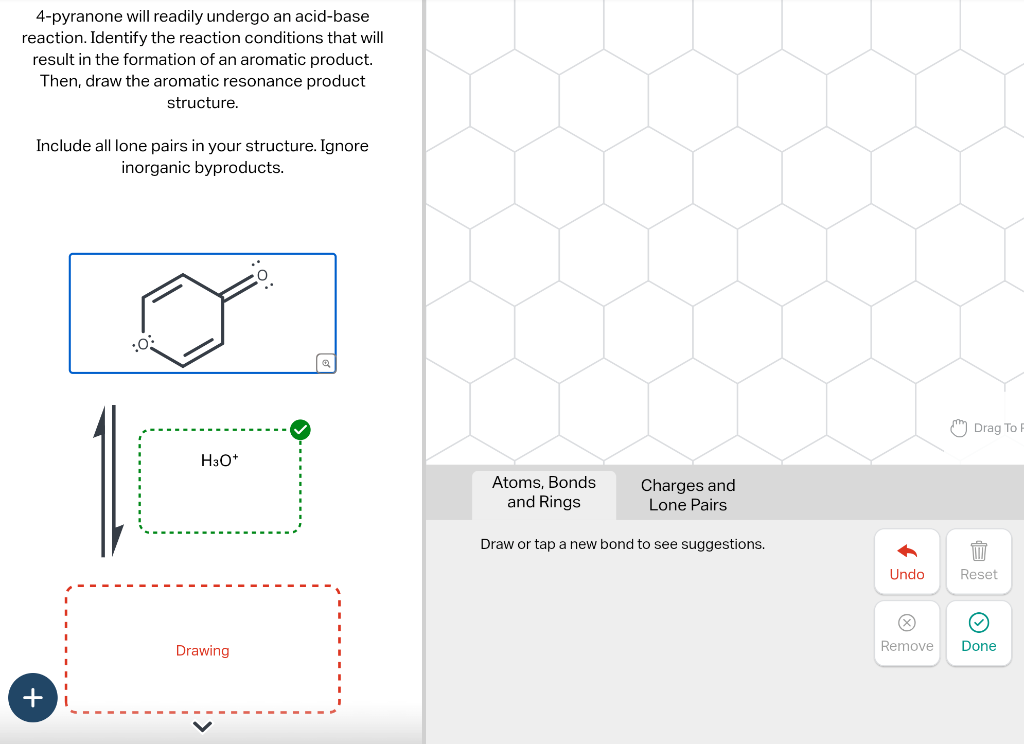 4-pyranone will readily undergo an acid-base
reaction. Identify the reaction conditions that wil
result in the formation of an aromatic product.
Then, draw the aromatic resonance product
structure.
Include all lone pairs in your structure. Ignore
inorganic byproducts.
= 2
CY
JE ™) brag To!
H HO" i
i : Atoms, Bonds Charges and
H i and Rings Lone Pairs
TTT Draw or tap a new bond to see suggestions. « wr
Undo Ri
’ \
1 H
: Co
H Drawing ' Remove = Done
H i
(+) | 0
v
This is AI generated Response.
Asked by: Rahul
Created at: 2026-01-18 17:51:05
Asked by: Rahul
Created at: 2026-01-18 17:51:05
Final Answer:
Rendered
Raw Text
Did you like this answer?
Let's break down the problem and provide a step-by-step solution:
---
## **Step 1: Identify the Reaction Conditions**
The substrate is **4-pyranone**, which is a six-membered ring containing an oxygen atom and a ketone at the 4-position.
The reaction conditions are **acidic (H₃O⁺)**.
---
## **Step 2: Mechanism Overview**
Under acidic conditions, 4-pyranone can tautomerize via an acid-catalyzed reaction to form **phenol**, which is aromatic. Here’s the process:
1. **Protonation of the carbonyl oxygen** (makes the carbonyl more electrophilic).
2. **Enolization (keto-enol tautomerization)**: Proton transfer and deprotonation at the alpha carbon, resulting in the formation of a double bond and an alcohol group.
3. **Aromatic resonance stabilization**: The resulting structure is aromatic and resonance stabilized (phenol).
---
## **Step 3: Draw the Aromatic Resonance Product**
### **Structure and Lone Pairs:**
The final aromatic product is **phenol**:
- Six-membered benzene ring.
- One carbon bears an OH group (phenol).
- Each oxygen has two lone pairs.
- All other atoms have their standard lone pairs (if any).
**Resonance:** The negative charge from the enolate intermediate is delocalized into the ring, forming the aromatic system.
---
### **Step 4: Final Answer and Drawing**
Here’s how you should draw the structure (with lone pairs):
1. **Draw a benzene ring**.
2. **Attach an OH group to one carbon** (this is phenol).
3. **Add two lone pairs on the oxygen atom of the OH group**.
---
#### **Summary Table**
| Step | Structure/Action | Notes |
|---------------|------------------------------|---------------------------------------------------|
| Start | 4-pyranone | Six-membered ring, O at position 1, C=O at 4 |
| Acid Catalysis| Add H₃O⁺ (protonation) | Protonates carbonyl, enables enolization |
| Tautomerize | Enol (phenol) formation | Double bond forms, aromatic stabilization |
| Final | Aromatic phenol (resonance) | Benzene ring with OH, two lone pairs on O |
---
### **Final Product Drawing**
Below is a simple diagram of the structure you should draw:
```
____
/ \
| |
| |
\____/
|
OH
```
- It's a benzene ring with an OH group attached to one carbon.
- Add two lone pairs to the O atom of the OH group.
---
## **Summary**
- **Reaction conditions:** Acidic (H₃O⁺)
- **Aromatic product:** Phenol (benzene ring with an OH group)
- **Include all lone pairs on the oxygen atom in your drawing**
Let me know if you need a stepwise electron-pushing mechanism or a more detailed resonance structure!
📢 Instructions:
- Ask anything relatd to above question only.
- For new Question goto :