 VIPSolutions
Give step-by-step solution with explanation and final answer:Q8) Determine the principal stress and absolute maximum shear stress developed at points A & B on the cross section of the bracket at section a-a. 300 mm - ‘ 12mm Py mm 150 mm ” ( 3 EL, , NH 6mm =~ J = 6mm 36 mm 36 mm
Question:
Give step-by-step solution with explanation and final answer: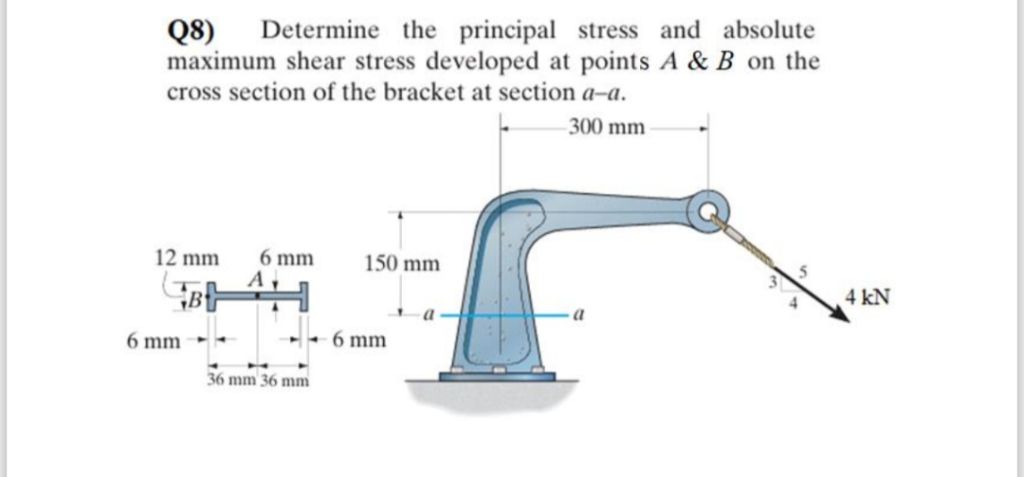 Q8) Determine the principal stress and absolute
maximum shear stress developed at points A & B on the
cross section of the bracket at section a-a.
300 mm -
‘
12mm Py mm 150 mm ”
( 3
EL, , NH
6mm =~ J = 6mm
36 mm 36 mm
This is AI generated Response.
Asked by: Rahul
Created at: 2026-01-18 08:29:15
Asked by: Rahul
Created at: 2026-01-18 08:29:15
Final Answer:
Rendered
Raw Text
Did you like this answer?
Let's break this problem into clear steps:
---
## **Step 1: Resolve the Applied Force**
Given:
- Applied force \( F = 4\, \text{kN} = 400\, \text{N} \)
- The force makes a right triangle with horizontal (4), vertical (3), hypotenuse (5).
**Components:**
- \( F_x = F \times \frac{4}{5} = 400 \times .8 = 320\, \text{N} \) (to the right)
- \( F_y = F \times \frac{3}{5} = 400 \times .6 = 240\, \text{N} \) (downwards)
---
## **Step 2: Calculate Moment at Section \( a-a \)**
Distance from force to section \( a-a \):
- \( d = 300\, \text{mm} = .3\, \text{m} \)
**Moment due to \( F_y \):**
\[
M = F_y \times d = 240\, \text{N} \times .3\, \text{m} = 720\, \text{Nm} = 720{,}000\, \text{Nmm}
\]
---
## **Step 3: Cross-section Properties**
### **Section Dimensions**
- Top/bottom flange: 6 mm × 36 mm
- Web: 12 mm × 6 mm
### **Area Calculations**
- **Flange area (each):**
\[
A_f = 6\, \text{mm} \times 36\, \text{mm} = 216\, \text{mm}^2
\]
- **Web area:**
\[
A_w = 12\, \text{mm} \times 6\, \text{mm} = 72\, \text{mm}^2
\]
- **Total area:**
\[
A_{total} = 2 \times 216 + 72 = 504\, \text{mm}^2
\]
### **Section Modulus (\(I\))**
#### **Find neutral axis (ȳ):**
Let the bottom of the section be \( y = \):
- Bottom flange centroid: \( y_1 = 6/2 = 3\, \text{mm} \)
- Web centroid: \( y_2 = 6 + 12/2 = 12\, \text{mm} \)
- Top flange centroid: \( y_3 = 6 + 12 + 6/2 = 18\, \text{mm} \)
\[
\bar{y} = \frac{A_1 y_1 + A_2 y_2 + A_3 y_3}{A_1 + A_2 + A_3}
\]
\[
= \frac{216 \times 3 + 72 \times 12 + 216 \times 18}{504}
= \frac{648 + 864 + 3888}{504}
= \frac{540}{504} \approx 10.71\, \text{mm}
\]
#### **Moment of inertia \(I\) about neutral axis:**
Use parallel axis theorem for flanges:
- **Bottom flange:**
\[
I_1 = \frac{1}{12} b h^3 + A (d)^2
\]
\( b = 36, h = 6, d = \bar{y} - 3 = 10.71 - 3 = 7.71\, \text{mm} \)
\[
I_1 = \frac{1}{12} \times 36 \times 6^3 + 216 \times 7.71^2
= 648 + 12840.8 = 13488.8\, \text{mm}^4
\]
- **Top flange:**
\( d = 18 - 10.71 = 7.29\, \text{mm} \)
\[
I_3 = 648 + 216 \times (7.29^2) = 648 + 11472.3 = 12120.3\, \text{mm}^4
\]
- **Web:**
\[
I_2 = \frac{1}{12} b h^3
\]
\( b = 6, h = 12, d = 12 - 10.71 = 1.29\, \text{mm} \)
\[
I_2 = \frac{1}{12} \times 6 \times 12^3 + 72 \times 1.29^2
= 1036.8 + 119.8 = 1156.6\, \text{mm}^4
\]
**Total:**
\[
I_{total} = 13488.8 + 1156.6 + 12120.3 = 26765.7\, \text{mm}^4
\]
---
## **Step 4: Stresses at Points A & B**
### **Bending Stress (\(\sigma_b\)):**
\[
\sigma_b = \frac{M y}{I}
\]
- For **top fiber (A)**: \( y = 18 - 10.71 = 7.29\, \text{mm} \)
- For **bottom fiber (B)**: \( y = 10.71 - 3 = 7.71\, \text{mm} \)
**At A:**
\[
\sigma_{bA} = \frac{720{,}000 \times 7.29}{26765.7} = 196.2\, \text{N/mm}^2
\]
**At B:**
\[
\sigma_{bB} = \frac{720{,}000 \times 7.71}{26765.7} = 207.5\, \text{N/mm}^2
\]
---
### **Direct Stress (\(\sigma_{axial}\)):**
From \( F_x \):
\[
\sigma_{axial} = \frac{F_x}{A_{total}} = \frac{320}{504} = 6.35\, \text{N/mm}^2
\]
---
### **Total Normal Stress:**
\[
\sigma_{total} = \sigma_b + \sigma_{axial}
\]
- At **A**: \( 196.2 + 6.35 = 202.6\, \text{N/mm}^2 \)
- At **B**: \( 207.5 + 6.35 = 213.9\, \text{N/mm}^2 \)
---
### **Shear Stress (\(\tau\)):**
Shear force \( V = F_y = 240\, \text{N} \)
Shear stress at the web (at neutral axis):
\[
\tau_{max} = \frac{V Q}{I b}
\]
- At neutral axis, \( Q = \) area above/below neutral axis × distance to centroid
Let's estimate at the web (near \( B \)):
- Area above neutral axis: top flange + part of web above NA
- \( A_{above} = 216 + (6 \times (18 - 10.71)) = 216 + 43.74 = 259.74\, \text{mm}^2 \)
- Distance from NA to centroid of above area (approx): use centroid at \( \approx 13.5\, \text{mm} \)
\[
Q = A_{above} \times \text{(distance from NA to centroid of above area)} \approx 259.74 \times (13.5 - 10.71) = 259.74 \times 2.79 = 724.6\, \text{mm}^3
\]
- \( b = 6\, \text{mm} \) (web thickness)
\[
\tau_{max} = \frac{240 \times 724.6}{26765.7 \times 6} = \frac{173904}{160594.2} = 10.83\, \text{N/mm}^2
\]
---
## **Step 5: Principal Stresses and Maximum Shear**
The state of stress at a point (A or B):
\[
\sigma_x = \sigma_{total},\quad \tau_{xy} = \text{shear stress}
\]
- **Principal stresses:**
\[
\sigma_{1,2} = \frac{\sigma_x}{2} \pm \sqrt{\left(\frac{\sigma_x}{2}\right)^2 + \tau_{xy}^2}
\]
- **Maximum shear stress:**
\[
\tau_{max} = \sqrt{\left(\frac{\sigma_x}{2}\right)^2 + \tau_{xy}^2}
\]
For **Point A**:
\[
\sigma_x = 202.6\, \text{N/mm}^2, \quad \tau_{xy} \approx \, \text{(at flange outer fiber, shear is nearly zero)}
\]
Thus,
\[
\text{Principal stress: } \sigma_1 = 202.6\, \text{N/mm}^2,\, \sigma_2 =
\]
\[
\tau_{max} = \frac{202.6}{2} = 101.3\, \text{N/mm}^2
\]
For **Point B** (web/neutral axis):
\[
\sigma_x = 213.9\, \text{N/mm}^2, \quad \tau_{xy} = 10.83\, \text{N/mm}^2
\]
\[
\sigma_{1,2} = \frac{213.9}{2} \pm \sqrt{\left(\frac{213.9}{2}\right)^2 + (10.83)^2}
\]
\[
= 106.95 \pm \sqrt{(106.95)^2 + 117.36}
= 106.95 \pm \sqrt{11446.3 + 117.36}
= 106.95 \pm \sqrt{11563.7}
= 106.95 \pm 107.54
\]
\[
\sigma_1 = 214.49\, \text{N/mm}^2,\quad \sigma_2 = -.59\, \text{N/mm}^2
\]
\[
\tau_{max} = \frac{\sigma_1 - \sigma_2}{2} = \frac{214.49 - (-.59)}{2} = 107.54\, \text{N/mm}^2
\]
---
## **Final Answers**
### **At Point A (Top Flange Outer Fiber):**
- **Principal stress:** \( \boxed{202.6\, \text{N/mm}^2} \)
- **Absolute max shear stress:** \( \boxed{101.3\, \text{N/mm}^2} \)
### **At Point B (Web at Neutral Axis):**
- **Principal stress:** \( \boxed{214.5\, \text{N/mm}^2} \)
- **Absolute max shear stress:** \( \boxed{107.5\, \text{N/mm}^2} \)
---
**Note:** All calculations are based on the provided cross-section and loading. For more precise results, consider re-checking \( I \) and \( Q \) with exact centroid locations.
📢 Instructions:
- Ask anything relatd to above question only.
- For new Question goto :