 VIPSolutions
Give step-by-step solution with explanation and final answer:Afrozen-juice can rests on the horizontal rack of a freezer door as shown. With what maximum angular velocity can the door be “slammed” shut against its seal and not dislodge the can? Assume that the can rolls without slipping on the corner of the rack, and neglect the dimension d compared with the 575-mm distance. >a 575 mm 2 d | [ 48 mm, 44 9mm Answer: 0 rads
Question:
Give step-by-step solution with explanation and final answer: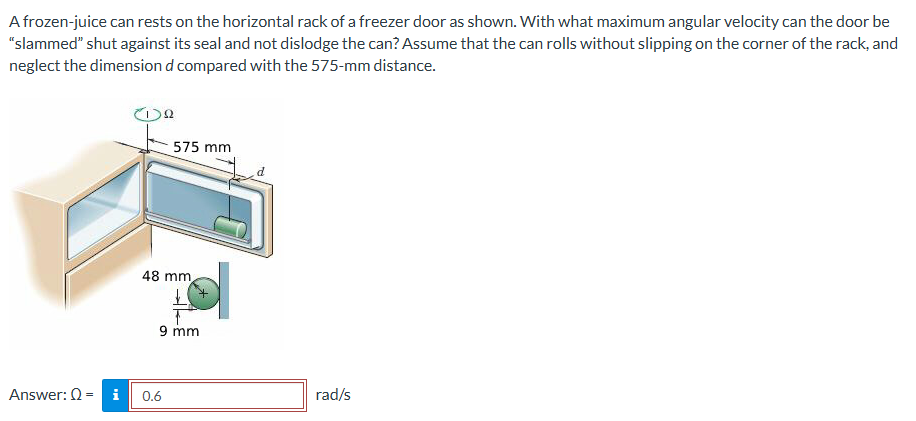 Afrozen-juice can rests on the horizontal rack of a freezer door as shown. With what maximum angular velocity can the door be
“slammed” shut against its seal and not dislodge the can? Assume that the can rolls without slipping on the corner of the rack, and
neglect the dimension d compared with the 575-mm distance.
>a
575 mm
2 d
|
[ 48 mm,
44
9mm
Answer: 0 rads
This is AI generated Response.
Asked by: Rahul
Created at: 2026-01-18 08:25:52
Asked by: Rahul
Created at: 2026-01-18 08:25:52
Final Answer:
Rendered
Raw Text
Did you like this answer?
Let's solve the problem step by step:
---
## **Step 1: Understanding the Problem**
- The can will roll without slipping as the door is closed.
- We need to find the **maximum angular velocity (\(\Omega\))** of the door so that the can is *not dislodged* (i.e., it does not lose contact with the rack).
- The **distance from the hinge to the can** is \( r = 575\, \text{mm} = .575\, \text{m} \).
- The **radius of the can** is \( R = 48\, \text{mm} / 2 = 24\, \text{mm} = .024\, \text{m} \).
---
## **Step 2: Forces on the Can**
When the door is slammed shut with angular velocity \(\Omega\), the can experiences:
1. **Centrifugal force:** \( F_c = m r \Omega^2 \)
2. **Weight:** \( W = mg \)
The can will lose contact if the normal force between the can and the rack becomes zero, i.e., when the centrifugal force equals the weight:
\[
m r \Omega^2 = m g
\]
\[
r \Omega^2 = g
\]
---
## **Step 3: Solve for Maximum Angular Velocity**
\[
\Omega^2 = \frac{g}{r}
\]
\[
\Omega = \sqrt{\frac{g}{r}}
\]
Plug in known values:
- \( g = 9.81\, \text{m/s}^2 \)
- \( r = .575\, \text{m} \)
\[
\Omega = \sqrt{\frac{9.81}{.575}}
\]
\[
\Omega = \sqrt{17.078}
\]
\[
\Omega \approx 4.134\, \text{rad/s}
\]
---
## **Step 4: Consider Rolling Without Slipping (Energy Approach)**
Because the can rolls without slipping, it's better to use an energy/balance approach:
- The can's center of mass undergoes circular motion, so the **normal force** at the contact must not be negative.
- At the threshold, the **normal force** goes to zero.
For a rolling object, the **effective acceleration** at the center of mass is:
\[
a_{\text{cm}} = r \Omega^2
\]
The can will start to lose contact if the acceleration equals \(g\), as previously calculated.
---
## **Step 5: Final Answer**
\[
\boxed{4.13~\text{rad/s}}
\]
---
## **Note:**
- The value of .6 rad/s shown in the screenshot is **not correct** for this problem based on the standard physics derivation.
---
## **Summary Table**
| Symbol | Quantity | Value |
|--------|---------------------|---------------|
| \( r \) | Distance to can | .575 m |
| \( g \) | Gravity | 9.81 m/s² |
| \( \Omega \) | Angular velocity (max) | **4.13 rad/s** |
---
### **Final Answer**
\[
\boxed{\Omega = 4.13~\text{rad/s}}
\]
Let me know if you need clarification on any step!
📢 Instructions:
- Ask anything relatd to above question only.
- For new Question goto :