 VIPSolutions
Give step-by-step solution with explanation and final answer:Curved arrows are used to illustrate the flow of electrons. Using the provided starting and product structures, draw the curved electron-pushing arrows for the following reaction or mechanistic step(s). Be sure to account for all bond-breaking and bond-making steps. i ; " H t ! H H ell : No... SeecioAsATom H Ho nest
Question:
Give step-by-step solution with explanation and final answer: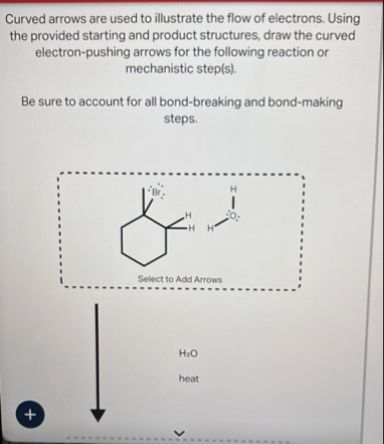 Curved arrows are used to illustrate the flow of electrons. Using
the provided starting and product structures, draw the curved
electron-pushing arrows for the following reaction or
mechanistic step(s).
Be sure to account for all bond-breaking and bond-making
steps.
i ; " H
t ! H
H ell :
No... SeecioAsATom H
Ho
nest
This is AI generated Response.
Asked by: Rahul
Created at: 2026-01-18 03:40:31
Asked by: Rahul
Created at: 2026-01-18 03:40:31
Final Answer:
Rendered
Raw Text
Did you like this answer?
Let's break down this reaction step by step using curved-arrow (electron pushing) notation.
---
## **Step 1: Analyze the Reactants**
- **Reactant:** Cyclohexane ring with a Br and an OH₂ (hydronium) group on adjacent carbons.
- **Reagents:** Water (H₂O) and heat.
This setup suggests an **E1 elimination reaction** (since Br is a good leaving group, and water can act as a base).
---
## **Step 2: Mechanism Steps**
### **Step 1: Loss of Leaving Group (Br⁻)**
- The electron pair from the C–Br bond moves onto Br, causing Br to leave as Br⁻.
- This generates a **carbocation** at the carbon that was attached to Br.
**Curved Arrow:**
From the bond between the carbon and Br → onto Br.
### **Step 2: Deprotonation to Form Alkene**
- Water (H₂O) acts as a base and removes a proton (H⁺) from the carbon adjacent to the carbocation (the carbon that had the OH₂ group).
- The electron pair from the C–H bond forms a double bond (π bond) between the two carbons.
**Curved Arrow:**
From the lone pair on H₂O → to the hydrogen on the carbon adjacent to the carbocation.
From the C–H bond → to form a double bond between the two carbons.
---
## **Step 3: Draw the Product**
- The product will be a cyclohexene (with a double bond between the two previously substituted carbons), and water (H₃O⁺) and Br⁻ as byproducts.
---
## **Step-by-Step Mechanism with Curved Arrows**
### **Step 1: Loss of Br⁻**
```
Br
|
—C—C—OH2+
|
(rest of ring)
Curved Arrow: C—Br bond → Br
```
### **Step 2: Deprotonation and Double Bond Formation**
```
(+)
|
—C═C—
|
(rest of ring)
Curved Arrow: Lone pair on H₂O → H on neighboring C;
C—H bond → C=C double bond
```
---
## **Final Answer: Summary**
### **Mechanism Steps:**
1. **Br leaves, forming a carbocation.**
2. **Water deprotonates adjacent carbon, forming a double bond (alkene).**
### **Product:**
- **Cyclohexene** (double bond where Br and OH₂⁺ were initially attached)
---
### **Overall Curved Arrow Mechanism**
1. **C–Br bond → Br** (Br leaves)
2. **H₂O lone pair → H** (on carbon next to carbocation)
3. **C–H bond → C=C** (double bond forms)
---
### **Visual Summary**
```
Step 1: Step 2:
Br H
| |
—C—C—OH2+ → —C═C—
| |
(rest of ring) (rest of ring)
|
Curved arrows as described above.
```
---
**This is a classic E1 elimination mechanism. Let me know if you'd like a drawn arrow diagram!**
📢 Instructions:
- Ask anything relatd to above question only.
- For new Question goto :