 VIPSolutions
Give step-by-step solution with explanation and final answer:2. (15 points: a-c 2pts, d 4pts, e-f 2.5pts) For the Linkage shown below: (a) how many links (I) are there? Number the links starting with 1 (don’t forget the ground” link) (b) Label all joints alphabetically starting with A. How many full joints (J;) are there? List them and describe their type. (c) How many half joints (Jz) are there? List them and describe their type. (d) Calculate the mobility using the Kutzbach revision of Gruebler equation. (€) Use linkage transformation to make the linkage have 2 DOF. (£) Use linkage transformation to make the linkage have 1 DOF. 7 _Q = ANY KR = \ .
Question:
Give step-by-step solution with explanation and final answer: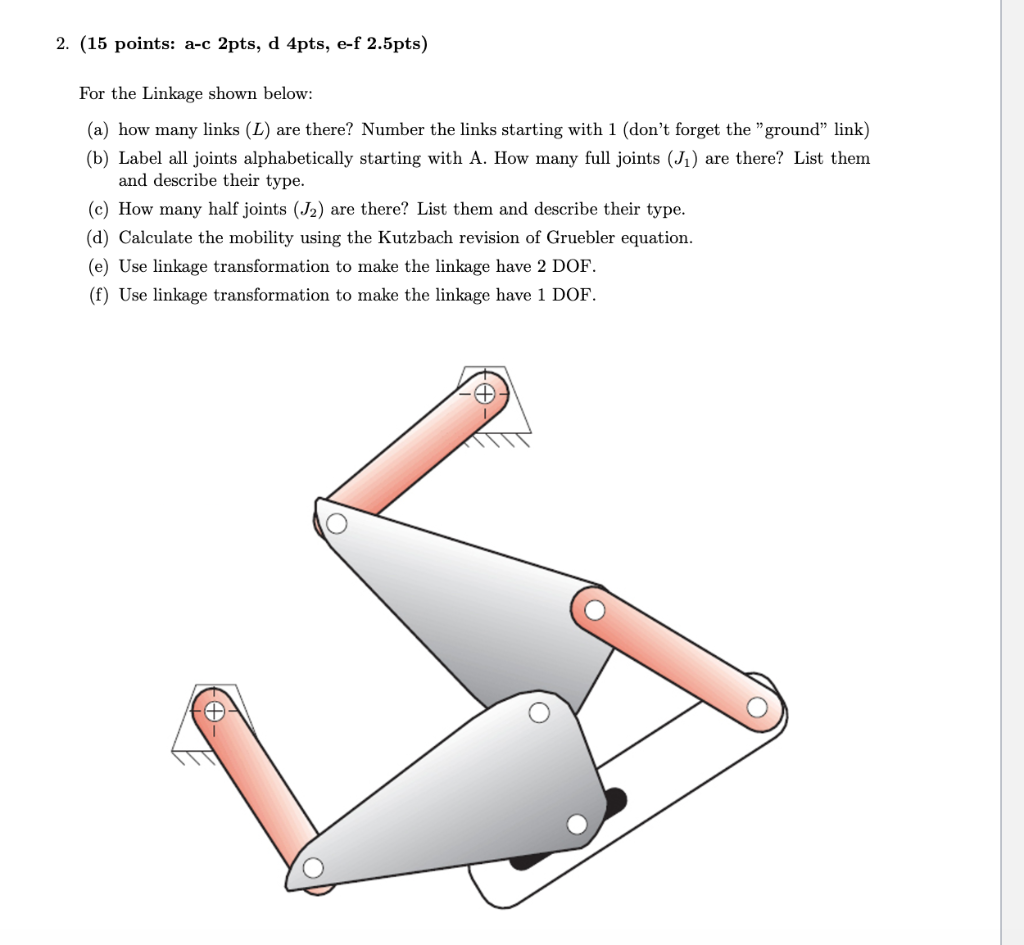 2. (15 points: a-c 2pts, d 4pts, e-f 2.5pts)
For the Linkage shown below:
(a) how many links (I) are there? Number the links starting with 1 (don’t forget the ground” link)
(b) Label all joints alphabetically starting with A. How many full joints (J;) are there? List them
and describe their type.
(c) How many half joints (Jz) are there? List them and describe their type.
(d) Calculate the mobility using the Kutzbach revision of Gruebler equation.
(€) Use linkage transformation to make the linkage have 2 DOF.
(£) Use linkage transformation to make the linkage have 1 DOF.
7
_Q
= ANY
KR =
\ .
This is AI generated Response.
Asked by: Rahul
Created at: 2026-01-18 03:27:13
Asked by: Rahul
Created at: 2026-01-18 03:27:13
Final Answer:
Rendered
Raw Text
Did you like this answer?
# Step-by-Step Solution
Let's address each part (a)-(f) for the given mechanism:
---
## (a) **How many links (L) are there? Number the links starting with 1 (include "ground" link)**
- **Links are rigid members between joints.**
- **Ground link:** The fixed frame (grey base).
- **Moving links:** Each rigid body between joints.
Let's count:
1. **Ground Link (1)**
2. **Top horizontal link (2)**
3. **Top triangle link (3)**
4. **Bottom triangle link (4)**
5. **Bottom horizontal link (5)**
**Total Links, \( L = 5 \)**
---
## (b) **Label all joints alphabetically starting with A. How many full joints (\( J_1 \)) are there? List and describe their type.**
### **Label the Joints:**
Let's label the visible pin joints:
- **A:** Top left pin (connects ground, link 2, link 3)
- **B:** Top right pin (connects link 2, link 3)
- **C:** Bottom left pin (connects ground, link 4, link 5)
- **D:** Bottom right pin (connects link 4, link 5)
- **E:** Middle pin (connects link 3, link 4, link 5)
### **Count Full Joints (\( J_1 \)):**
- **Full joint:** A joint that constrains two links together with one relative motion (e.g., a revolute pin joint).
- Each visible pin is a full joint.
**Types:** All appear to be revolute (pin) joints.
**List:**
- **A:** Revolute
- **B:** Revolute
- **C:** Revolute
- **D:** Revolute
- **E:** Revolute
**Total Full Joints, \( J_1 = 5 \)**
---
## (c) **How many half joints (\( J_2 \)) are there? List and describe their type.**
- **Half joint:** A joint that constrains only one DOF (e.g., a sliding or prismatic joint).
- **In the diagram:** All joints are pin (revolute) joints, so **no half joints** are present.
**Total Half Joints, \( J_2 = \)**
---
## (d) **Calculate the mobility using the Kutzbach revision of Gruebler equation.**
### **Kutzbach Criterion (for planar linkage):**
\[
M = 3(L-1) - 2J_1 - J_2
\]
Where:
- \( L = 5 \)
- \( J_1 = 5 \)
- \( J_2 = \)
\[
M = 3(5-1) - 2(5) - = 3 \times 4 - 10 = 12 - 10 = 2
\]
**Mobility, \( M = 2 \) (degrees of freedom)**
---
## (e) **Use linkage transformation to make the linkage have 2 DOF.**
- **Already has 2 DOF** (from above calculation).
- **No transformation needed.**
---
## (f) **Use linkage transformation to make the linkage have 1 DOF.**
- **Reduce DOF by 1.**
### **Methods:**
- **Add a constraint:** Add a full joint (revolute) connecting two previously unconnected links.
- **Remove a link or joint:** Weld two links together, or remove a link/joint to reduce mobility.
#### **Example transformation:**
- **Add a pin (revolute joint) between points B and D (connecting link 2 and link 5).**
- Now, total full joints \( J_1 = 6 \):
\[
M = 3(5-1) - 2 \times 6 - = 12 - 12 =
\]
But this locks the mechanism. Instead, let's consider fixing one more link (making it part of the ground):
- **If we fix link 2 as ground (so ground includes both the base and link 2), then \( L = 4 \), \( J_1 = 5 \):**
\[
M = 3(4-1) - 2 \times 5 = 9 - 10 = -1
\]
This also overconstraints the mechanism. The most common and correct modification is to **add a full joint between two previously unconstrained links** (e.g., between link 3 and link 5 at some point), so that:
- **\( J_1 = 6 \):**
\[
M = 3(5-1) - 2 \times 6 = 12 - 12 =
\]
But you want 1 DOF, so perhaps **add a prismatic joint or remove one link**.
#### **Alternative: Remove a link**
- **Remove one of the triangular links (say link 4), so \( L = 4 \), \( J_1 = 4 \):**
\[
M = 3(4-1) - 2 \times 4 = 9 - 8 = 1
\]
**So, to get 1 DOF: Remove link 4 (or link 3).**
---
# **Summary Table**
| Part | Answer |
|------|--------|
| (a) | 5 links (numbered: 1-ground, 2-top horizontal, 3-top triangle, 4-bottom triangle, 5-bottom horizontal) |
| (b) | 5 full joints: A (rev), B (rev), C (rev), D (rev), E (rev) |
| (c) | half joints |
| (d) | \( M = 2 \) DOF |
| (e) | Already has 2 DOF |
| (f) | Remove one triangle link (link 3 or 4) to get \( M = 1 \) DOF |
---
## **Final Answers** (concise):
**(a)** 5 links (numbered as above).
**(b)** 5 full (revolute) joints: A, B, C, D, E.
**(c)** half joints.
**(d)** Mobility \( M = 2 \).
**(e)** Already 2 DOF—no change needed.
**(f)** Remove one triangle link (link 3 or 4) to obtain 1 DOF.
📢 Instructions:
- Ask anything relatd to above question only.
- For new Question goto :