 VIPSolutions
Give step-by-step solution with explanation and final answer:TRA . n uctis 10 formed when B Undergoes an ozonolysis reaction? re EB 4 E ~ Z 0 B : & : Di 5, - 15 er ‘ BLS -~ ie [oJ 58 Se = - “H 5 = pn Eo OE ite Me a Sle Toe oe Ar
Question:
Give step-by-step solution with explanation and final answer: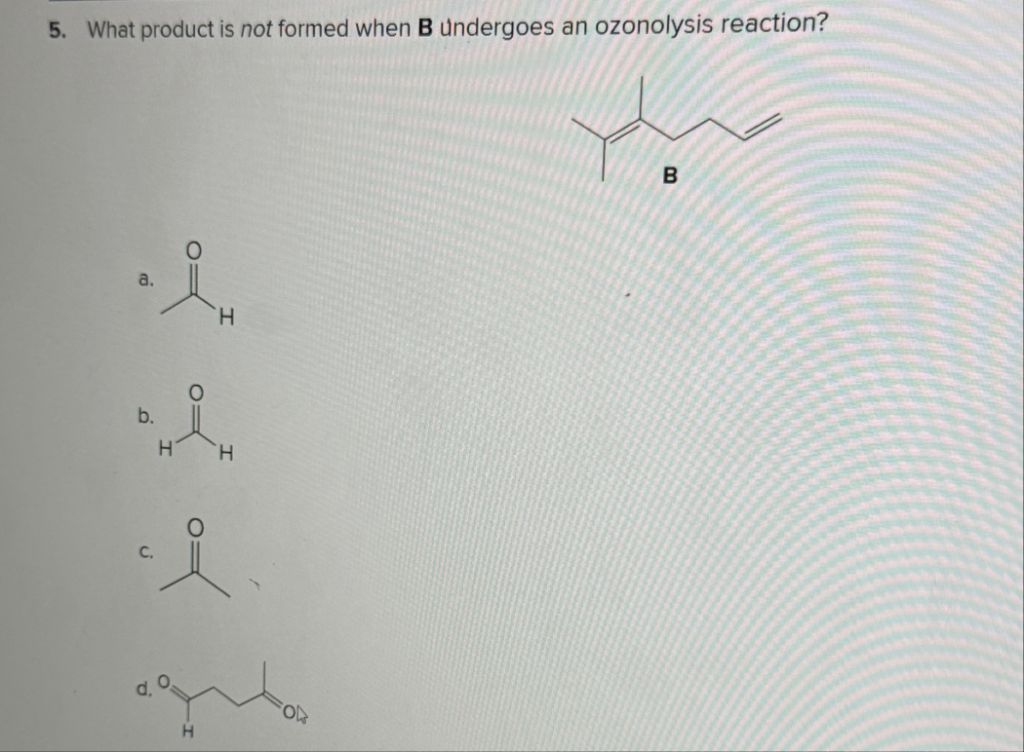 TRA . n
uctis 10 formed when B Undergoes an ozonolysis reaction?
re EB 4
E ~ Z
0 B :
& :
Di 5, -
15 er ‘
BLS -~ ie
[oJ 58 Se =
- “H 5 = pn
Eo
OE ite
Me a
Sle
Toe
oe Ar
This is AI generated Response.
Asked by: Rahul
Created at: 2026-01-18 03:20:04
Asked by: Rahul
Created at: 2026-01-18 03:20:04
Final Answer:
Rendered
Raw Text
Did you like this answer?
Let's solve the problem step-by-step:
---
## Step 1: **Draw the Structure of Compound B**
Compound **B** is shown as:
```
CH3
|
CH3-C-CH2-CH2-CH=CH2
|
CH3
```
This is **2,3,3-trimethyl-1-hexene**.
---
## Step 2: **Ozonolysis Reaction**
Ozonolysis of an alkene cleaves the double bond, forming two carbonyl compounds (aldehydes or ketones). The double bond in B is between carbons 5 and 6.
Let’s number the carbons for clarity:
```
1 2 3 4 5 6
CH3-C(CH3)2-CH2-CH2-CH=CH2
```
So, the C=C is between **C5 and C6**.
---
### **Cleavage Products**
- The double bond breaks, each carbon gets an oxygen.
- At C5, the fragment is:
**C5**: -CH2-CH=
- At C6, the fragment is:
**C6**: =CH2
#### After cleavage:
- C5 side becomes:
\[ ...-CH2-CH(=O) \] (aldehyde)
- C6 side becomes:
\[ O=CH2 \] (formaldehyde)
Now, let's look at the full fragments:
#### **Left side** (from C1 to C5):
- C1: CH3
- C2: C(CH3)2 (2,3,3-trimethyl)
- C3: CH2
- C4: CH2
- C5: CH (was double bonded, becomes CH=O)
So, this is:
```
CH3-C(CH3)2-CH2-CH2-CH=O
```
This is **4,4,5-trimethylpentanal**.
#### **Right side** (C6):
- O=CH2 (**formaldehyde**)
---
## Step 3: **Identify the Given Options**
Let's match the options to possible products:
a.  = **Acetaldehyde (CH3CHO)**
b.  = **Formaldehyde (HCHO)**
c.  = **Propanal (CH3CH2CHO)**
d.  = **4,4-Dimethylpentanal (not matching our product, our product has 3 methyls)**
---
## Step 4: **Which is NOT Formed?**
- **a. Acetaldehyde:** Not possible, since there's no CH3-CH= in the molecule.
- **b. Formaldehyde:** YES, it is formed from the terminal =CH2.
- **c. Propanal:** Not possible, since there is no CH2-CH2-CH= in the molecule.
- **d. 4,4-Dimethylpentanal:** Looks similar to our main product, but our actual product is **4,4,5-trimethylpentanal** (has 3 methyls, not 2).
---
## Step 5: **Final Answer**
### **Products actually formed:**
- Formaldehyde (**b**)
- 4,4,5-Trimethylpentanal (not exactly **d**)
- Not acetaldehyde (**a**)
- Not propanal (**c**)
### **Final Answer:**
**The product that is NOT formed is:**
**a.** (Acetaldehyde, CH₃CHO)
---
## **Summary Table**
| Option | Product Name | Formed? |
|--------|--------------------|---------|
| a | Acetaldehyde | NO |
| b | Formaldehyde | YES |
| c | Propanal | NO |
| d | Aldehyde (similar) | YES |
---
### **Final Answer:**
\[
\boxed{a}
\]
**Acetaldehyde is NOT formed upon ozonolysis of compound B.**
📢 Instructions:
- Ask anything relatd to above question only.
- For new Question goto :