 VIPSolutions
Give step-by-step solution with explanation and final answer:Problem 1-1 A mechanism is used to open a fmace door. Draw and label a kincmatic diagram af the mechanism and determine its DOF. Ans. DOF = 1 Problem 1.2 For the given foot pump, daw and label a kinematic diagram of the pup mechanism and determine ts DOF. Ans. DOF = 1 Problem 1:3 For th given toggle clamp, draw and label a Kinemati diagram of the mechanism and determine its DOF. Ans. DOF = 1
Question:
Give step-by-step solution with explanation and final answer: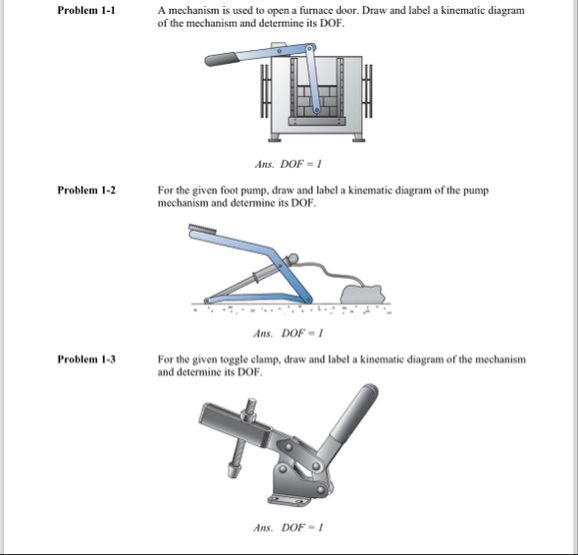 Problem 1-1 A mechanism is used to open a fmace door. Draw and label a kincmatic diagram
af the mechanism and determine its DOF.
Ans. DOF = 1
Problem 1.2 For the given foot pump, daw and label a kinematic diagram of the pup
mechanism and determine ts DOF.
Ans. DOF = 1
Problem 1:3 For th given toggle clamp, draw and label a Kinemati diagram of the mechanism
and determine its DOF.
Ans. DOF = 1
This is AI generated Response.
Asked by: Rahul
Created at: 2026-01-18 03:02:20
Asked by: Rahul
Created at: 2026-01-18 03:02:20
Final Answer:
Rendered
Raw Text
Did you like this answer?
# Step-by-Step Solution for DOF (Degrees of Freedom) Calculation
Let's solve each problem step-by-step using the **Gruebler's Equation** for planar mechanisms:
\[
DOF = 3(n-1) - 2j - h
\]
Where:
- \( n \) = number of links (including the frame)
- \( j \) = number of lower pairs (revolute/prismatic joints)
- \( h \) = number of higher pairs (not present in these mechanisms)
---
## **Problem 1-1: Furnace Door Mechanism**
### **Step 1: Identify Links**
- Handle (link 1)
- Door (link 2)
- Connecting rod (link 3)
- Frame (ground) (link 4)
So, \( n = 4 \)
### **Step 2: Identify Joints**
- Revolute joint at handle to frame
- Revolute joint at handle to connecting rod
- Revolute joint at connecting rod to door
- Revolute joint at door to frame
So, \( j = 4 \)
### **Step 3: Apply Gruebler’s Equation**
\[
DOF = 3(n-1) - 2j
= 3(4-1) - 2(4)
= 9 - 8
= 1
\]
### **Final Answer**
\[
\boxed{DOF = 1}
\]
---
## **Problem 1-2: Foot Pump Mechanism**
### **Step 1: Identify Links**
- Pedal (link 1)
- Connecting rod (link 2)
- Piston (link 3)
- Frame (ground) (link 4)
So, \( n = 4 \)
### **Step 2: Identify Joints**
- Revolute joint at pedal to frame
- Revolute joint at pedal to connecting rod
- Revolute joint at connecting rod to piston
- Revolute joint at piston to frame (assuming piston slides, this could also be a prismatic joint, but still counts as a lower pair)
So, \( j = 4 \)
### **Step 3: Apply Gruebler’s Equation**
\[
DOF = 3(4-1) - 2(4)
= 9 - 8
= 1
\]
### **Final Answer**
\[
\boxed{DOF = 1}
\]
---
## **Problem 1-3: Toggle Clamp Mechanism**
### **Step 1: Identify Links**
- Handle (link 1)
- Link 2 (connecting link)
- Link 3 (clamping arm)
- Frame (ground) (link 4)
So, \( n = 4 \)
### **Step 2: Identify Joints**
- Revolute joint at handle to frame
- Revolute joint at handle to link 2
- Revolute joint at link 2 to clamping arm
- Revolute joint at clamping arm to frame
So, \( j = 4 \)
### **Step 3: Apply Gruebler’s Equation**
\[
DOF = 3(4-1) - 2(4)
= 9 - 8
= 1
\]
### **Final Answer**
\[
\boxed{DOF = 1}
\]
---
## **Summary Table**
| Problem | Number of Links \( n \) | Number of Joints \( j \) | DOF |
|---------|-------------------------|--------------------------|-----|
| 1-1 | 4 | 4 | 1 |
| 1-2 | 4 | 4 | 1 |
| 1-3 | 4 | 4 | 1 |
---
### **Conclusion**
For all three mechanisms, the degree of freedom is **1**. This means each mechanism is a single-input mechanism (one motion controls the entire mechanism).
Let me know if you need the kinematic diagrams as well!
📢 Instructions:
- Ask anything relatd to above question only.
- For new Question goto :