 VIPSolutions
Give step-by-step solution with explanation and final answer: (give me answer without using bullet-points)Given: = Natural gos. contains. GOmol% CHy 7 mol % Cry, 3mol% Ny ~ 30% excess air (79 mol% Na, 21 mol% O) = 100 mol /h of natural gas are fed at 25°C — All components deal gas. 2) Flow rate of air (F) fed to bumer. 2) Complete comrstion products and dew pont. temgperatise. 3) Heat released durng combustion.
Question:
Give step-by-step solution with explanation and final answer:
(give me answer without using bullet-points)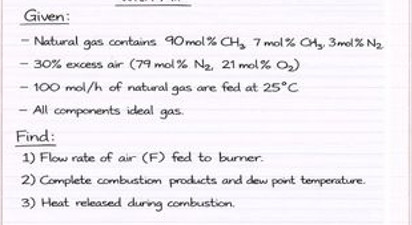 Given:
= Natural gos. contains. GOmol% CHy 7 mol % Cry, 3mol% Ny
~ 30% excess air (79 mol% Na, 21 mol% O)
= 100 mol /h of natural gas are fed at 25°C
— All components deal gas.
2) Flow rate of air (F) fed to bumer.
2) Complete comrstion products and dew pont. temgperatise.
3) Heat released durng combustion.
This is AI generated Response.
Asked by: Francis
Created at: 2026-01-17 21:50:04
Asked by: Francis
Created at: 2026-01-17 21:50:04
Final Answer:
Rendered
Raw Text
Did you like this answer?
Let's solve the problem step by step:
---
## **Step 1: Basis and Feed Calculation**
Given 100 mol/h of natural gas:
- 90% CH₄: 90 mol/h
- 7% C₂H₆: 7 mol/h
- 3% N₂: 3 mol/h
---
## **Step 2: Combustion Reactions**
For complete combustion:
- CH₄ + 2O₂ → CO₂ + 2H₂O
- C₂H₆ + 3.5O₂ → 2CO₂ + 3H₂O
O₂ required for each:
- CH₄: 90 mol × 2 = 180 mol O₂
- C₂H₆: 7 mol × 3.5 = 24.5 mol O₂
Total theoretical O₂ required = 180 + 24.5 = **204.5 mol O₂/h**
---
## **Step 3: Air Calculation**
Air composition: 21% O₂, 79% N₂ (by mole)
Let F = moles of air fed per hour.
O₂ supplied by F mol air = .21 × F
We are using 30% excess air:
Total O₂ supplied = 1.3 × theoretical O₂ = 1.3 × 204.5 = **265.85 mol O₂/h**
So,
.21 × F = 265.85
F = 265.85 / .21 = **1,266.9 mol air/h**
**Answer 1:**
Flow rate of air fed to burner = **1,267 mol/h (rounded to whole number)**
---
## **Step 4: Combustion Products**
O₂ supplied = 265.85 mol/h
O₂ consumed = 204.5 mol/h
O₂ excess = 61.35 mol/h
CO₂ produced:
- From CH₄: 90 mol/h
- From C₂H₆: 7 × 2 = 14 mol/h
Total CO₂ = 90 + 14 = **104 mol/h**
H₂O produced:
- From CH₄: 90 × 2 = 180 mol/h
- From C₂H₆: 7 × 3 = 21 mol/h
Total H₂O = 180 + 21 = **201 mol/h**
N₂ in feed: 3 mol/h (from fuel)
N₂ from air: .79 × 1,266.9 = **1,001.85 mol/h**
Total N₂ = 1,001.85 + 3 = **1,004.85 mol/h**
Total products:
CO₂ = 104 mol/h
H₂O = 201 mol/h
O₂ (excess) = 61.35 mol/h
N₂ = 1,004.85 mol/h
**Answer 2 (Combustion products):**
- CO₂: 104 mol/h
- H₂O: 201 mol/h
- O₂: 61.35 mol/h (excess)
- N₂: 1,004.85 mol/h
**Dew Point:**
Dew point is the temperature at which water vapor starts to condense.
Mole fraction of H₂O in products = 201 / (104 + 201 + 61.35 + 1,004.85) = 201 / 1,371.2 ≈ .147
At 1 atm, use steam tables: vapor pressure at dew point p = .147 atm
From steam tables, the dew point ≈ **53°C**
---
## **Step 5: Heat Released (Enthalpy of Reaction)**
Standard enthalpy of combustion:
- CH₄: ΔH° = –802 kJ/mol
- C₂H₆: ΔH° = –1,418 kJ/mol
Total heat released per hour:
= (90 mol/h × –802 kJ/mol) + (7 mol/h × –1,418 kJ/mol)
= –72,180 kJ/h + (–9,926 kJ/h)
= –82,106 kJ/h
**Answer 3:**
**Heat released during combustion = 82,106 kJ/h**
---
### **Summary of Answers**
1. Flow rate of air fed to burner = **1,267 mol/h**
2. Combustion products (mol/h): CO₂ = 104, H₂O = 201, O₂ = 61.35, N₂ = 1,004.85. Dew point ≈ **53°C**
3. Heat released during combustion = **82,106 kJ/h**
📢 Instructions:
- Ask anything relatd to above question only.
- For new Question goto :