This is AI generated Response.
Asked by: Francis
Created at: 2026-01-17 21:06:31
Final Answer:
RenderedRaw Text
Did you like this answer?
## Step-by-Step Solution
Let's address each part of the question using the data and information provided.
---
### (a) **Suggest a Rate Law Consistent with the Data**
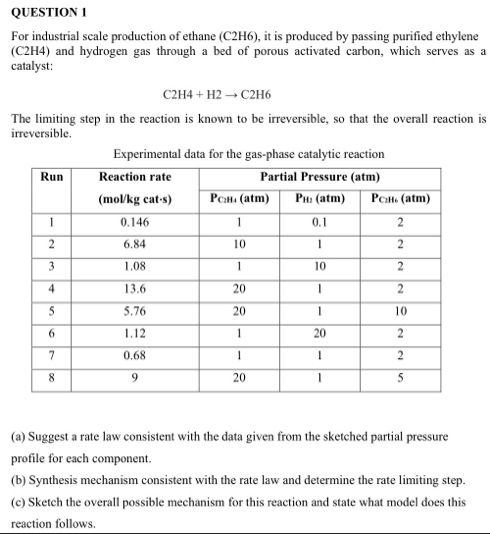
First, we analyze how the rate changes with the partial pressures of each reactant.
#### **Step 1: Dependence on Ethylene (C₂H₄) Pressure**
Compare runs where only \( P_{C_2H_4} \) changes, while others are constant.
Runs 3, 4, and 5:
- Run 3: \( P_{C_2H_4} = 1 \), rate = 1.08
- Run 4: \( P_{C_2H_4} = 10 \), rate = 13.6
- Run 5: \( P_{C_2H_4} = 20 \), rate = 13.6
Between runs 3 and 4: Increasing \( P_{C_2H_4} \) from 1 to 10 increases rate from 1.08 to 13.6, suggesting a near-linear dependence at low pressure.
Between runs 4 and 5: Increasing \( P_{C_2H_4} \) from 10 to 20 does **not** increase the rate, indicating saturation.
This suggests a Langmuir-Hinshelwood type rate law with respect to ethylene.
#### **Step 2: Dependence on Hydrogen (H₂) Pressure**
Compare runs 1, 2, and 3:
- Run 1: \( P_{H_2} = .1 \), rate = .146
- Run 2: \( P_{H_2} = 1 \), rate = 6.84
- Run 3: \( P_{H_2} = 10 \), rate = 1.08
The rate increases sharply with \( P_{H_2} \) at first, but then decreases at higher \( P_{H_2} \), suggesting inhibition at high \( P_{H_2} \).
#### **Step 3: Dependence on Ethane (C₂H₆) Pressure**
Compare runs 6 and 7 (\( P_{C_2H_6} \) changes from 1 to 2, others constant):
- Run 6: \( P_{C_2H_6} = 1 \), rate = 1.7
- Run 7: \( P_{C_2H_6} = 2 \), rate = .68
Increasing \( P_{C_2H_6} \) decreases the rate, so product inhibits the reaction.
#### **Step 4: Write the Rate Law**
The observations (saturation at high \( P_{C_2H_4} \), inhibition by \( H_2 \) and \( C_2H_6 \)) fit a Langmuir-Hinshelwood rate law:
\[
\text{rate} = \frac{k P_{C_2H_4} P_{H_2}}{(1 + a_{C_2H_4} P_{C_2H_4} + a_{H_2} P_{H_2} + a_{C_2H_6} P_{C_2H_6})^2}
\]
But the denominator could be linear in partial pressures if only surface coverages matter (one site per molecule):
\[
\text{rate} = \frac{k P_{C_2H_4} P_{H_2}}{(1 + a_{C_2H_4} P_{C_2H_4} + a_{H_2} P_{H_2} + a_{C_2H_6} P_{C_2H_6})}
\]
This law accounts for (i) first-order at low pressures, (ii) saturation at high \( P_{C_2H_4} \), and (iii) inhibition by \( H_2 \) and \( C_2H_6 \).
---
### (b) **Synthesis Mechanism and Rate-Limiting Step**
A possible mechanism is as follows:
1. **Adsorption of C₂H₄:**
\( \text{C}_2\text{H}_4(g) + * \rightleftharpoons \text{C}_2\text{H}_4* \)
2. **Adsorption of H₂:**
\( \text{H}_2(g) + 2* \rightleftharpoons 2\text{H}* \)
3. **Surface Reaction (Rate-Limiting):**
\( \text{C}_2\text{H}_4* + 2\text{H}* \rightarrow \text{C}_2\text{H}_6* + 2* \)
4. **Desorption of C₂H₆:**
\( \text{C}_2\text{H}_6* \rightleftharpoons \text{C}_2\text{H}_6(g) + * \)
The **rate-limiting step** is the surface reaction between adsorbed ethylene and hydrogen atoms.
---
### (c) **Sketch the Overall Mechanism and State the Model**
The mechanism is:
1. \( \text{C}_2\text{H}_4(g) + * \rightleftharpoons \text{C}_2\text{H}_4* \)
2. \( \text{H}_2(g) + 2* \rightleftharpoons 2\text{H}* \)
3. \( \text{C}_2\text{H}_4* + 2\text{H}* \rightarrow \text{C}_2\text{H}_6* + 2* \) (rate-limiting)
4. \( \text{C}_2\text{H}_6* \rightleftharpoons \text{C}_2\text{H}_6(g) + * \)
This is a **Langmuir-Hinshelwood mechanism** where both reactants are adsorbed, and the surface reaction is the slow step. The rate law derived from this mechanism fits the experimental data, with product and reactant inhibitions due to competitive adsorption.
---
### **Final Answers**
(a) The rate law is:
\[
\text{rate} = \frac{k P_{C_2H_4} P_{H_2}}{(1 + a_{C_2H_4} P_{C_2H_4} + a_{H_2} P_{H_2} + a_{C_2H_6} P_{C_2H_6})}
\]
(b) The synthesis mechanism is:
1. Adsorption of ethylene and hydrogen
2. Surface reaction between adsorbed ethylene and hydrogen (rate-limiting step)
3. Desorption of ethane
(c) The overall mechanism is a Langmuir-Hinshelwood model, where both reactants adsorb and react on the surface, with the surface reaction as the rate-limiting step. This model explains the observed rate law, including reactant saturation and product inhibition.
VIPSolutions focuses on clear, step‑by‑step explanations so you can learn quickly. Whether you need an AI‑generated walkthrough or a short hint to get unstuck, each solution is organized for fast reading and easy review later.
Search similar questions, compare approaches, and bookmark the best answers for revision. Our goal is simple: quick, reliable study help that feels natural—not noisy.
 VIPSolutions
 QUESTION 1
For industrial scale production of ethane (C2H). it is produced by passing purified ethylene
(C2H4) and hydrogen gas through a bed of porous activated carbon, which serves as a
canlyst
COMA +2 CoH
“The limiting sep in the reaction is known to be irreversible, so that the overall reaction is
imevesible
Experimental daa for the gas-phase catalytic reaction
Rn
RL Be
2 NC NC NR
4 136 0 | BE
3 576 2 0
GQ 2 To [2
8 9 20 | [ 5
(@) Suggest a rate aw consistent with the data given from th sketched partial pressure
profile for each component.
(6) Synthesis mechanism consistent ith the rat Law and determine the rat limiting scp.
(©) Sketch the overall possible mechanism for tis reaction and state what model does this
reaction follows.