 VIPSolutions
Give step-by-step solution with explanation and final answer: (give me answer without using bullet points)Derive the rate expression for a solid-catalyzed reaction following the Eley-Rideal mechanism, hers the ga: phase reactant A colices dict withthe adsorbed species I - § oor the produc. The drain ist asus that the saface reactions the rate sep and {hat adsrption follows a Lange sohar, knKuPaPy Tras Re PA = Tp, + KB Sketch the Levenspiel plot of Fa — 7.4 versus conversion X for an autocatalyti reaction deny the aptml reactor confueaton consisting of a CSTR operating at the conversion corresponding othe minimum at reciprocal, followed by a PPR to achive the final Osta the vm reduction percentage compared oa sla FR Establish the integrated rat law fo sscond-orde reversible reaction A.» J cared out in arabe woe batch reactor The solution eqs he sibstituion of the volume expansion factor 4 nto the concentration terms Cg = N.x/V. leading ta transcendental integral function of conversion X. ven [F dX _f* (1+ ex X)dx “ou Sv mn x Rare Analyze the Kintic cat fom a iret reactor test povided below detain the teaction order vith respect othe paris pressure of Hycrogen Pir The at is messed at low comarsion eure th conceiration of reactants reais efectiely constant across tho catalyst bed [Pusfatm) T15 T5045 [60 [75 | (=r... (mol/g 3) [0.045 [0.064 | 0.078 | 0.091] 0.107] Caloitethe expan using no fnr regression.
Question:
Give step-by-step solution with explanation and final answer:
(give me answer without using bullet points)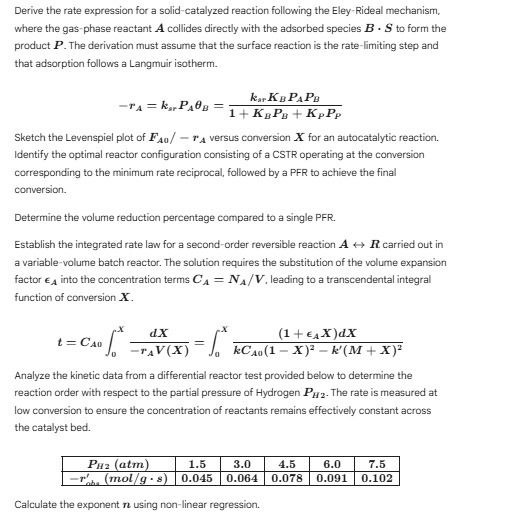 Derive the rate expression for a solid-catalyzed reaction following the Eley-Rideal mechanism,
hers the ga: phase reactant A colices dict withthe adsorbed species I - § oor the
produc. The drain ist asus that the saface reactions the rate sep and
{hat adsrption follows a Lange sohar,
knKuPaPy
Tras Re PA = Tp, + KB
Sketch the Levenspiel plot of Fa — 7.4 versus conversion X for an autocatalyti reaction
deny the aptml reactor confueaton consisting of a CSTR operating at the conversion
corresponding othe minimum at reciprocal, followed by a PPR to achive the final
Osta the vm reduction percentage compared oa sla FR
Establish the integrated rat law fo sscond-orde reversible reaction A.» J cared out in
arabe woe batch reactor The solution eqs he sibstituion of the volume expansion
factor 4 nto the concentration terms Cg = N.x/V. leading ta transcendental integral
function of conversion X.
ven [F dX _f* (1+ ex X)dx
“ou Sv mn x Rare
Analyze the Kintic cat fom a iret reactor test povided below detain the
teaction order vith respect othe paris pressure of Hycrogen Pir The at is messed at
low comarsion eure th conceiration of reactants reais efectiely constant across
tho catalyst bed
[Pusfatm) T15 T5045 [60 [75 |
(=r... (mol/g 3) [0.045 [0.064 | 0.078 | 0.091] 0.107]
Caloitethe expan using no fnr regression.
Asked by: Francis
Created at: 2026-01-17 15:21:27
Final Answer:
📢 Instructions:
- Ask anything relatd to above question only.
- For new Question goto :