 VIPSolutions
Give step-by-step solution with explanation and final answer:Extra Credit: Which reagents would you use? Show steps? (4 pts) A — Ap 1.Devise a reaction scheme to synthesize the following i dpc rk ey p' pS LI LQ. J ON d. a " 2.Predict the reactant/ product of the following reactions: (3 points each ) o » Ee) 18, — 0 ) aw So = bo cid ma, da As eo. Aa __. ) § oa us crico0n f o> = o- .
Question:
Give step-by-step solution with explanation and final answer: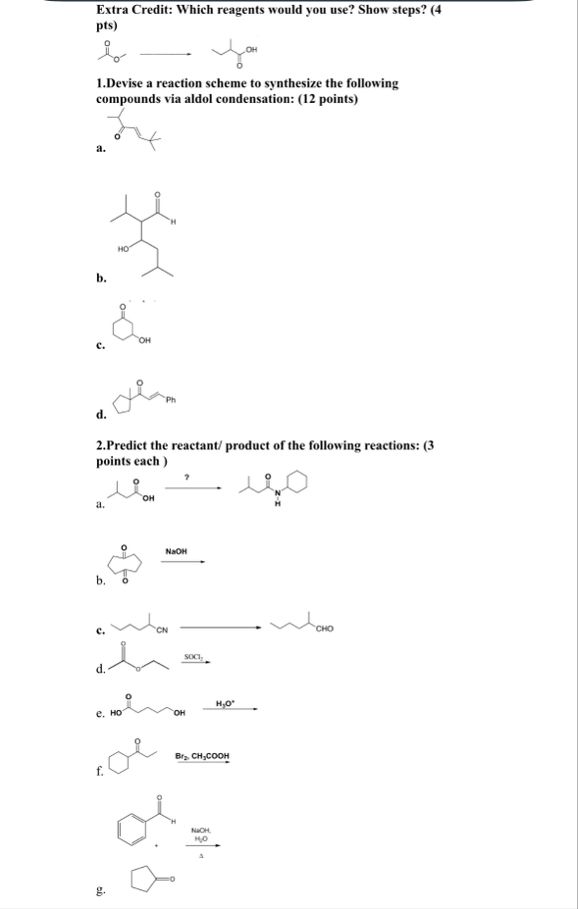 Extra Credit: Which reagents would you use? Show steps? (4
pts)
A — Ap
1.Devise a reaction scheme to synthesize the following
i dpc rk ey
p'
pS
LI
LQ.
J ON
d. a "
2.Predict the reactant/ product of the following reactions: (3
points each )
o » Ee)
18, — 0
) aw
So =
bo
cid ma,
da As
eo. Aa __.
) §
oa us crico0n
f
o> =
o-
.
This is AI generated Response.
Asked by: Rahul
Created at: 2026-01-17 08:08:48
Asked by: Rahul
Created at: 2026-01-17 08:08:48
Final Answer:
Rendered
Raw Text
Did you like this answer?
Let's break down the questions step by step:
---
## 1. Devise a Reaction Scheme via Aldol Condensation
Aldol condensation involves the reaction of an enolate (from an aldehyde or ketone) with another carbonyl compound.
### (a)
**Product:** 2,2,4,4-tetramethyl-3-hydroxy-3-pentanone
#### Retrosynthesis:
- The central alcohol comes from aldol addition.
- Both sides are tert-butyl groups, which suggests starting with pivaldehyde (tert-butyl aldehyde).
**Scheme:**
2 eq. pivaldehyde + NaOH (aq) → 3-hydroxy-2,2,4,4-tetramethylpentan-5-one (aldol product)
### (b)
**Product:** 3-hydroxy-2,4-dimethylpentan-2-one
#### Retrosynthesis:
- The hydroxy group is on C-3; two methyls on C-2 and C-4.
- Start with isobutyraldehyde (2-methylpropanal) and acetone.
**Scheme:**
Isobutyraldehyde + acetone + NaOH → 3-hydroxy-2,4-dimethylpentan-2-one
### (c)
**Product:** 3-hydroxy-3-phenylpropanal
#### Retrosynthesis:
- The alcohol is on C-3 (with a phenyl group); aldehyde is at C-1.
- Benzaldehyde + acetaldehyde (ethanal).
**Scheme:**
Benzaldehyde + acetaldehyde + NaOH → 3-hydroxy-3-phenylpropanal
### (d)
**Product:** 3-hydroxy-1,3-diphenylpropan-1-one
#### Retrosynthesis:
- Both ends are phenyl groups.
- Benzaldehyde and acetophenone.
**Scheme:**
Benzaldehyde + acetophenone + NaOH → 3-hydroxy-1,3-diphenylpropan-1-one
---
## 2. Predict the Reactant/Product
### (a)
**Alcohol → Aldehyde (Oxidation)**
- Reagent is PCC or DMP.
- **Product:** 2-hexanone
### (b)
**Cyclohexanone + NaOH**
- Aldol condensation (self) → α,β-unsaturated ketone
- **Product:** 2-cyclohexen-1-one
### (c)
**Nitrile to Aldehyde**
- 1. Reduction (DIBAL-H)
- **Product:** Pentanal
### (d)
**Carboxylic Acid + SOCl₂**
- Converts to acid chloride
- **Product:** Acid chloride (replace -OH with -Cl)
### (e)
**Hydration of Epoxide**
- Acidic conditions open the epoxide to form a trans-1,2-diol.
- **Product:** trans-1,2-cyclohexanediol
### (f)
**Alpha-Bromination (Hell-Volhard-Zelinsky)**
- Br₂, CH₃COOH on carboxylic acid → α-bromo acid
### (g)
**Intramolecular Aldol Condensation**
- Forms a six-membered ring (cyclohexenone derivative).
- **Product:** 2-cyclohexen-1-one
---
## **Summary Table**
| Q | Reaction/Reagents | Product/Reactant |
|------|-----------------------------------------------|-----------------------------------------|
| 1a | 2 pivaldehyde + NaOH | 3-hydroxy-2,2,4,4-tetramethylpentan-5-one |
| 1b | isobutyraldehyde + acetone + NaOH | 3-hydroxy-2,4-dimethylpentan-2-one |
| 1c | benzaldehyde + acetaldehyde + NaOH | 3-hydroxy-3-phenylpropanal |
| 1d | benzaldehyde + acetophenone + NaOH | 3-hydroxy-1,3-diphenylpropan-1-one |
| 2a | PCC/DMP | 2-hexanone |
| 2b | NaOH | 2-cyclohexen-1-one |
| 2c | DIBAL-H (reduction of nitrile) | pentanal |
| 2d | SOCl₂ | acid chloride |
| 2e | H₃O⁺ | trans-1,2-cyclohexanediol |
| 2f | Br₂, CH₃COOH | α-bromo acid |
| 2g | NaOH, heat | 2-cyclohexen-1-one |
If you need the mechanisms or stepwise details for any part, let me know!
📢 Instructions:
- Ask anything relatd to above question only.
- For new Question goto :