 VIPSolutions
Give step-by-step solution with explanation and final answer:The bracket shown in Figure 6 is subjected to the external loading at two points. It is supported by pins at B and C. Determine to the nearest 5 mm the diameter of the steel pins at A and C if the factor of safety for shear is 1.5, and the failure shear stress for the steel is 82.5 MPa. Hint: AB is a two force member, Hint £2: Start with a global FBD, find the resultant shear at pins A and C Hint #3: Consider whether the pins are in single or double shear! B A = A 200mm Cc c RL 75mm J 50mm 25K 15 kN Figure 6
Question:
Give step-by-step solution with explanation and final answer: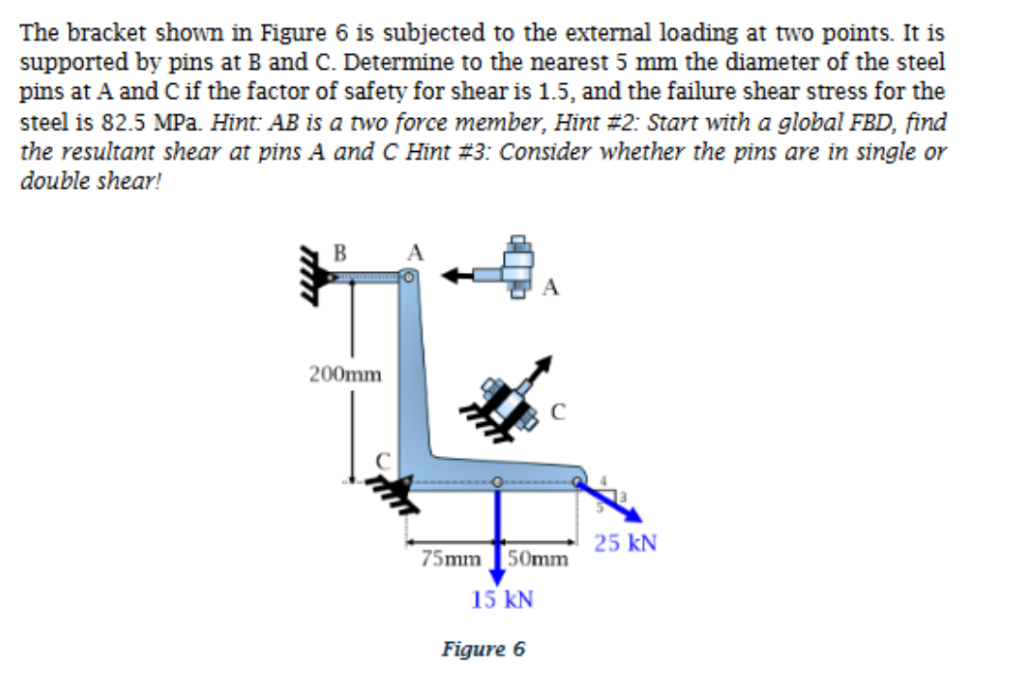 The bracket shown in Figure 6 is subjected to the external loading at two points. It is
supported by pins at B and C. Determine to the nearest 5 mm the diameter of the steel
pins at A and C if the factor of safety for shear is 1.5, and the failure shear stress for the
steel is 82.5 MPa. Hint: AB is a two force member, Hint £2: Start with a global FBD, find
the resultant shear at pins A and C Hint #3: Consider whether the pins are in single or
double shear!
B A =
A
200mm
Cc
c
RL
75mm J 50mm 25K
15 kN
Figure 6
This is AI generated Response.
Asked by: Rahul
Created at: 2026-01-17 07:04:53
Asked by: Rahul
Created at: 2026-01-17 07:04:53
Final Answer:
Rendered
Raw Text
Did you like this answer?
Let's solve the problem step-by-step:
---
## **Step 1: Free Body DiagramFBD) & Reactions**
Given:**
- \( F_ = 15\, \text{kN} \) (downward at 75 mm from C)
- \( F_2 = 25\, \text{kN} \) at an angle (3-4-5 triangle) at 125 mm from C
- Pins at **A** and **C**
- Factor of Safety (FS) = **1.5**
- Failure Shear Stress \( \tau_{fail} = 82.5\, \text{MPa} \)
### **Determine Pin Forces (Reactions at A and C)**
#### **Sum Moments about C:**
Let:
- \( A_x, A_y \): Reaction at A (horizontal/vertical)
- \( C_x, C_y \): Reaction at C
\[
\sum M_C =
\]
Distances:
- \( \overrightarrow{CA} = 200\, \text{mm} \) up
- \( \overrightarrow{CF} = 75\, \text{mm} \) right (for 15 kN)
- \( \overrightarrow{CF_2} = 75 + 50 = 125\, \text{mm} \) right (for 25 kN)
Resolve \( F_2 \) using the 3-4-5 triangle:
- Horizontal: \( 25 \times \frac{4}{5} = 20\, \text{kN} \)
- Vertical: \( 25 \times \frac{3}{5} = 15\, \text{kN} \) **down**
\[
\sum M_C = = A_y \cdot 200 - 15 \cdot 75 - 25 \cdot 125 \cdot \sin\theta
\]
But let's get the moment arms:
- For 15 kN: \( 75\, \text{mm} \)
- For 25 kN: \( 125\, \text{mm} \)
- 25 kN is at an angle: vertical component causes moment about C.
\[
\sum M_C = = A_y \cdot 200 - 15 \cdot 75 - (25 \cdot \sin\theta) \cdot 125
\]
But \( \sin\theta = \frac{3}{5} \):
\[
\sum M_C = = A_y \cdot 200 - 15 \cdot 75 - (25 \cdot .6) \cdot 125
\]
\[
A_y \cdot 200 = 1125 + 1875
\]
\[
A_y \cdot 200 = 300
\]
\[
A_y = \frac{300}{200} = 15\, \text{kN}
\]
#### **Sum Forces in Y:**
\[
\sum F_y = : A_y + C_y - 15 - 25 \cdot .6 =
\]
\[
A_y + C_y = 15 + 15 = 30\, \text{kN}
\]
\[
C_y = 30 - A_y = 30 - 15 = 15\, \text{kN}
\]
#### **Sum Forces in X:**
\[
\sum F_x = : A_x + C_x - 25 \cdot .8 =
\]
\[
A_x + C_x = 20\, \text{kN}
\]
We need another equation—let's consider moments about A for \( C_x \):
#### **Sum Moments about A:**
- 15 kN: 200 mm below A
- 25 kN: Find moment arm from A
For 15 kN:
\[
M_A = 15 \cdot (200) = 300\, \text{kN-mm} \text{ (CW)}
\]
For 25 kN: the perpendicular distance from A is:
\[
\text{Vertical drop from A to F2} = 200\, \text{mm}
\]
\[
M_{A,25} = 25 \cdot .8 \cdot 200 = 400\, \text{kN-mm} \text{ (CW)}
\]
Pin C resists with \( C_x \) and \( C_y \). The perpendicular distance for \( C_x \) from A is 200 mm.
\[
\sum M_A = = C_y \cdot - C_x \cdot 200 + 300 + 400
\]
\[
-C_x \cdot 200 + 700 =
\]
\[
C_x = \frac{700}{200} = 35\, \text{kN}
\]
Now, from above:
\[
A_x + C_x = 20
\]
\[
A_x = 20 - 35 = -15\, \text{kN}
\]
---
## **Step 2: Resultant Shear at Pins**
- At **A**: \( A_x = -15\, \text{kN} \), \( A_y = 15\, \text{kN} \)
- At **C**: \( C_x = 35\, \text{kN} \), \( C_y = 15\, \text{kN} \)
\[
R_A = \sqrt{A_x^2 + A_y^2} = \sqrt{(-15)^2 + 15^2} = \sqrt{225 + 225} = \sqrt{450} \approx 21.2\, \text{kN}
\]
\[
R_C = \sqrt{C_x^2 + C_y^2} = \sqrt{35^2 + 15^2} = \sqrt{1225 + 225} = \sqrt{145} \approx 38.1\, \text{kN}
\]
---
## **Step 3: Pin Shear (Single or Double Shear?)**
- **A**: Pin at A is in **double shear** (since AB is a two-force member).
- **C**: Pin at C is in **single shear**.
---
## **Step 4: Allowable Shear Stress**
\[
\tau_{allow} = \frac{\tau_{fail}}{FS} = \frac{82.5}{1.5} = 55\, \text{MPa}
\]
---
## **Step 5: Pin Diameter Calculation**
Shear force per section:
- **Double Shear:** \( V_{section} = \frac{R}{2} \)
- **Single Shear:** \( V_{section} = R \)
Shear area \( A = \frac{\pi}{4} d^2 \)
### **Pin A (Double Shear):**
\[
\tau_{allow} = \frac{R_A/2}{A}
\]
\[
55 = \frac{21.2 \times 10^3 / 2}{\frac{\pi}{4} d^2}
\]
\[
55 = \frac{10,600}{.785 d^2}
\]
\[
55 \times .785 d^2 = 10,600
\]
\[
43.175 d^2 = 10,600
\]
\[
d^2 = \frac{10,600}{43.175} \approx 245.5
\]
\[
d = \sqrt{245.5} \approx 15.7\, \text{mm}
\]
Round up to nearest 5 mm: **20 mm**
---
### **Pin C (Single Shear):**
\[
\tau_{allow} = \frac{R_C}{A}
\]
\[
55 = \frac{38.1 \times 10^3}{.785 d^2}
\]
\[
55 \times .785 d^2 = 38,100
\]
\[
43.175 d^2 = 38,100
\]
\[
d^2 = \frac{38,100}{43.175} \approx 882.7
\]
\[
d = \sqrt{882.7} \approx 29.73\, \text{mm}
\]
Round up to nearest 5 mm: **30 mm**
---
## **Final Answers**
### **To the Nearest 5 mm:**
- **Diameter of pin at A:** \( \boxed{20\, \text{mm}} \)
- **Diameter of pin at C:** \( \boxed{30\, \text{mm}} \)
---
### **Summary Table**
| Pin | Shear Type | Resultant Force (kN) | Diameter (mm) |
|-----|--------------|----------------------|---------------|
| A | Double Shear | 21.2 | **20** |
| C | Single Shear | 38.1 | **30** |
---
### **Shear Stress Calculation Recap**
- Allowable shear stress: \( 55\, \text{MPa} \) (with FS = 1.5)
- Used resultant forces and checked shear type at each pin.
---
### **Boxed Final Answers**
\[
\boxed{
\begin{aligned}
\text{Diameter of pin at A} & :\, 20\, \text{mm} \\
\text{Diameter of pin at C} & :\, 30\, \text{mm} \\
\end{aligned}
}
\]
📢 Instructions:
- Ask anything relatd to above question only.
- For new Question goto :