 VIPSolutions
Give step-by-step solution with explanation and final answer:1. QD (a) What type of reaction is this? (b) Draw a reasonable step-by-step mechanism to account Tot formation of he pros. ped en J
Question:
Give step-by-step solution with explanation and final answer: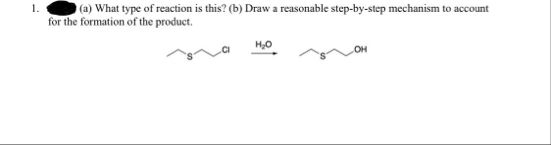 1. QD (a) What type of reaction is this? (b) Draw a reasonable step-by-step mechanism to account
Tot formation of he pros.
ped en J
This is AI generated Response.
Asked by: Rahul
Created at: 2026-01-17 03:22:38
Asked by: Rahul
Created at: 2026-01-17 03:22:38
Final Answer:
Rendered
Raw Text
Did you like this answer?
Let's break down the problem step by step:
---
## (a) **Type of Reaction**
The reaction shown is:
\[
\ce{R-S-CH2CH2CH2Cl + H2O -> R-S-CH2CH2CH2OH}
\]
Where \(\ce{R-S-}\) is a thioether group.
**Type of Reaction:**
This is a **nucleophilic substitution** reaction. Specifically, it appears to be an **SN1** or **SN2** substitution, where the \(\ce{Cl}\) is replaced by an \(\ce{OH}\) group from water.
---
## (b) **Step-by-Step Mechanism**
Let's analyze the mechanism. Since the starting compound is a primary alkyl halide (the chloride is on a primary carbon), the reaction will most likely proceed via an **SN2 mechanism** (bimolecular nucleophilic substitution).
### Step 1: Nucleophilic Attack
- Water (\(\ce{H2O}\)) acts as a nucleophile.
- It attacks the carbon attached to the chlorine (\(\ce{Cl}\)), simultaneously displacing the chloride ion (\(\ce{Cl^-}\)).
- This is a **one-step mechanism** (concerted process).
**Mechanism Diagram:**
```
R-S-CH2CH2CH2-Cl + H2O → R-S-CH2CH2CH2-OH + HCl
```
**Curved Arrows:**
1. Lone pair on oxygen of water attacks the electrophilic carbon (carbon attached to Cl).
2. The bond between carbon and chlorine breaks and chlorine leaves as \(\ce{Cl^-}\).
### Step 2: Deprotonation
- The product from the first step is a protonated alcohol (\(\ce{R-S-CH2CH2CH2-OH2^+}\)).
- A base (often another water molecule) removes a proton (\(\ce{H^+}\)) from the oxygen, yielding the neutral alcohol (\(\ce{R-S-CH2CH2CH2-OH}\)).
---
## **Overall Reaction**
\[
\ce{R-S-CH2CH2CH2-Cl + H2O ->[SN2] R-S-CH2CH2CH2-OH + HCl}
\]
---
## **Summary Table**
| Step | Description | Species Involved |
|------|-------------------------------------------|----------------------------|
| 1 | Nucleophilic attack (SN2) | Water, alkyl chloride |
| 2 | Deprotonation of protonated alcohol | Protonated alcohol, water |
---
## **Final Answer**
### (a)
**Type of reaction:** Nucleophilic substitution (SN2).
### (b)
**Step-by-step mechanism:**
1. Water attacks the electrophilic carbon, displacing chloride (SN2).
2. Water deprotonates the resulting oxonium ion to give the alcohol.
**Final Product:**
\[
\ce{R-S-CH2CH2CH2-OH}
\]
📢 Instructions:
- Ask anything relatd to above question only.
- For new Question goto :