 VIPSolutions
Give step-by-step solution with explanation and final answer:5. Answer the following questions: a) Draw the expected 'H NMR spectrum of the following compound: ~F oe b) The acid-catalyzed dehydration of 1-methylcyclohexanol yields a mixture of two alkenes (A and B). How could you use "TH NMR to help you decide which was which? CH, " CH CH Crom Oy» (p A B
Question:
Give step-by-step solution with explanation and final answer: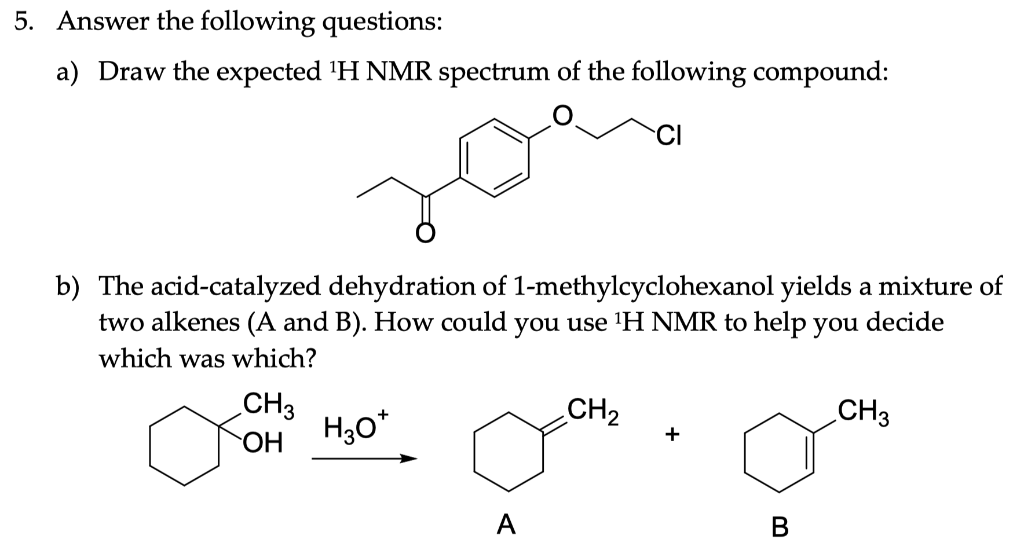 5. Answer the following questions:
a) Draw the expected 'H NMR spectrum of the following compound:
~F oe
b) The acid-catalyzed dehydration of 1-methylcyclohexanol yields a mixture of
two alkenes (A and B). How could you use "TH NMR to help you decide
which was which?
CH, " CH CH
Crom Oy» (p
A B
This is AI generated Response.
Asked by: Rahul
Created at: 2026-01-17 03:05:14
Asked by: Rahul
Created at: 2026-01-17 03:05:14
Final Answer:
Rendered
Raw Text
Did you like this answer?
Let’s break down each part step-by-step:
---
## **a) Draw the expected \( ^1\mathrm{H} \) NMR spectrum of the given compound**
**Structure Analysis:**
- The compound is 4-(Chloromethoxy)propiophenone.
Identify different types of protons:
1. **Aromatic protons (phenyl ring, para-substituted):**
- 4 protons, split into two doublets due to symmetry
2. **Methylene next to carbonyl (Ph-CO-CH2-):**
- 2 protons, singlet/triplet, deshielded
3. **Methylene next to O (Ph-O-CH2-CH2-Cl):**
- 2 protons, next to O, deshielded
4. **Methylene next to Cl (-CH2-Cl):**
- 2 protons, next to Cl, highly deshielded
### **Expected \( ^1\mathrm{H} \) NMR Peaks:**
| Proton Type | Chemical Shift (ppm) | Integration | Splitting |
|----------------------------------|---------------------|-------------|-----------------|
| Aromatic (para, 2x2H) | 7.8-8.2 & 7.-7.4 | 2H + 2H | Both doublets |
| CH2 next to CO (Ph-CO-CH2-) | 2.8-3.2 | 2H | Triplet |
| CH2 next to O (Ph-O-CH2-) | 3.8-4.2 | 2H | Triplet |
| CH2 next to Cl (-CH2-Cl) | 3.6-4. | 2H | Triplet/Multiplet|
#### **Diagram (not to scale):**
```
8.2 8. 7.4 7.2 4.2 4. 3.8 3.2 3. 2.8 (ppm)
|____| |____| |____| |____| |____|
Ar-H Ar-H O-CH2- Cl-CH2- CO-CH2-
(2H, d) (2H, d) (2H, t) (2H, t) (2H, t)
```
---
## **b) Using \( ^1\mathrm{H} \) NMR to distinguish between alkenes A and B**
### **Structures:**
- **A:** 1-methylcyclohex-1-ene (alkene at position 1, methyl at position 1)
- **B:** 1-methylcyclohex-2-ene (alkene at position 2, methyl at position 1)
### **Key Differences in \( ^1\mathrm{H} \) NMR:**
**Alkene Protons:**
- **A (exocyclic alkene):** The double bond is at the ring junction. The alkene proton signals (vinyl protons) will appear as singlets or simple multiplets around 4.7–5.7 ppm.
- **B (internal alkene):** The alkene hydrogens are on the ring, typically appearing as multiplets around 5.2–5.8 ppm, but with more complex coupling.
**Methyl Group:**
- **A:** The methyl is attached to the double bond (allylic), will appear upfield (1.5–2. ppm), possibly as a singlet.
- **B:** Methyl is allylic to the double bond, similar region, but the pattern may differ due to the ring position.
#### **How NMR Distinguishes Them:**
- **Count and splitting of alkene proton signals:**
- **A:** Should show *two* vinyl protons (same carbon, exocyclic, singlet or doublet).
- **B:** Should show *three* vinyl protons (internal double bond; more complex multiplets).
#### **Summary Table:**
| Compound | Alkene Protons (ppm) | Multiplicity | Methyl Protons (ppm) |
|----------|----------------------|--------------|----------------------|
| **A** | ~4.7–5.1 (2H, s) | Singlet | ~1.6 (3H, s) |
| **B** | ~5.2–5.8 (2–3H, m) | Multiplet | ~1.6 (3H, s) |
### **Conclusion:**
- **Use the number and multiplicity of alkene proton signals in the \( ^1\mathrm{H} \) NMR to distinguish A and B.**
- A: Exocyclic alkene (fewer, simpler vinyl signals)
- B: Internal alkene (more vinyl protons, more complex multiplet)
---
## **Final Answers (Summary):**
### **a) 1H NMR Spectrum:**
- 2 doublets (aromatic, 2H each, 7.–8.2 ppm)
- 3 triplets/multiplets (three -CH2- groups, 2H each, 2.8–4.2 ppm, deshielded based on proximity to O, Cl, C=O)
### **b) Use of \( ^1\mathrm{H} \) NMR:**
- Analyze alkene region (4.7–5.8 ppm)
- Compound A: Simpler (exocyclic) alkene signals (singlet or doublet)
- Compound B: More complex (internal) alkene signals (multiplet)
Let me know if you need the actual chemical shift values or a drawn spectrum!
📢 Instructions:
- Ask anything relatd to above question only.
- For new Question goto :