 VIPSolutions
Give step-by-step solution with explanation and final answer:Many roads are banked to improve safety in poor driving conditions. A car of mass m is driven around a circular curve of radius R at constant speed v. The road is banked by angle 8 relative to the horizontal. There is friction between the car tires and the road surface, with a static friction coefficient ps. The acceleration duc to gravity is given by g. A. Sketch the physical situation. Write a list of known/given quantities from the problem statement and what quantities you will need to find /determine. Label your sketch with the known information. Establish an appropriate coordinate system to solve the problem. Identify any physical assumptions you will make o solve the problem. B. Draw a free body diagram for the car. You will be graded based on the expectations for drawing frec-body diagrams laid out in the document: A Guide to Free-body Diagrams. Using your diagram, determine a symbolic expression for the maximum speed Ung, that car may have to make it around the curve without sliding. C. Determine a symbolic expression for the minimum speed Vpn that the car may have to ‘make it around the curve without sliding. This should be expressed only in terms of the given quantities and the acceleration duc to gravity, g. D. Sense-make: EE 2 a. Check the units (or dimension) of your expression for the minimum and maximum speed. b. In the limiting case of a frictionless surface, show that your results to parts C and D simplify to the expected result for the speed that the car must have to make it around the curve without sliding. E. The Daytona International Speedway features a turn with a radius of 300m and a bank angle of 30°. In this question, you will consider two different scenarios. a. In the first scenario, you are a racing team’s engineer. Find the top speed that a car can make the turn on a dry day, without sliding, You determine a worst-case static friction cocfficient on this day of 0.8 between dry rubber and asphalt. b. In the second scenario, you are the track manager responsible for calling off the race if conditions are not suitable. In particular, you must shut down the track if a stationary car (such as after a crash) will side down the banked turn and into the path of other cars. At what value of jt; should you call off the race?
Question:
Give step-by-step solution with explanation and final answer: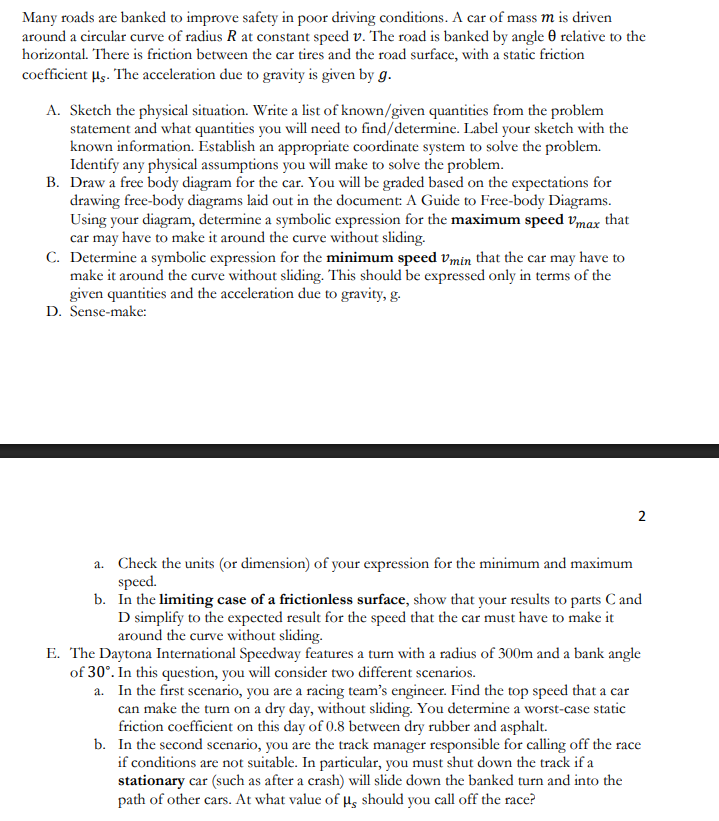 Many roads are banked to improve safety in poor driving conditions. A car of mass m is driven
around a circular curve of radius R at constant speed v. The road is banked by angle 8 relative to the
horizontal. There is friction between the car tires and the road surface, with a static friction
coefficient ps. The acceleration duc to gravity is given by g.
A. Sketch the physical situation. Write a list of known/given quantities from the problem
statement and what quantities you will need to find /determine. Label your sketch with the
known information. Establish an appropriate coordinate system to solve the problem.
Identify any physical assumptions you will make o solve the problem.
B. Draw a free body diagram for the car. You will be graded based on the expectations for
drawing frec-body diagrams laid out in the document: A Guide to Free-body Diagrams.
Using your diagram, determine a symbolic expression for the maximum speed Ung, that
car may have to make it around the curve without sliding.
C. Determine a symbolic expression for the minimum speed Vpn that the car may have to
‘make it around the curve without sliding. This should be expressed only in terms of the
given quantities and the acceleration duc to gravity, g.
D. Sense-make:
EE
2
a. Check the units (or dimension) of your expression for the minimum and maximum
speed.
b. In the limiting case of a frictionless surface, show that your results to parts C and
D simplify to the expected result for the speed that the car must have to make it
around the curve without sliding.
E. The Daytona International Speedway features a turn with a radius of 300m and a bank angle
of 30°. In this question, you will consider two different scenarios.
a. In the first scenario, you are a racing team’s engineer. Find the top speed that a car
can make the turn on a dry day, without sliding, You determine a worst-case static
friction cocfficient on this day of 0.8 between dry rubber and asphalt.
b. In the second scenario, you are the track manager responsible for calling off the race
if conditions are not suitable. In particular, you must shut down the track if a
stationary car (such as after a crash) will side down the banked turn and into the
path of other cars. At what value of jt; should you call off the race?
Asked by: Rahul
Created at: 2026-01-17 00:14:15
Final Answer:
📢 Instructions:
- Ask anything relatd to above question only.
- For new Question goto :