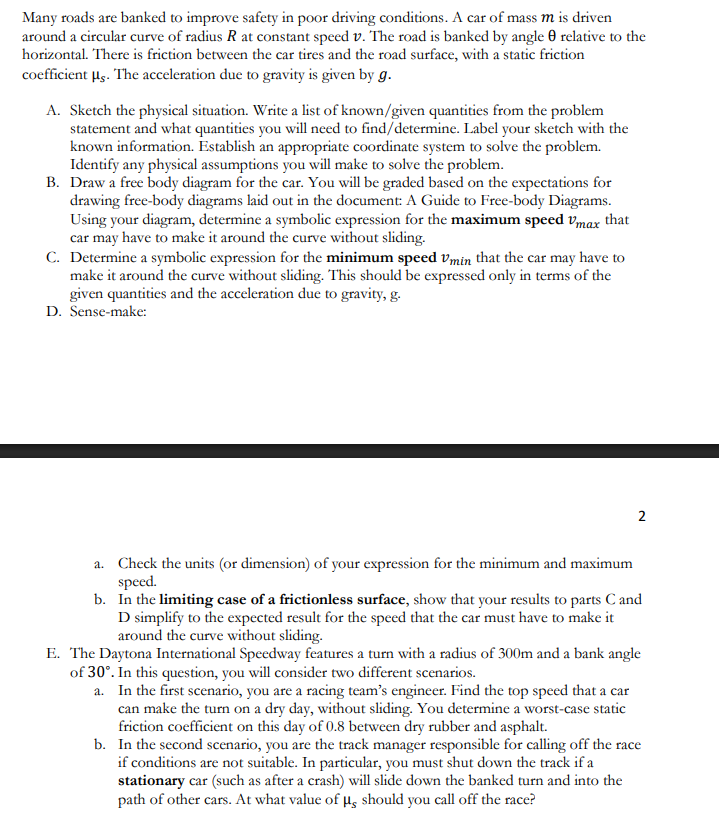
Give step-by-step solution with explanation and final answer:Many roads are banked to improve safety in poor driving conditions. A car of mass m is driven
around a circular curve of radius R at constant speed v. The road is banked by angle 8 relative to the
horizontal. There is friction between the car tires and the road surface, with a static friction
coefficient ps. The acceleration duc to gravity is given by g.
A. Sketch the physical situation. Write a list of known/given quantities from the problem
statement and what quantities you will need to find /determine. Label your sketch with the
known information. Establish an appropriate coordinate system to solve the problem.
Identify any physical assumptions you will make o solve the problem.
B. Draw a free body diagram for the car. You will be graded based on the expectations for
drawing frec-body diagrams laid out in the document: A Guide to Free-body Diagrams.
Using your diagram, determine a symbolic expression for the maximum speed Ung, that
car may have to make it around the curve without sliding.
C. Determine a symbolic expression for the minimum speed Vpn that the car may have to
‘make it around the curve without sliding. This should be expressed only in terms of the
given quantities and the acceleration duc to gravity, g.
D. Sense-make:
EE
2
a. Check the units (or dimension) of your expression for the minimum and maximum
speed.
b. In the limiting case of a frictionless surface, show that your results to parts C and
D simplify to the expected result for the speed that the car must have to make it
around the curve without sliding.
E. The Daytona International Speedway features a turn with a radius of 300m and a bank angle
of 30°. In this question, you will consider two different scenarios.
a. In the first scenario, you are a racing team’s engineer. Find the top speed that a car
can make the turn on a dry day, without sliding, You determine a worst-case static
friction cocfficient on this day of 0.8 between dry rubber and asphalt.
b. In the second scenario, you are the track manager responsible for calling off the race
if conditions are not suitable. In particular, you must shut down the track if a
stationary car (such as after a crash) will side down the banked turn and into the
path of other cars. At what value of jt; should you call off the race?
Question:
Give step-by-step solution with explanation and final answer:Many roads are banked to improve safety in poor driving conditions. A car of mass m is driven
around a circular curve of radius R at constant speed v. The road is banked by angle 8 relative to the
horizontal. There is friction between the car tires and the road surface, with a static friction
coefficient ps. The acceleration duc to gravity is given by g.
A. Sketch the physical situation. Write a list of known/given quantities from the problem
statement and what quantities you will need to find /determine. Label your sketch with the
known information. Establish an appropriate coordinate system to solve the problem.
Identify any physical assumptions you will make o solve the problem.
B. Draw a free body diagram for the car. You will be graded based on the expectations for
drawing frec-body diagrams laid out in the document: A Guide to Free-body Diagrams.
Using your diagram, determine a symbolic expression for the maximum speed Ung, that
car may have to make it around the curve without sliding.
C. Determine a symbolic expression for the minimum speed Vpn that the car may have to
‘make it around the curve without sliding. This should be expressed only in terms of the
given quantities and the acceleration duc to gravity, g.
D. Sense-make:
EE
2
a. Check the units (or dimension) of your expression for the minimum and maximum
speed.
b. In the limiting case of a frictionless surface, show that your results to parts C and
D simplify to the expected result for the speed that the car must have to make it
around the curve without sliding.
E. The Daytona International Speedway features a turn with a radius of 300m and a bank angle
of 30°. In this question, you will consider two different scenarios.
a. In the first scenario, you are a racing team’s engineer. Find the top speed that a car
can make the turn on a dry day, without sliding, You determine a worst-case static
friction cocfficient on this day of 0.8 between dry rubber and asphalt.
b. In the second scenario, you are the track manager responsible for calling off the race
if conditions are not suitable. In particular, you must shut down the track if a
stationary car (such as after a crash) will side down the banked turn and into the
path of other cars. At what value of jt; should you call off the race?
This is AI generated Response.
Asked by: Rahul
Created at: 2026-01-17 00:12:24
Thought Process:
RenderedRaw Text
**Breaking down the banked curve problem**
I need to provide a step-by-step solution that explains how to find maximum and minimum speeds on a banked curve involving friction. This will include checking units and the frictionless limit, plus a numerical example from Daytona International Speedway with a radius of 300 meters and a 30° bank angle.
For dry conditions, with a static friction coefficient of 0.8, I’ll calculate the top speed the car can achieve without sliding.
I'll also determine the static friction threshold to decide when to shut down the race due to safety concerns.**Finding the critical friction coefficient**
I need to determine the critical static friction coefficient, μ_s_crit, that prevents a stationary car from sliding down a banked turn at a 30° angle. Since the car isn't moving (v=0), there's no centripetal acceleration. The forces to consider include the car's weight acting downward, the normal force perpendicular to the inclined plane, and static friction acting up the slope to counteract the gravitational component pulling it down.
Wait, for stationary objects on an incline, the friction coefficient must satisfy μ_s ≥ tan θ, right? But there’s a little confusion since the banked plane is also curved. I need to clarify that detail carefully.**Clarifying the banking angle and conditions**
The banking angle is relative to the horizontal, meaning the road surface slants at an angle θ. For a stationary car, there’s no need for centripetal acceleration since it's not moving. The gravitational force creates a component down the slope of mg sin(θ), while the normal force balances it with mg cos(θ). Static friction needs to act up the slope with a maximum of μ_s N = μ_s mg cos(θ).
To prevent sliding, the condition is μ_s must be greater than or equal to tan(θ). For θ = 30°, tan(θ) is 0.577. Thus, if μ_s < 0.577, a stationary car would slide.**Determining the race cancellation criteria**
Management has decided to call off the race if the friction coefficient, μ_s, falls below 0.577, or about 0.58. The question implies we need to identify the threshold that indicates a stationary car would slide. I’ll mention that the race should be canceled if μ_s < 0.577.
Now, I need to derive the maximum and minimum speeds for the banked curve. I’ll recall the standard formulas and choose axes parallel and perpendicular to the banked plane, noting that centripetal acceleration is horizontal. This simplifies analyzing the forces involved.**Deriving speed equations for the banked turn**
For this banked turn problem, I've set up two main equations from the forces acting on the stationary car. The first relates the normal force to gravitational and frictional components, while the second gives the horizontal forces related to centripetal acceleration. Plugging these into a general formula, I’ve established equations for maximum and minimum speeds:
- \(v_{max} = \sqrt{\frac{Rg(\sin \theta + \mu_s \cos \theta)}{\cos \theta - \mu_s \sin \theta}}\)
- \(v_{min} = \sqrt{\frac{Rg(\sin \theta - \mu_s \cos \theta)}{\cos \theta + \mu_s \sin \theta}}\)
I’ll ensure proper unit checks and discuss limiting cases, noting that for high friction days, \(v_{min}\) can effectively be zero, while the calculations for \(v_{max}\) show realistic race speeds. Now, I’ll focus on the numerical values for this specific situation at the Daytona track.**Setting up the formulas and calculations**
To analyze the banked turn, I will set my axes: x horizontal and y vertical.
For step B, I’ll create a free body diagram (FBD) showing the weight (mg) acting downward, the normal force (N) perpendicular to the surface, and static friction (f) pointing either up or down the slope depending on the scenario.
Next, I’ll derive the maximum speed (v_max) assuming friction acts down-slope and the minimum speed (v_min) with friction acting up-slope. Then I'll ensure unit checks, noting that as μ approaches zero, results should reduce to the frictionless case.
Importantly, the denominator in my formulas must remain positive—this keeps the speeds realistic, leading me to consider conditions for top speed.
Finally, I’ll compute the numeric results for Daytona, considering a design speed under frictionless conditions, and I’ll present everything clearly with step-by-step calculations and checks.
Final Answer:
RenderedRaw Text
Did you like this answer?
Step A. Understand and set up
- Known/given: m, R, v, bank angle θ (relative to horizontal), static friction coefficient μs, gravity g.
- Need: the range of speeds that keep the car from sliding: vmax and vmin.
- Assumptions: uniform circular motion at constant speed, the car is a particle, contact is rigid, only weight, normal force N, and static friction fs act. No air drag or engine/brake forces across the slope.
- Coordinates: x is horizontal toward the center of the turn (radial inward), y is vertical upward.
- Geometry: The road is banked by θ. The surface normal N tilts θ away from vertical toward the center. Static friction acts along the slope; its direction depends on whether the car tends to slide up the bank (outward) or down the bank (inward).
Step B. Free-body diagram and equations
Forces on the car:
- Weight: mg downward (−y).
- Normal: N has components Ncosθ upward (+y) and Nsinθ inward (+x).
- Static friction fs along the slope. Define s = +1 when friction points down the slope (toward the center), and s = −1 when it points up the slope (toward the outside).
Components: horizontal inward s fs cosθ, vertical −s fs sinθ.
Equations of motion:
1) Vertical equilibrium (no vertical acceleration):
N cosθ − mg − s fs sinθ = 0. (1)
2) Inward radial equation (centripetal):
N sinθ + s fs cosθ = m v^2 / R. (2)
At the threshold of impending slip, fs = μs N. Substitute into (1)–(2):
(1) gives N(cosθ − s μs sinθ) = mg ⇒ N = mg / (cosθ − s μs sinθ).
(2) gives m v^2 / R = N (sinθ + s μs cosθ).
Eliminate N to get the speed at the slip threshold:
v^2 = R g (sinθ + s μs cosθ) / (cosθ − s μs sinθ).
Interpretation of s:
- For large speeds the car tends to slide up the bank, so friction must act down the slope (s = +1) to supply extra inward force. This gives vmax.
- For small speeds the car tends to slide down the bank, so friction acts up the slope (s = −1) and we get vmin.
Therefore,
vmax = sqrt[ R g (sinθ + μs cosθ) / (cosθ − μs sinθ) ].
vmin = sqrt[ R g (sinθ − μs cosθ) / (cosθ + μs sinθ) ].
Notes on applicability:
- The denominators must be positive (cosθ − μs sinθ > 0 and cosθ + μs sinθ > 0). The latter is always true for 0 ≤ μs. The first requires μs < cotθ.
- If sinθ − μs cosθ ≤ 0 (i.e., μs ≥ tanθ), then vmin is not a positive real number; physically, the car can remain stationary without sliding, so vmin = 0.
Step C. Special checks (sense-making)
a) Units: Rg has units m·m/s^2 = m^2/s^2. The ratio of trig expressions is dimensionless. Taking a square root yields m/s, a speed. Units check.
b) Frictionless limit (μs → 0):
vmax = vmin = sqrt[ R g (sinθ/cosθ) ] = sqrt(R g tanθ),
the standard frictionless banked-curve speed.
Step E. Daytona International Speedway: R = 300 m, θ = 30°
Useful values: sin30° = 0.500, cos30° = 0.8660, tan30° = 0.5774, g = 9.81 m/s^2.
E(a) Dry day, μs = 0.80. Top speed without sliding:
- Numerator: sinθ + μs cosθ = 0.500 + 0.80×0.8660 = 1.1928.
- Denominator: cosθ − μs sinθ = 0.8660 − 0.80×0.500 = 0.4660.
- Ratio = 1.1928/0.4660 ≈ 2.558.
- Rg = 300×9.81 = 2943 m^2/s^2.
- v^2 = 2943×2.558 ≈ 7.53×10^3 ⇒ vmax ≈ 86.8 m/s.
In other units: ≈ 312 km/h ≈ 194 mph.
E(b) When will a stationary car slide down the bank?
For v = 0, the condition for no sliding on a slope is μs ≥ tanθ.
Threshold μs,crit = tan 30° ≈ 0.577.
Thus you should call off the race if μs is expected to drop below about 0.58, because a stationary car would then slide down the bank into the path of other cars.
Final results
- General:
vmax = sqrt[ R g (sinθ + μs cosθ) / (cosθ − μs sinθ) ].
vmin = sqrt[ R g (sinθ − μs cosθ) / (cosθ + μs sinθ) ], or vmin = 0 if μs ≥ tanθ.
Frictionless: v = sqrt(R g tanθ).
- Daytona (R = 300 m, θ = 30°, μs = 0.80): vmax ≈ 86.8 m/s ≈ 312 km/h ≈ 194 mph.
- Call off threshold for a stationary car: μs,crit = tan 30° ≈ 0.577 (call off if μs < 0.58).
VIPSolutions focuses on clear, step‑by‑step explanations so you can learn quickly. Whether you need an AI‑generated walkthrough or a short hint to get unstuck, each solution is organized for fast reading and easy review later.
Search similar questions, compare approaches, and bookmark the best answers for revision. Our goal is simple: quick, reliable study help that feels natural—not noisy.
 VIPSolutions
 Many roads are banked to improve safety in poor driving conditions. A car of mass m is driven
around a circular curve of radius R at constant speed v. The road is banked by angle 8 relative to the
horizontal. There is friction between the car tires and the road surface, with a static friction
coefficient ps. The acceleration duc to gravity is given by g.
A. Sketch the physical situation. Write a list of known/given quantities from the problem
statement and what quantities you will need to find /determine. Label your sketch with the
known information. Establish an appropriate coordinate system to solve the problem.
Identify any physical assumptions you will make o solve the problem.
B. Draw a free body diagram for the car. You will be graded based on the expectations for
drawing frec-body diagrams laid out in the document: A Guide to Free-body Diagrams.
Using your diagram, determine a symbolic expression for the maximum speed Ung, that
car may have to make it around the curve without sliding.
C. Determine a symbolic expression for the minimum speed Vpn that the car may have to
‘make it around the curve without sliding. This should be expressed only in terms of the
given quantities and the acceleration duc to gravity, g.
D. Sense-make:
EE
2
a. Check the units (or dimension) of your expression for the minimum and maximum
speed.
b. In the limiting case of a frictionless surface, show that your results to parts C and
D simplify to the expected result for the speed that the car must have to make it
around the curve without sliding.
E. The Daytona International Speedway features a turn with a radius of 300m and a bank angle
of 30°. In this question, you will consider two different scenarios.
a. In the first scenario, you are a racing team’s engineer. Find the top speed that a car
can make the turn on a dry day, without sliding, You determine a worst-case static
friction cocfficient on this day of 0.8 between dry rubber and asphalt.
b. In the second scenario, you are the track manager responsible for calling off the race
if conditions are not suitable. In particular, you must shut down the track if a
stationary car (such as after a crash) will side down the banked turn and into the
path of other cars. At what value of jt; should you call off the race?