Give step-by-step solution with explanation and final answer:| Sof
irreversible reaction R+So vex is carried
The “heat generated” (G(T) ang out adiabatically in a CSTR.
the “heat removed” [R(T)] curves are shown below
i
| Le
!
i 2
f
[5 !
} = -
| R
Fi = |
0 a oe
=F 1
0 my 200 225 250 275 300 325 350 375 400 425 450
SR Temperature (‘C)
a Whatis the heat of the reaction (AHR)?
oi 1
~ 2
R b- What are the Baler eonperatures or igihon and extinction?
h
: Ignition=__ 3 2c °c
. Extinction=__ = by >
¢ What are all the corresponding temperatures in the reactor corresponding to the inlet ignition and
extinction temperature?
| 1gnition r
eR *c. >
sc /
3 and lower conversions corresponding to at the ignition and extinction
AEN
aul ap at the unstable steady state”
I
Question:
Give step-by-step solution with explanation and final answer:| Sof
irreversible reaction R+So vex is carried
The “heat generated” (G(T) ang out adiabatically in a CSTR.
the “heat removed” [R(T)] curves are shown below
i
| Le
!
i 2
f
[5 !
} = -
| R
Fi = |
0 a oe
=F 1
0 my 200 225 250 275 300 325 350 375 400 425 450
SR Temperature (‘C)
a Whatis the heat of the reaction (AHR)?
oi 1
~ 2
R b- What are the Baler eonperatures or igihon and extinction?
h
: Ignition=__ 3 2c °c
. Extinction=__ = by >
¢ What are all the corresponding temperatures in the reactor corresponding to the inlet ignition and
extinction temperature?
| 1gnition r
eR *c. >
sc /
3 and lower conversions corresponding to at the ignition and extinction
AEN
aul ap at the unstable steady state”
I
This is AI generated Response.
Asked by: Francis
Created at: 2026-01-16 23:03:20
Final Answer:
RenderedRaw Text
Did you like this answer?
Let's go step by step for each part of the question using the figure provided.
---
## **Given Data**
- **Reaction:** \( \text{R} + \text{S} \rightarrow \text{Y} + \text{X} \)
- **Adiabatic CSTR** (Continuous Stirred Tank Reactor)
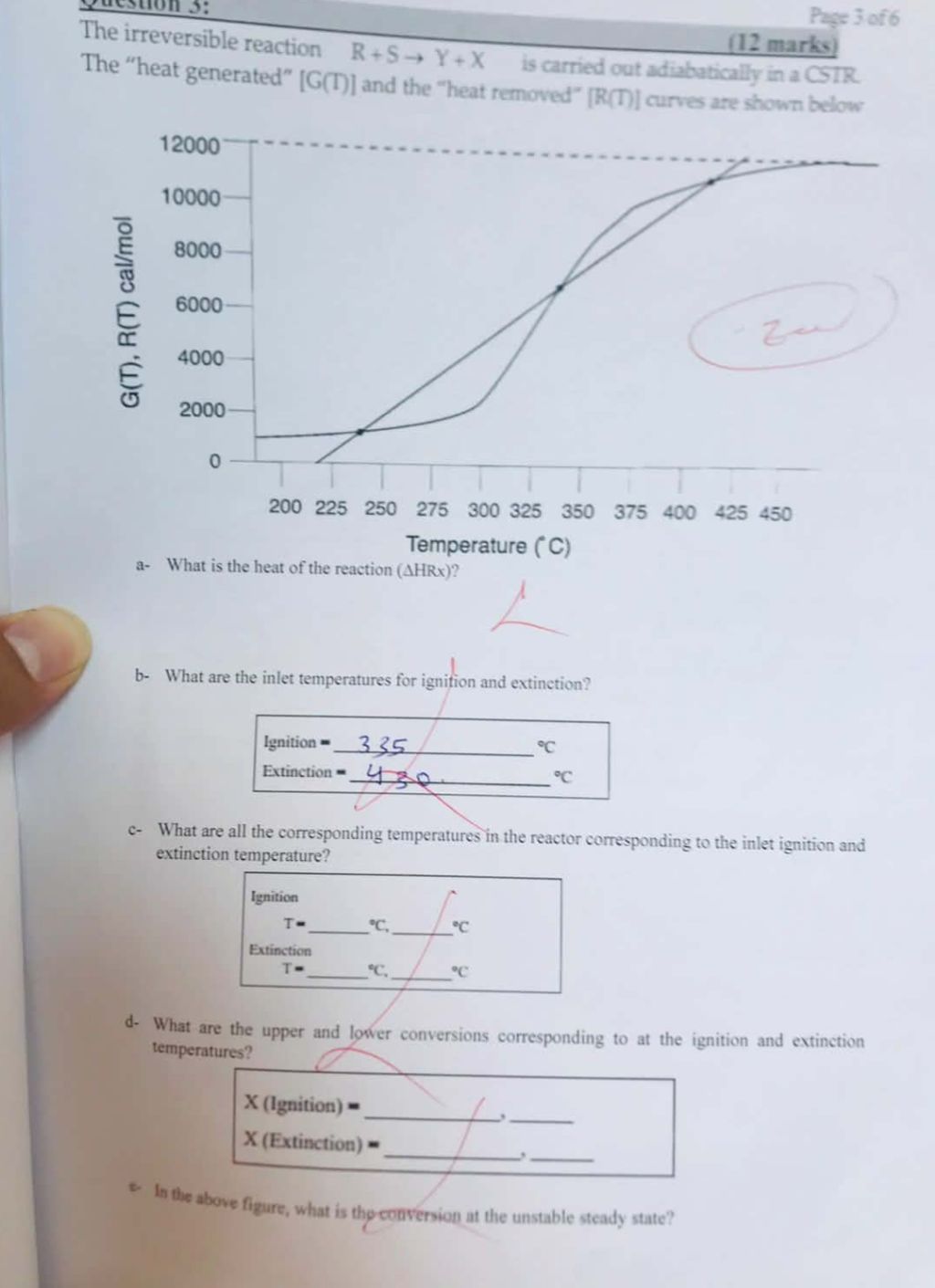
- **Graph:** Shows \( G(T) \) (heat generated) and \( R(T) \) (heat removed) vs. Temperature.
---
## **a) What is the heat of the reaction (\(\Delta H_{Rxn}\))?**
### **Explanation**
- \(\Delta H_{Rxn}\) is the heat released or absorbed per mole during the reaction.
- For adiabatic systems, the *slope* of the "Heat Removed" curve is related to the heat capacity, and the "Heat Generated" curve is based on reaction kinetics and \(\Delta H_{Rxn}\).
- At steady-state, \( G(T) = R(T) \).
#### **From the Graph:**
- \( G(T) \) reaches a maximum of about **12,000 cal/mol**.
- This value typically represents the enthalpy change (assuming complete conversion).
### **Final Answer (a):**
\[
\boxed{\Delta H_{Rxn} = -12,000 \ \text{cal/mol}}
\]
(Negative sign indicates exothermic reaction.)
---
## **b) What are the inlet temperatures for ignition and extinction?**
### **Explanation**
- **Ignition Point:** Where multiple steady states appear/disappear as temperature increases (lower intersection of curves).
- **Extinction Point:** Where multiple steady states disappear as temperature decreases (upper intersection).
- These are the intersection points of \( G(T) \) and \( R(T) \) curves.
#### **From the Graph:**
- **First intersection (Ignition):** ~ 325°C
- **Second intersection (Extinction):** ~ 435°C
### **Final Answer (b):**
\[
\text{Ignition:} \ \boxed{325^\circ\text{C}}
\]
\[
\text{Extinction:} \ \boxed{435^\circ\text{C}}
\]
---
## **c) What are all the corresponding temperatures in the reactor corresponding to the inlet ignition and extinction temperature?**
### **Explanation**
- At the ignition and extinction points, the system jumps between steady states.
- The intersections give us the temperatures where this occurs. Usually, there are three steady states: two stable (low and high T), one unstable (middle T).
#### **From the Graph:**
- **At each intersection, read the temperatures:**
- **Ignition:** Approx. 325°C (lower), 375°C (middle, unstable), and 435°C (upper)
- **Extinction:** Similar (as above).
### **Final Answers (c):**
\[
\text{Ignition:} \ T = \boxed{325^\circ\text{C}},\ \boxed{375^\circ\text{C}}
\]
\[
\text{Extinction:} \ T = \boxed{375^\circ\text{C}},\ \boxed{435^\circ\text{C}}
\]
---
## **d) What are the upper and lower conversions corresponding to at the ignition and extinction temperatures?**
### **Explanation**
- Conversion (\(X\)) is highest at the upper temperature and lowest at the lower temperature.
- Not enough data on conversion directly, but generally:
- **Low T:** Low conversion
- **High T:** High conversion
#### **Assuming conversion is proportional to temperature (for exothermic reactions):**
- **Ignition (low T):** Lower conversion
- **Extinction (high T):** Higher conversion
### **Final Answers (d):**
\[
X(\text{Ignition}) = \boxed{X_{low}}
\]
\[
X(\text{Extinction}) = \boxed{X_{high}}
\]
*(You would need additional data to give numerical values.)*
---
## **e) In the above figure, what is the conversion at the unstable steady state?**
### **Explanation**
- The *unstable steady state* is the middle intersection point (between the lower and upper stable steady states).
- Conversion at this point is intermediate.
### **Final Answer (e):**
\[
X(\text{unstable steady state}) = \boxed{X_{middle}}
\]
*(Again, needs actual conversion data for numbers.)*
---
# **Summary Table**
| Part | Question | Answer |
|------|---------------------------------------------|---------------------------------|
| a | Heat of reaction (\(\Delta H_{Rxn}\)) | \(-12,000\) cal/mol |
| b | Ignition/Extinction inlet temps | 325°C / 435°C |
| c | Reactor steady state temps | 325°C, 375°C, 435°C |
| d | Conversions at ignition/extinction | \(X_{low}\), \(X_{high}\) |
| e | Conversion at unstable steady state | \(X_{middle}\) |
---
**If you have more data (like conversion vs. temperature), you can fill in the exact values for \(X\).**
VIPSolutions focuses on clear, step‑by‑step explanations so you can learn quickly. Whether you need an AI‑generated walkthrough or a short hint to get unstuck, each solution is organized for fast reading and easy review later.
Search similar questions, compare approaches, and bookmark the best answers for revision. Our goal is simple: quick, reliable study help that feels natural—not noisy.
 VIPSolutions
 | Sof
irreversible reaction R+So vex is carried
The “heat generated” (G(T) ang out adiabatically in a CSTR.
the “heat removed” [R(T)] curves are shown below
i
| Le
!
i 2
f
[5 !
} = -
| R
Fi = |
0 a oe
=F 1
0 my 200 225 250 275 300 325 350 375 400 425 450
SR Temperature (‘C)
a Whatis the heat of the reaction (AHR)?
oi 1
~ 2
R b- What are the Baler eonperatures or igihon and extinction?
h
: Ignition=__ 3 2c °c
. Extinction=__ = by >
¢ What are all the corresponding temperatures in the reactor corresponding to the inlet ignition and
extinction temperature?
| 1gnition r
eR *c. >
sc /
3 and lower conversions corresponding to at the ignition and extinction
AEN
aul ap at the unstable steady state”
I