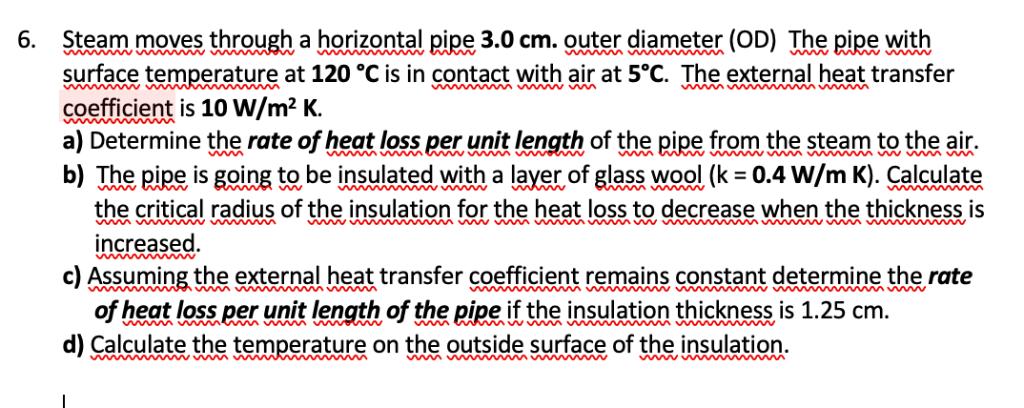
Give step-by-step solution with explanation and final answer:6. Steam moves through a horizontal pipe 3.0 cm. outer diameter (OD) The pipe with
surface temperature at 120 °Cis in contact with air at 5°C. The external heat transfer
coefficient is 10 W/m? K.
a) Determine the rate of heat loss per unit length of the pipe from the steam to the air.
b) The pipe is going to be insulated with a layer of glass wool (k = 0.4 W/m K). Calculate
the critical radius of the insulation for the heat loss to decrease when the thickness is
increased.
c) Assuming the external heat transfer coefficient remains constant determine the rate
of heat loss per unit length of the pipe if the insulation thickness is 1.25 cm.
d) Calculate the temperature on the outside surface of the insulation.
|
Question:
Give step-by-step solution with explanation and final answer:6. Steam moves through a horizontal pipe 3.0 cm. outer diameter (OD) The pipe with
surface temperature at 120 °Cis in contact with air at 5°C. The external heat transfer
coefficient is 10 W/m? K.
a) Determine the rate of heat loss per unit length of the pipe from the steam to the air.
b) The pipe is going to be insulated with a layer of glass wool (k = 0.4 W/m K). Calculate
the critical radius of the insulation for the heat loss to decrease when the thickness is
increased.
c) Assuming the external heat transfer coefficient remains constant determine the rate
of heat loss per unit length of the pipe if the insulation thickness is 1.25 cm.
d) Calculate the temperature on the outside surface of the insulation.
|
This is AI generated Response.
Asked by: Rahul
Created at: 2026-01-15 17:33:22
Final Answer:
RenderedRaw Text
Did you like this answer?
Let's solve each part step by step:
---
## **Given Data**
- **Pipe Outer Diameter (\(D_o\))** = **3. cm** = .03 m
(Radius \(r_o = D_o/2 = .015\,\text{m}\))
- **Pipe Surface Temperature (\(T_s\))** = **120°C**
- **Air Temperature (\(T_\infty\))** = **5°C**
- **External heat transfer coefficient (\(h\))** = **10 W/m²·K**
- **Thermal conductivity of insulation (\(k\))** = **.4 W/m·K** (for part b onward)
---
## **a) Rate of heat loss per unit length (without insulation)**
This is an **external convection** problem.
**Heat loss per unit length**:
\[
\dot{Q}' = \frac{T_s - T_\infty}{R'}
\]
where \( R' \) is the total thermal resistance per unit length.
Since we only have convection from the pipe surface to air (no insulation yet):
\[
R' = R'_{\text{conv, air}} = \frac{1}{h \cdot 2 \pi r_o}
\]
Plug in values:
- \( h = 10\, \text{W/m}^2\cdot\text{K} \)
- \( r_o = .015\, \text{m} \)
- \( T_s = 120^\circ \text{C} \)
- \( T_\infty = 5^\circ \text{C} \)
\[
R' = \frac{1}{10 \cdot 2 \pi \cdot .015} = \frac{1}{.9425} = 1.061 \,\text{K·m/W}
\]
\[
\dot{Q}' = \frac{120 - 5}{1.061} = \frac{115}{1.061} = 108.4\, \text{W/m}
\]
**Final answer (a):**
\[
\boxed{\dot{Q}' = 108.4\, \text{W/m}}
\]
---
## **b) Critical radius of insulation**
For a cylinder:
\[
r_{cr} = \frac{k}{h}
\]
Given:
- \( k = .4\, \text{W/m·K} \)
- \( h = 10\, \text{W/m}^2\cdot\text{K} \)
\[
r_{cr} = \frac{.4}{10} = .04\, \text{m} = 4.\, \text{cm}
\]
**Final answer (b):**
\[
\boxed{r_{cr} = 4.\, \text{cm}}
\]
---
## **c) Rate of heat loss per unit length (with insulation, thickness = 1.25 cm)**
- **Insulation thickness** = 1.25 cm = .0125 m
- **New outer radius** \( r_2 = r_o + \text{thickness} = .015 + .0125 = .0275\, \text{m} \)
**Thermal resistances:**
1. **Conduction through insulation:**
\[
R'_{\text{ins}} = \frac{\ln(r_2/r_o)}{2\pi k}
\]
2. **Convection from insulation surface to air:**
\[
R'_{\text{conv}} = \frac{1}{h \cdot 2\pi r_2}
\]
3. **Total resistance:**
\[
R'_{\text{total}} = R'_{\text{ins}} + R'_{\text{conv}}
\]
**Calculate each:**
- \( \ln(r_2/r_o) = \ln(.0275/.015) = \ln(1.833) = .606 \)
\[
R'_{\text{ins}} = \frac{.606}{2 \pi \times .4} = \frac{.606}{2.513} = .241\, \text{K·m/W}
\]
\[
R'_{\text{conv}} = \frac{1}{10 \cdot 2\pi \cdot .0275} = \frac{1}{1.7279} = .578\, \text{K·m/W}
\]
\[
R'_{\text{total}} = .241 + .578 = .819\, \text{K·m/W}
\]
\[
\dot{Q}' = \frac{120 - 5}{.819} = \frac{115}{.819} = 140.4\, \text{W/m}
\]
**Final answer (c):**
\[
\boxed{\dot{Q}' = 140.4\, \text{W/m}}
\]
---
## **d) Temperature on the outside surface of the insulation**
Let \( T_2 \) = temperature at insulation outer surface.
\[
\dot{Q}' = \frac{T_2 - T_\infty}{R'_{\text{conv}}}
\]
\[
T_2 = \dot{Q}' \cdot R'_{\text{conv}} + T_\infty
\]
Plug in:
- \( \dot{Q}' = 140.4\, \text{W/m} \)
- \( R'_{\text{conv}} = .578\, \text{K·m/W} \)
- \( T_\infty = 5^\circ \text{C} \)
\[
T_2 = 140.4 \times .578 + 5 = 81.2 + 5 = 86.2^\circ \text{C}
\]
**Final answer (d):**
\[
\boxed{T_2 = 86.2^\circ \text{C}}
\]
---
### **Summary of Answers**
a) \(\boxed{108.4\, \text{W/m}}\)
b) \(\boxed{4.\, \text{cm}}\)
c) \(\boxed{140.4\, \text{W/m}}\)
d) \(\boxed{86.2^\circ \text{C}}\)
Let me know if you need a detailed explanation for any step!
VIPSolutions focuses on clear, step‑by‑step explanations so you can learn quickly. Whether you need an AI‑generated walkthrough or a short hint to get unstuck, each solution is organized for fast reading and easy review later.
Search similar questions, compare approaches, and bookmark the best answers for revision. Our goal is simple: quick, reliable study help that feels natural—not noisy.
 VIPSolutions
 6. Steam moves through a horizontal pipe 3.0 cm. outer diameter (OD) The pipe with
surface temperature at 120 °Cis in contact with air at 5°C. The external heat transfer
coefficient is 10 W/m? K.
a) Determine the rate of heat loss per unit length of the pipe from the steam to the air.
b) The pipe is going to be insulated with a layer of glass wool (k = 0.4 W/m K). Calculate
the critical radius of the insulation for the heat loss to decrease when the thickness is
increased.
c) Assuming the external heat transfer coefficient remains constant determine the rate
of heat loss per unit length of the pipe if the insulation thickness is 1.25 cm.
d) Calculate the temperature on the outside surface of the insulation.
|