 VIPSolutions
Give step-by-step solution with explanation and final answer:kat bey es dem eda he ssn tn Co A E SE (=p one coe men (4580) i a A Sri ee eae re ER Ea pinion) i i ys mh ae Cy Ee Le oe) i S.J I a a rk: rio cr erty
Question:
Give step-by-step solution with explanation and final answer: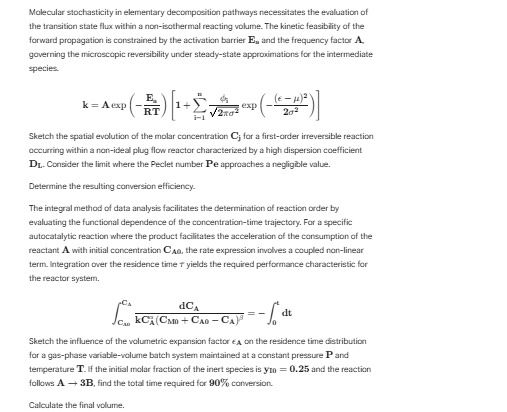 kat bey es dem eda he ssn
tn
Co
A E SE (=p
one coe men (4580)
i a A
Sri ee eae
re
ER Ea
pinion)
i i
ys mh ae Cy
Ee Le oe)
i S.J I a
a rk: rio
cr erty
This is AI generated Response.
Asked by: Francis
Created at: 2026-01-15 14:39:55
Asked by: Francis
Created at: 2026-01-15 14:39:55
Final Answer:
Rendered
Raw Text
Did you like this answer?
Let's break down solve each part-by-step as.
---
##1. Sketch the Evolution of \(_{A1 \) for Non-Ideal Flow Reactor (PFR with High Disp**
Given:
**First-order reaction**
-Non-idealFR:** High dispersion large \( D_L \)axial dispersion)
- **eclet number: \( Pe \frac{L}{D_L \), limit \( Pe \ is very small( D_L \ is very large**Gover Equation (with):**
\[
\frac{\ C_A}{partial t} u \fracpartial C_A}{\partial x = D_L \{\partial^2 C_A}{\partial x^2} - kC
\]
**Steady-State (\( \frac C_A}{\partial t}= \)), Boundary Conditions:**
- \( x = C_A = C_{A} \)
- = L: \) zero gradient (\( \frac{\partial C_A}{\partial} = \))
**When \( D_L \) is very large ( \( Pe \)),** the reactor behaves like a **CSTR** (-mixed):
\[
C_{A,\text{ = \frac{C_{A}}{1 + k\tau}
\]
where \( \tau \frac{V}{Q} \).
**Sketch- For large dispersion, the concentration drops smoothly and is almost (similar to a CSTR), not the exponential drop seen in an ideal PFR.
---
## **. Reaction Conversion Efficiency**
**Conversion, \( X \\[
X = 1 - \frac{C_{,\text{out}}}{C_{A\For a CSTR:
\[
C_{A,\text{out}} = \frac{C_{A}}{1 + k\tau\implies X = 1 - \frac{1 + k\tau} = \frac{k\tau}{1 + k\tau\]
**Result:**
- As dispersion increases ( ), conversion approaches that of a CSTR.
---
## **3. Rate Law for Autatalytic Reaction**
Given:
\[
\frac{_A}{dt} = -kC_A(C_{A} + C_A - C_A*)
\]
where \( C_A^* \) constant.
**Integration to Find Residence Time Distribution:**
Given:
\[
\int_{C_{A^{_{A}} \frac{dC_A}{kC_A(C_{A} + C_{A} - C_A)} -\int_{}^{t} dt
\]
This requires partial fraction decomposition. Let's simplify denominator:
Let \(_A^* = C_{A} \) (only assumed for autocatalytic reactions; adjust if stated otherwise):
\[
C_{A} + C_{A} - C_A = 2CA} - C_A
\]
So denominator is \( C_A (2C_{A} - C) \).
Decompose:
\[
\frac{1}{C_A (2C_{A} - C_A)} = \frac{A}{C_A} + \fracB}{2C_{A} - C_A}
\]
Solving for A and B:
\[
1 A(2C_{A} - C_A) + B C_A
\]
Let \( C_A = \Rightarrow 1 = 2C_{A}A \Rightarrow A = \frac{}{2C_{A}} \)
Let \( C_A = 2C_{A} \Rightarrow 1 = B (2CA}) \Rightarrow B = \frac{1}{2C_{A}} \)
So:
\\int_{C_{A}}^{C_{A}} \left[ \frac{1}{2C_{}}\left( \frac{1}{C_A} + \frac{1}{2C_{A} - C_A} \right)\right] dC_A = -kt\]
Integrate:
\[
\frac{1}{2C_{A}} \left[ \ln(C) - \ln(2C_{A} - C_A) \right] \Big|_{C_{}}^{C_{A}}
= -kt
\]
\[
\frac{1}{2C_{A}} \left( \ln \frac{C_A}{2C_{A} - C_A} - \ \frac{C_{A}}{2C_{A} - C_{A}} \right) -kt
\]
\[
\frac{1}{2C_{A}} \left( \ln \frac{C_A}{2C_{A} - C_A} - \ln \frac{C_{A}}{C_{A}} \right) = -kt
\]
\[
\frac{1}{2_{A}} \ln \frac{C_A}{2C_{A} - C_A} = -
\]
\[
\ln \frac{C_A}{2C_{A} - C_A} = -2k_{A} t
\]
\[
\frac{C_A}{2C_{A} - C} = \exp(-2kC_{A} t)
\]
\[
C_A = (2CA} - C_A) \exp(-2kC_{A} t)
\]
\[
C_A (1 + \exp(-kC_{A} t)) = 2C_{A} \exp(-2kC_{A} t)
\]
\[
C_A = \frac{2C_{A} \exp(-2k_{A} t)}{1 + \exp(-2kC_{A} t)}
\]
---
## **4. Influence of Volumetric Expansion on Residence TimeGiven:
- **Batch system, constant pressure \( P \), temperature \( T \)**
- Initial mole fraction of species: \( y_ = .25 \)
- Reaction: \( A \rightarrow 3B \- **Total time required for 90% conversion**
### **Step 1: Calculate the Expansion Factor (\( \ \))**
For \( A \rightarrow 3B \):
\[
\epsilon = \frac{\text{moles of product gas} - \text{moles of reactant gas}}{\textmoles of A reacted}}
= \frac{3 - 1}{1} = 2
\]
###Step 2: Total Initial Moles**
Let total initial moles = 1 mol
Moles of inert = y_ = .25 \)
So, moles of A = .75 mol
###Step 3: At 90% Conversion (\( X = .9 \))**
Moles of A = \( .9 \times .75 = .675 \)
Moles of A left = .75 - .675 = .075 \)
Moles of B formed = \( \times .675 = 2.025 \)
Total moles at 90% conversion:
\[
n_{,90\%} = \text{A left} + \text{B formed} + \text{in}
= .075 + 2.025 + .25 = 2.35
\]
moles = .75 (A) + .25 (inert) = 1 mol
**Expansion factor at 90% conversion:**
\[
\text{Expansion factor = \frac{n_{total,90\%}}{n_{total,initial}}
= \frac{2.35}{1} = 2.35
\]
---
## **5. Final Answer Summary**
- **Spatial profile of \( C_{A1} \):** For high dispersion (low Pe), concentration profile is nearly flat (CSTR-like).
- **Conversion efficiency:** \( X = \frac{k\tau}{1 + k\tau} \)
- **Integrated rate expression (autocatalytic):**
\[
C_A = \frac{2C_{A} \exp(-2kC_{A} t)}{1 \exp(-2kC_{A} t)}
\]
- **Volumetric expansion at 90% conversion:**
**Expansion factor = 2.35**
---
## **Boxed Final Answers**
### **a Conversion for CSTR:**
\[
X = \frac{k\tau}{1 + k\tau}
\]
### **b) Autocatalytic Batch Solution:**
\[
C_A = \frac{2_{A} \exp(-2kC_{A} t)}{1 + \exp(-2k_{A} t)}
\]
### **c) Volumetric Expansion Factor for 90% Conversion:**
\[
\boxed{2.35}
\]
Let me know if you need further details or!
📢 Instructions:
- Ask anything relatd to above question only.
- For new Question goto :