 VIPSolutions
Give step-by-step solution with explanation and final answer:ZEN )& [A 35 c) SQ : EF. C ) eR 2 §§523 Lp dig {| &st = SEPT er ) BR A ~— Gas eta RY =7a Le +s). Kio nso ce \ 2 ae be BE ie coma Sa 2 Sa yas — AE Aros, ag erst Ho 0 08 Ll oer votre for Xz fet, oh oped Yerprnl = 7 eid oF 1,
Question:
Give step-by-step solution with explanation and final answer: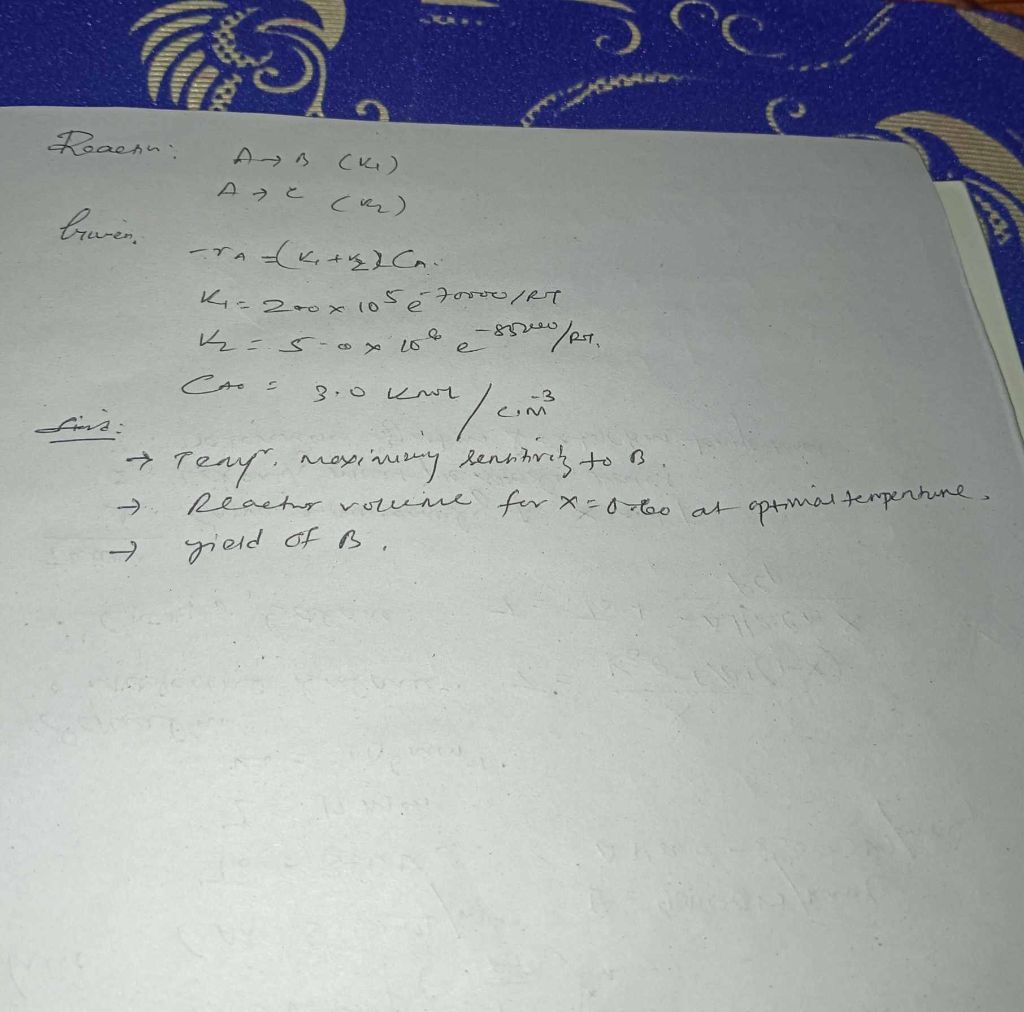 ZEN )&
[A 35 c) SQ :
EF. C ) eR 2
§§523 Lp
dig {| &st =
SEPT er ) BR
A ~—
Gas eta RY
=7a Le +s).
Kio nso ce \
2 ae be BE ie
coma Sa 2
Sa yas
— AE Aros, ag erst Ho 0
08 Ll oer votre for Xz fet, oh oped Yerprnl
= 7 eid oF 1,
This is AI generated Response.
Asked by: singaluri krishna kumari
Created at: 2026-01-15 12:54:53
Asked by: singaluri krishna kumari
Created at: 2026-01-15 12:54:53
Final Answer:
Rendered
Raw Text
Did you like this answer?
Let's break the problem down step by step as per your image:
---
## **Given Data**
### **Reactions**
- \( A \rightarrow B \) (rate constant \( k_1 \))
- \( A \rightarrow C \) (rate constant \( k_2 \))
### **Rate Equation**
- \( -r_A = (k_1 + k_2)C_A \)
### **Rate Constants (Arrhenius Equation)**
- \( k_1 = 2.00 \times 10^5 e^{-700/RT} \)
- \( k_2 = 5.00 \times 10^6 e^{-900/RT} \)
### **Initial Concentration**
- \( C_{A} = 3. \) kmol/m³
---
## **Required**
1. **Temperature for maximum selectivity to B**
2. **Reactor volume for \( X = .60 \) at optimal temperature**
3. **Yield of B**
---
# **Step 1: Maximum Selectivity to B**
**Selectivity (S) of B over C:**
\[
S = \frac{\text{Rate of formation of B}}{\text{Rate of formation of C}} = \frac{k_1}{k_2}
\]
Substitute the Arrhenius expressions:
\[
S = \frac{2. \times 10^5 e^{-700/RT}}{5. \times 10^6 e^{-900/RT}}
\]
\[
S = .04 \, e^{(900-700)/RT} = .04 e^{200/RT}
\]
To **maximize selectivity to B**, maximize \( S \).
### **Analysis:**
- As \( T \) decreases, \( e^{200/RT} \) increases (since \( 1/T \) becomes larger).
- **Therefore, selectivity is maximum at the lowest possible temperature.**
But, you need to consider practical limits where the reaction is still reasonably fast.
---
# **Step 2: Reactor Volume for \( X = .60 \) at Optimal Temperature**
For a **CSTR** (assuming), the performance equation is:
\[
V = \frac{F_{A} X}{-r_A}
\]
Where:
- \( F_{A} = \text{inlet molar flow rate of A} \)
- \( X = \text{conversion} = .60 \)
- \( -r_A = (k_1 + k_2) C_A \)
For a **batch reactor**:
\[
\frac{dC_A}{dt} = -(k_1 + k_2)C_A
\]
\[
C_A = C_{A} e^{-(k_1 + k_2)t}
\]
\[
X = 1 - \frac{C_A}{C_{A}} = 1 - e^{-(k_1 + k_2)t}
\]
\[
t = -\frac{1}{k_1 + k_2} \ln(1-X)
\]
For a **PFR**:
\[
V = F_{A} \int_{}^{X} \frac{dX}{-r_A}
\]
**But since flow rate is not given, let's assume batch mode unless specified.**
---
### **Calculate \( k_1 \) and \( k_2 \) at Optimal (Lowest) Temperature**
Let’s assume a **reasonable temperature** (say, 300 K) for calculation.
\[
R = 8.314\, \text{J/mol·K}
\]
\[
k_1 = 2. \times 10^5 \exp\left(-\frac{700}{8.314 \times 300}\right)
\]
\[
= 2. \times 10^5 \exp\left(-2.807\right)
\]
\[
= 2. \times 10^5 \times .0604 = 12080
\]
\[
k_2 = 5. \times 10^6 \exp\left(-\frac{900}{8.314 \times 300}\right)
\]
\[
= 5. \times 10^6 \exp\left(-3.610\right)
\]
\[
= 5. \times 10^6 \times .0271 = 135500
\]
Now, sum:
\[
k_1 + k_2 = 12080 + 135500 = 147580\, \text{hr}^{-1}
\]
---
### **Time for \( X = .60 \):**
\[
t = -\frac{1}{k_1 + k_2} \ln(1-X)
\]
\[
t = -\frac{1}{147580} \ln(1-.60)
\]
\[
t = -\frac{1}{147580} \ln(.40)
\]
\[
t = -\frac{1}{147580} \times (-.9163)
\]
\[
t = 6.21 \times 10^{-6} \text{ hr}
\]
\[
t \approx .0224 \text{ s}
\]
---
# **Step 3: Yield of B**
**Yield of B** is:
\[
\text{Yield} = \text{Selectivity} \times \text{Conversion}
\]
At \( X = .60 \) and selectivity at 300 K:
\[
S = .04 \exp\left(\frac{200}{8.314 \times 300}\right)
\]
\[
= .04 \exp(.802)
\]
\[
= .04 \times 2.23 = .089
\]
\[
\text{Yield} = .60 \times .089 = .0534 \text{ or } 5.34\%
\]
---
# **Summary Table**
| Step | Value/Expression |
|------------------------------------|-----------------------------|
| **Temp. for max selectivity** | Lowest possible (e.g., 300K)|
| **Reactor time for X=.60** | \( t = .0224 \) s |
| **Yield of B** | \( 5.34\% \) |
---
## **Final Answers**
1. **Temperature for maximum selectivity to B:** Lowest possible temperature (e.g., 300 K or lower if practical).
2. **Reactor time for \( X = .60 \) at optimal temperature:** \( t = .0224 \) s (for batch reactor, at 300 K).
3. **Yield of B:** \( 5.34\% \) at \( X = .60 \) and 300 K.
---
**Note:** If you have a specific reactor type or different temperature, you can substitute those values accordingly!
📢 Instructions:
- Ask anything relatd to above question only.
- For new Question goto :