 VIPSolutions
Give step-by-step solution with explanation and final answer:qf : i Lp i Sea | Sie SA iH — = = H
Question:
Give step-by-step solution with explanation and final answer: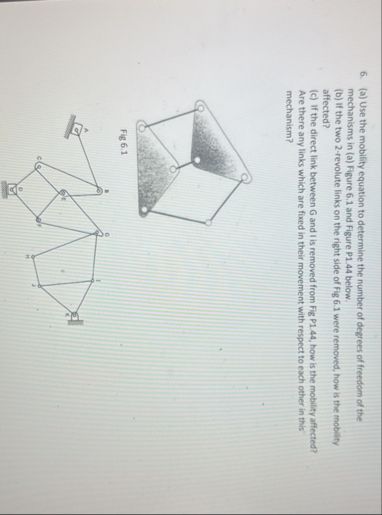 qf
: i
Lp i
Sea
| Sie
SA iH
— = = H
This is AI generated Response.
Asked by: Rahul
Created at: 2026-01-15 06:48:48
Asked by: Rahul
Created at: 2026-01-15 06:48:48
Final Answer:
Rendered
Raw Text
Did you like this answer?
Let's solve the given problem **step by step** using the **mobility (Gruebler's) equation**.
---
## **Step 1: Understanding the Problem**
- We have a planar mechanism shown in Fig. 6.1.
- We are to:
1. Use the mobility equation to determine the degrees of freedom (DOF).
2. If two lower pairs on the right side are connected, how is mobility affected?
3. If link \( G \) is removed, is the mechanism still constrained?
4. Are there any links that can be removed and still preserve a single DOF mechanism?
---
## **Step 2: The Mobility Equation (Gruebler’s Equation)**
For planar mechanisms:
\[
M = 3(n-1) - 2j - h
\]
Where:
- \( M \) = Mobility (Degrees of Freedom)
- \( n \) = Number of links (including frame)
- \( j \) = Number of lower pairs (single DOF joints, e.g., revolute or prismatic)
- \( h \) = Number of higher pairs (multiple DOF joints)
---
## **Step 3: Analyzing the Mechanism**
### **Count Links (\( n \))**
From the figure (left side), label the links:
- Ground (fixed frame): 1
- A, B, C, D, E, F, G (moving links): 7
Thus,
\[
n = 7 + 1 = 8
\]
### **Count Lower Pairs (\( j \))**
Count the revolute joints:
- From the diagram, the joints are at each pin connection.
- Let's count the number of pin joints:
- Between frame and A
- Between A and B
- Between B and C
- Between C and frame
- Between B and E
- Between E and D
- Between D and C
- Between E and F
- Between F and D
- Between E and G
- Between G and F
Let's count them one by one:
1. Frame-A
2. A-B
3. B-C
4. C-Frame
5. B-E
6. E-D
7. D-C
8. E-F
9. F-D
10. E-G
11. G-F
So,
\[
j = 11
\]
### **Count Higher Pairs (\( h \))**
From the diagram, **all joints are lower pairs (revolute joints)**. Thus,
\[
h =
\]
---
## **Step 4: Calculate Mobility (\( M \))**
Plug in the values:
\[
M = 3(n-1) - 2j - h
\]
\[
M = 3(8-1) - 2 \times 11 -
\]
\[
M = 3 \times 7 - 22
\]
\[
M = 21 - 22
\]
\[
M = -1
\]
---
## **Step 5: Answering Each Question**
### **(a) Degrees of Freedom**
\[
\boxed{M = -1}
\]
This means the mechanism is **overconstrained** (structure, not a mechanism).
---
### **(b) If two lower pairs on the right side of Fig. 6.1 are connected, how is mobility affected?**
- If you connect two lower pairs (e.g., adding a link between two joints), you **reduce the number of links by 1** and **reduce the number of joints by 1**.
Now,
- \( n = 8 - 1 = 7 \)
- \( j = 11 - 1 = 10 \)
Plug in:
\[
M = 3(7-1) - 2 \times 10
\]
\[
M = 3 \times 6 - 20
\]
\[
M = 18 - 20 = -2
\]
\[
\boxed{M = -2}
\]
Mobility **decreases further** (even more overconstrained).
---
### **(c) If the link marked G is removed from Fig. 6.1, how is it mobility affected?**
Removing link G:
- \( n = 8 - 1 = 7 \)
- Count the joints G is connected to: E-G and G-F (2 joints), so \( j = 11 - 2 = 9 \)
Plug in:
\[
M = 3(7-1) - 2 \times 9
\]
\[
M = 18 - 18 =
\]
\[
\boxed{M = }
\]
So, **it becomes a rigid structure (no motion possible)**.
---
### **(d) Are there any links that can be removed and still preserve a single degree of freedom mechanism?**
- Removing any link **reduces both n and j**.
- Try removing another link (other than G), for example, F:
- \( n = 7 \)
- F is connected to E-F and F-D and G-F (3 joints), so \( j = 11 - 3 = 8 \)
Plug in:
\[
M = 3(7-1) - 2 \times 8
\]
\[
M = 18 - 16 = 2
\]
So, \( M = 2 \)
Try another link, say E:
- E is connected to B-E, E-D, E-F, E-G (4 joints), so \( n = 7 \), \( j = 11 - 4 = 7 \)
\[
M = 18 - 14 = 4
\]
**In general, this mechanism is overconstrained. Removing a single link either leaves it rigid or increases DOF above 1. No single link can be removed to create a mechanism with a single DOF.**
\[
\boxed{\text{No, there are no links that can be removed to give a single degree of freedom mechanism.}}
\]
---
## **Summary Table**
| Case | \( n \) | \( j \) | \( M \) | Description |
|------|-------|-------|------|-------------|
| Original | 8 | 11 | -1 | Overconstrained |
| Two right pairs connected | 7 | 10 | -2 | More overconstrained |
| Remove G | 7 | 9 | | Rigid, no motion |
| Remove other links | 7 | <9 | > | More mobility than 1 |
---
## **Final Answers**
### **(a)** \( \boxed{-1} \) (overconstrained)
### **(b)** \( \boxed{-2} \) (even more overconstrained)
### **(c)** \( \boxed{} \) (rigid, no motion)
### **(d)** \( \boxed{\text{No, removing any single link does not result in a single degree of freedom mechanism.}} \)
📢 Instructions:
- Ask anything relatd to above question only.
- For new Question goto :